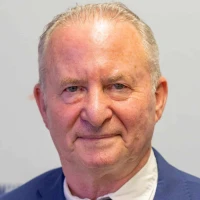
International Jewish and Israel advocate Millie Magid has a message for those confronting rising antisemitism and anti-Israel sentiment around the world: Think critically, build relationships and take action.
“In reality, we have to think about the future,” Magid told JNS in an interview at the JNS Media Hub in Jerusalem on Oct.19. “Critical thinking, it seems, has been removed from the world’s reality.”
Repeated accusations against Israel have too often replaced serious examination of facts, she said.
“People hear it again and again: ‘genocide, genocide, apartheid, apartheid,’” she said. “People are not thinking on their own.”
Magid, a Peruvian-born American Jewish activist, has spent decades supporting humanitarian, medical, educational and Jewish causes in Israel and around the world with her husband, American businessman and longtime Israel supporter, Larry Magid.
Raised in a Catholic family in Peru, she said her interest in the Bible began at an early age. As a teenager, she questioned her religious upbringing while her country was confronting the Shining Path terrorist organization.
After meeting Larry, she began exploring Judaism and eventually moved to the United States.
“Larry is the one who was the vehicle that brought me to my Judaism,” she said.
When the couple married, Magid asked to spend their honeymoon in Jerusalem. Her first visit to Israel transformed what she had learned from books into something tangible, she recalled.
“The minute that I stepped foot in Jerusalem and in Israel, I felt alive,” she said. “All the stories became real.”
‘I was looking for truth’
Her curiosity about Israel and the conflict led her to seek out both Jews and Arabs and hear their perspectives firsthand.
“I was looking for truth,” she said.
Over the years, Magid became increasingly involved in Jewish communal and diplomatic activity, including with Israel Bonds, the Conference of Presidents of Major American Jewish Organizations and B’nai B’rith International.
As a senior vice president of B’nai B’rith International and chair of its U.N. Affairs Committee, Magid has participated in meetings with world leaders, diplomats and ambassadors on the sidelines of the U.N. General Assembly and at the U.N. Human Rights Council in Geneva.

She recalled meeting Turkish President Recep Tayyip Erdoğan shortly before the Hamas-led terrorist attacks in southern Israel on Oct. 7, 2023.
During the meeting, Erdoğan discussed regional economic cooperation and a possible visit to Israel. Magid said she asked him how such plans could succeed while Turkey supported Hamas and the Muslim Brotherhood.
“He looked at me, tapped me on my shoulder, and said, ‘Thank you for asking that question and for caring about the people from Gaza,’” she recalled. “That’s it. There was no answer.”

Oct. 7 and its aftermath
Millie and Larry Magid were in Israel when Hamas attacked on Oct. 7, 2023.
Two days earlier, they had visited Magen David Adom’s National Blood Services Center in Ramle. After the attack, Larry volunteered with ZAKA in southern Israel, helping deal with the bodies of victims.
Magid sought ways to help in Jerusalem before returning to the United States, where she began raising money and organizing events to explain what had happened in Israel.
She said the speed with which international sympathy for Israel gave way to condemnation reinforced her belief in the importance of education and advocacy.
“We wanted to make sure that people understood what was happening,” she said.
For Magid, personal relationships are among the most effective tools of diplomacy. “I think it’s all about relationships and all about trust,” she said.
She cited her work in Latin America and through B’nai B’rith as examples of how long-term personal connections can open doors that formal advocacy sometimes cannot.
Education, particularly among young Jews, is a priority for her.
Youth need opportunities to confront antisemitism and misinformation directly and develop the confidence to challenge them, Magid said.
She has worked with Jewish students who have participated in advocacy efforts at international institutions, including in Geneva. “It’s very important for the younger generation of students to be able to have their voices heard.”
From Uganda to Israel
One experience, Magid said, demonstrated how a seemingly minor personal encounter can have consequences far beyond the original meeting.
At the U.S. Open Tennis Championships, she met Ruhakana Rugunda, then Uganda’s ambassador to the United Nations and later the country’s prime minister.
Magid asked him why Uganda so often condemned Israel at the United Nations and whether he had ever visited the Jewish state.
He had not.
“You’ve never been to Israel?” she recalled asking him. “This is not acceptable. You must be in Israel.”
Magid and her husband invited Rugunda to visit. Several months later, he accepted.
During a four-day trip, they took him around the country, including to hospitals and Jewish and Arab communities, so he could see Israel firsthand.
Magid said Rugunda later told them that his children had initially opposed his trip because they believed Israel was an apartheid and genocidal state. His visit changed his perception, she said, and was followed by further visits and growing connections between his family and Israel.
The experience reinforced a lesson that has guided her activism.
“Don’t disregard small encounters,” Magid recalled Rugunda telling her.

‘Action is what we need’
Magid said condemnations of antisemitism are not enough.
“We condemn this, we condemn that,” she said. “But honestly, where does it take us? Those condemnations—where do they take us? It’s just paper, words.”
“Action is what we need to fight antisemitism,” she said, urging Jews to become involved in schools, sponsor educational initiatives and trips to Israel, support organizations combating antisemitism and help young Jews strengthen their connection to Israel.
“Instead of complaining, complaining, complaining, let’s make a plan of action,” she said.
Despite the surge in antisemitism since Oct. 7, 2023, Magid said she remains optimistic, particularly because of Israel’s younger generation and the soldiers who have defended the country during the war.
“We have to have faith,” she said. “We will stay here forever.”
For Magid, teaching young people to question slogans and examine competing claims remains central to that future.
“We have to teach our kids, younger people—even adults—to think on their own,” she said. “We have to think about the future.”
Watch the full interview here.