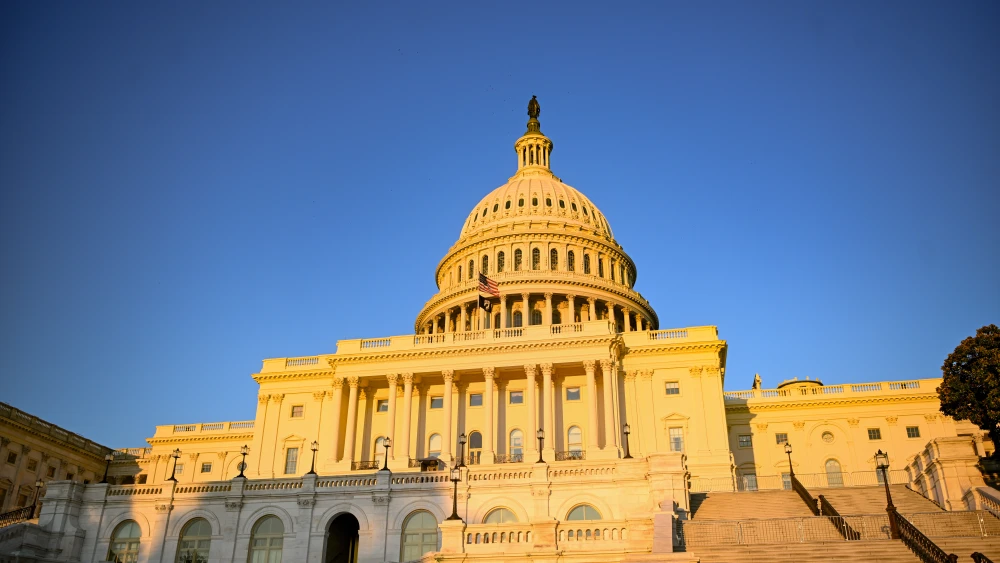
The House Appropriations Committee released a bill on Monday that would direct $5 million in federal funding to protect religious sites and fight the surge in religiously motivated hate crimes, including Jew-hatred.
The bipartisan, bicameral legislation releases funding held in reserve by the U.S. Department of Justice geared to “combat, address or otherwise respond to precipitous or extraordinary increases in crime,” and in this case to “address the precipitous increases in hate crimes targeting individuals on the basis of religion.”
Nathan Diament, executive director of the Orthodox Union Advocacy Center, told JNS that the grant is intended to support the Jewish community as it continues to face steep security costs.
“Jewish communities have been forced to pay what amounts to an ‘antisemitism tax’ to fund private security guards, because local law enforcement does not have the resources to meet the rise in antisemitic threats,” Diament said. “This new program will start to alleviate that burden at a crucial moment when antisemitic crimes have skyrocketed.”
Rep. Grace Meng (D-N.Y.), ranking member of the appropriations Subcommittee on Commerce, Justice, Science and Related Agencies, told JNS that the funding would make it easier for religious sites to hire security staff.
“In recent years, there has been a significant rise in attacks on houses of worship of Americans of many faiths, including the Jewish community,” Meng said. “This bipartisan win will help stop incidents before they occur and builds on existing programs that help at-risk institutions enhance their physical security.”
The funding for the security grant is separate from the U.S. Department of Homeland Security’s larger Non-Profit Security Grant Program, which distributed $94.4 million to Jewish organizations in 2025.
Formally titled the “Commerce, Justice, Science; Energy and Water Development; and Interior and Environment Appropriations Act, 2026,” the bill enjoys bipartisan support but prompted strongly partisan reactions from the chair and ranking member of the committee.
“Gone are the days of bloated, backroom omnibuses,” panel chairman Tom Cole (R-Okla.) stated. “Thanks to Republican governance, funding decisions will move through a deliberate, member-driven process that emphasizes transparency, accountability and timely consideration.
Ranking member Rosa DeLauro (D-Conn.) said that the bill was a “forceful rejection of draconian cuts to public services proposed by the Trump administration and Republicans in Congress.”
“There is not a single Republican poison pill provision in this bill,” DeLauro wrote. “Democrats successfully defeated every single one.”
Cole wrote that if the bill moves forward, the House will stay on track to complete all of the fiscal year 2026 appropriations bills before federal funding expires on Jan. 30.