U.S. President Donald Trump’s Board of Peace is demanding that Hamas conclude a deal to demilitarize Gaza by the end of this week, according to four diplomats familiar with the talks, The New York Times reported on Monday.
“Board of Peace and Hamas representatives are expected to meet in Cairo on Tuesday to conclude a demilitarization agreement by the end of the week. ... While the officials were firm on the deadline, it could change,” the Times reported.
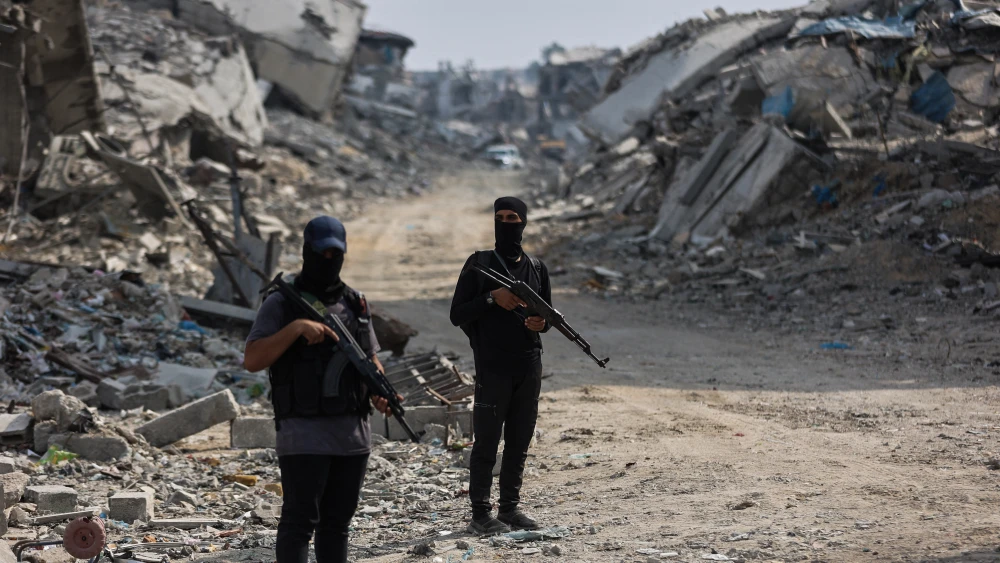
The demand by the Board of Peace, a transitional administration to help rebuild the Gaza Strip, requires Hamas to give up nearly all its weapons, relinquish power and provide maps of its underground tunnel network.
“There is only one party standing in the way of a better life for civilians in Gaza—and it’s Hamas. And Hamas is on the clock,” Mike Waltz, U.S. ambassador to the United Nations, posted to his X account on Monday.
There is only one party standing in the way of a better life for civilians in Gaza - and it’s Hamas.
— Ambassador Mike Waltz (@USAmbUN) April 6, 2026
And Hamas is on the clock.https://t.co/Zod0UL3ZZP
Nickolay Mladenov, director-general of the Board of Peace and High Representative for Gaza, delivered the disarmament proposal last month to Hamas leaders, the Times reported.
In a somewhat cryptic tweet on Friday, Mladenov said that “he who will not cross the river will drown in the sea.” It was interpreted as a warning to Hamas of serious repercussions if it refused to demilitarize.
Hamas on Sunday denounced calls for its disarmament under the ceasefire plan.
In a televised statement translated by Reuters, a Hamas spokesman said that raising the issue of demilitarization “in a crude manner” is unacceptable. “What the enemy is trying to push through today against the Palestinian resistance, via our brotherly mediators, is extremely dangerous,” said Abu Obeida, a nom de guerre used by Hamas spokesmen.
Washington’s demands for disarmament were “nothing but an overt attempt to continue the genocide against our people, something we will not accept under any circumstances,” he said.
Abu Obeida urged mediators to address what he described as Israeli violations of the first phase of Trump’s plan before any discussion about the second phase. “The enemy is the one who undermines the agreement,” the terrorist spokesman said.
Similarly, on April 2, Hamas representatives told mediators that they would not discuss disarmament before receiving guarantees that the Israel Defense Forces intends to withdraw fully from Gaza.
Hamas also claims that Israel isn’t letting enough humanitarian trucks into Gaza. The Times reported that 4,200 trucks a week was the agreed-upon number as part of the October 2025 ceasefire agreement, but the number has “repeatedly fallen short.”
However, the Meir Amit Intelligence and Terrorism Information Center (ITIC), an Israel-based research group, reported that Hamas is taxing the entry of those trucks to replenish its coffers. Together with the smuggling of cigarettes and other products, Hamas is generating millions of shekels in revenue, it said.
Hamas has also cited as an Israeli violation its continuing attacks inside Gaza. Hamas terrorists reportedly infiltrate across the Yellow Line, the demarcation line dividing Gaza into roughly two parts, on a near-daily basis to carry out attacks. Recent reports say the terrorist organization is attempting to kidnap Israeli soldiers.
Israel has retained control of 53%-58% of the Gaza Strip, creating a buffer zone to protect its southern communities.
Since the ceasefire took effect, Hamas has ramped up its military recovery, relying on locally made weapons and smuggling from Egypt using UAVs, according to the ITIC. Thousands of new terrorists have been recruited and trained. Terrorist infrastructure has been rehabilitated.