
The images from the Knesset shocked many around the world. When Israeli Minister of Security Itamar Ben-Gvir popped a bottle of champagne to celebrate the passage of a law imposing the death penalty on terrorists whose goal is to destroy the State of Israel, he was widely condemned for demonstrating execrable taste, for which he was admonished by Knesset Speaker Amir Ohana. Indeed, the blowback against the 62-47 vote in favor of the measure in its final readings went beyond disgust with the always-controversial Ben-Gvir. The law itself was widely denounced as an act of discrimination against Palestinian Arabs, who were, critics claimed, being singled out for punishment.
The international outrage about the so-called “racist” death penalty law is part of a familiar narrative about Israel that has become normalized in mainstream media coverage of the Jewish state in recent years. It fits in with the torrent of stories about an alleged epidemic of “settler” violence targeting innocent Palestinians and the ongoing effort to depict the war against Hamas in Gaza as a nonstop war crime if not an outright “genocide.”
A claim of moral equivalence
Taken together, such coverage paints a dismal picture of the political culture of a country dominated by right-wingers. It applies to all those who support the government of Prime Minister Benjamin Netanyahu, but, in particular, those like Ben-Gvir, who are identified as settlers in Judea and Samaria. They are seen as not merely callous about the taking of life, but also as somehow the moral equivalent to terrorists and morally inferior to ordinary Palestinians.
In doing so, a press that is inherently hostile to the Jewish state can dismiss the arguments about the danger posed not just to Israel but to the West in general from Arab and Islamist terrorism. After all, if Israelis are racists eager to hang Palestinians and complicit in a wave of violence seeking to terrorize their Arab neighbors, then why should Americans or anyone else, for that matter, support the Jewish state?
The “genocide” blood libels about the war against Hamas have worked their way into mainstream discourse, rather than being dismissed as just another antisemitic attempt to delegitimize Israel. Claims that the capital punishment law is racist as well as barbaric, and that settlers are engaged in pogroms tolerated by the Netanyahu government, are just as dangerous.
Unlike the campaign to delegitimize a war against terrorists in Gaza that the overwhelming majority of Israelis support, many Israelis oppose the death penalty and take a dim view of the residents of Judea and Samaria for a variety of reasons. And even if they refute the “genocide” lies because they know them to be false, the Israeli left and even some centrists are all too ready to go along with the assertions that a government in which Ben-Gvir has an important cabinet post is dominated by extremists who have no place in government, let alone passing laws that offend their sensibilities and alienate the international community.
Demonizing the ‘settlers’
A considerable portion of the Israeli electorate also views settlers as religious fanatics who are an obstacle to peace, even while acknowledging that no Palestinian peace partner exists. They are willing to believe that some of those living across the so-called Green Line are likely guilty of everything that the Palestinians and their cheerleaders in the press and non-governmental organization allies say they’ve done. And that, in turn, generates a wave of criticism from liberal American Jews, who are easily persuaded to condemn what they see as Israeli wrongdoers betraying ideas about Jewish ethics and morality.
If the death-penalty law really was as racist as its critics claim—and if the reality of life in the “West Bank” really was one of routine Jewish violence in which Palestinians were living in fear—then those making these assertions might have a leg to stand on. The truth is that whatever one feels about the death penalty and how it might be implemented, the new Israeli law is not racist. It is a reasonable, if debatable, attempt to deal with a real problem.
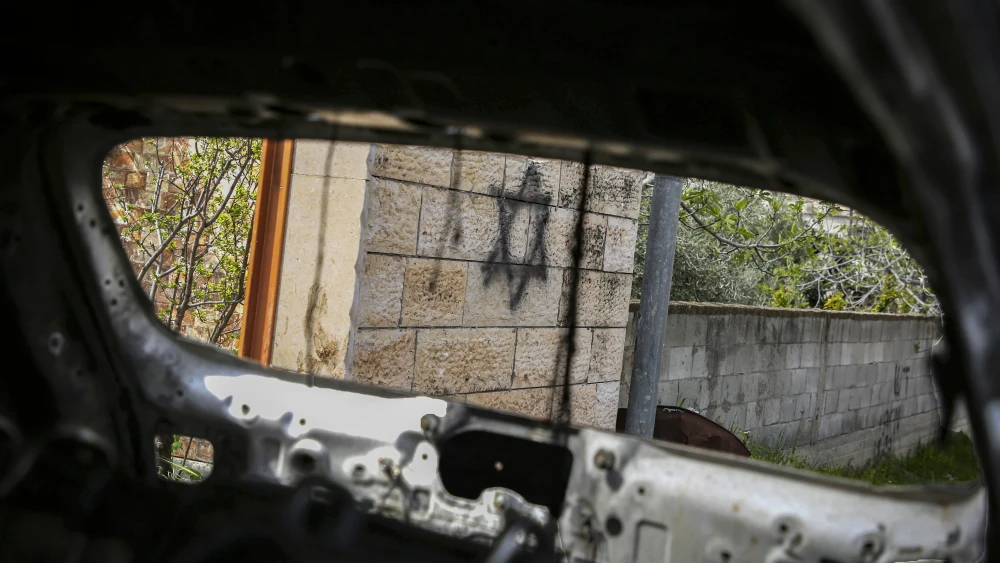
At the same time, the narrative about “settler violence” isn’t merely false but also a bizarre inversion of reality. It is the Jews who live in the territories who are the victims of a daily tsunami of often murderous Palestinian violence. Indeed, most of the incidents in which such residents are supposedly engaged in thuggish behavior are either acts of self-defense against Arab attacks or Palestinian information operations designed to falsely claim ownership over land to which they have no right.
And yet, the Palestinian terror campaign being waged against Jews living in the territories is ignored by both the secular and Jewish media. Jewish groups, including some that are otherwise supportive of Israel, blindly accept the claims of biased observers like the U.N. Office for the Coordination of Humanitarian Affairs (OCHA) or far-left-wing Jewish groups like B’Tselem, which are the sources for most of the allegations of settler violence.
As Liel Leibovitz wrote in Tablet, “Why They Lie About Jewish Terrorists,” and Gadi Taub detailed in “The Settler Violence Myth,” the assertions that thuggish extremist Jews have been allowed by the Israeli government to run riot in Judea and Samaria are simply false.
Not every claim of Jewish misconduct against Palestinians is necessarily untrue. Supporters of Israel don’t have to apologize for the fact that a few people out of a Jewish population of several hundred thousand residents of the territories might be guilty of illegal behavior. But as Leibovitz and Taub make clear, the assertions that the settlers are engaged in an indiscriminate and unprovoked campaign of violence against Arabs is out and out wrong.
An epidemic of Palestinian terror
Breaking down the incidents cited as definitive proof of misconduct, the assumptions about settler violence are easily exploded. Most of these alleged crimes turn out to be the opposite of what is often asserted. Rather than Jews seeking to intimidate Arabs, most recorded instances of Jewish violence turn out to be cases of the so-called settlers defending themselves against rock-throwing or worse. The same is true for contentions that Jews are stealing Palestinian land, uprooting olive orchards of long standing and using force to pressure Arabs to flee their homes.
As Leibovitz points out, “In 2024, there were more than 6,300 Palestinian terror attacks against Jews in Judea and Samaria, leading to 27 murdered Israelis and more than 300 wounded. The deadly trend continued last year, too, with 5,051 attacks by Palestinians, during which 24 Israelis were murdered and 400 wounded. Those included 458 attacks with Molotov cocktails, 655 attempts to blind drivers with laser pointers, 286 explosive charges and 19 terrorist shooting assaults.”
Compare that to OCHA’s claims that 1,400 incidents of settler violence occurred in 2024 and 1,700 such crimes occurred in 2025.
Even if OCHA’s data is to be believed, when lining up the two sets of numbers, the story comes across very differently than the headlines in outlets like The New York Times, The Guardian, PBS or even the liberal Times of Israel about a troubling rise in Jewish gangsterism in Judea and Samaria.
But the point is, no one should believe claims put forth by the United Nations about Jews behaving badly in the territories any more than they should accept the world body’s skewed accusations about Israeli actions in Gaza or any other topic concerning the Jewish state. Taking a deep dive into these statistics, as Leibovitz and Taub have done, shows a thinly veiled effort to gin up a scandal for which there is little or no evidence.
The Jews residing in the territories which form the heart of the ancient Jewish homeland are living in a state of virtual siege, and rather than being encouraged or enabled in violence by the government in Jerusalem or the Israel Defense Forces, many living in these communities feel they are not given adequate protection. That is why a small minority of them sometimes engage in actions that are either misconstrued as “Jewish terrorism” or are, in fact, cases of illegal retaliation against those who are trying to make their lives hell.
But rather than condoning wrongdoing, the IDF seeks to stop them and arrest Jewish perpetrators. That stands in stark contrast to the policy of the Palestinian Authority, which rewards terrorism against Jews with salaries and/or pensions for those who commit such crimes, as well as to their families. In Israeli society, those accused of misbehavior against Arabs are pariahs and derided as extremists. Palestinians who shed Jewish blood are treated as heroes.
An Israeli conundrum
And that is also the context in which the new death-penalty law should be understood.
Rather than being considered as nothing more than evidence of Jewish lust for violence or even revenge, it is an attempt to solve a serious problem for which Israel’s critics have no solution.
In just the last decade, there have been several thousand incidents of Palestinian terrorism against Israelis. Even if you treat the Oct. 7 attacks—the largest mass slaughter of Jews since the Holocaust—as a singular event, the total of every other such event in which hundreds of Jews were murdered and thousands maimed and wounded amounts to several thousand.
Yet each time a Palestinian Arab commits an act of cold-blooded murder, he or she can be confident that sooner or later, they will avoid punishment. That’s because they know that Hamas and other terror groups are always seeking to kidnap Israelis in an effort to force Jerusalem to free terrorists in exchange for ransoming them. Even those who have committed the most bestial of crimes, including those that occurred on Oct. 7, when the slaughter was particularly depraved and involved what American legal scholars call “aggravating factors” in death-penalty cases such as rape, torture and kidnapping, have been let loose. They return to their homes or go into comfortable exiles, acclaimed as heroes and paid generous sums as a reward for their terrorism. Applying the death penalty to those who committed such despicable crimes may be controversial but it would certainly be justice.
The death penalty exists in Israel, but to date, only one person—Nazi war criminal Adolf Eichmann—has been executed in the Jewish state. Many in Israel, as is true elsewhere, oppose capital punishment in principle. Even Jewish religious law, which allows for the death penalty, places rigorous limits on its application.
But as long as terrorists who commit murder are given, at best, life sentences for their crimes, that sets up a situation not only in which they will eventually be freed, but also a situation in which Palestinians are incentivized to kidnap Jews. And that is exactly what happened on Oct. 7.
Many Israelis believe that the only solution is to execute the terrorists before they can be freed in hostage exchanges.
Will that deter terrorism? That is far from clear, especially since many of those who murder Israelis are motivated by thoughts of martyrdom in the jihad against the Jews.
Nor is it likely that Israel’s liberal-dominated Supreme Court will allow the death-penalty law to be implemented, though, as in many of their other egregious interventions and power grabs, their assertion of a right to overrule the legislation is entirely unsupported by law and inherently anti-democratic.
Still, creating a legal mechanism that removes one major incentive for murders of Jews is not racist. It is simply an attempt to find a way to avoid a cycle of violence in which terrorism is rewarded.
Nevertheless, the argument that this law is more evidence of Israeli barbarism is absurd. While many democratic countries have outlawed the death penalty, the practice is far from rare around the world. In the United States, where some states allow the death penalty and others do not, fewer than two dozen murderers are executed on an annual basis. But executions for a variety of crimes (including for sexual preferences and behavior that is defended as a basic human right in the West) are widespread in Arab and Muslim countries, including in Palestinian-controlled territory, as well as elsewhere in the Third World. China executes thousands of people every year for an unspecified series of offenses against its tyrannical regime, as well as keeps approximately a million prisoners in the laogai, Beijing’s own modern version of the Soviet “gulag archipelago.”
Seen in that context, Israel’s efforts to deter a wave of terrorist murders against its citizens ought not to be considered an outrage or even controversial.
An ideological agenda
So, why are mainstream and even liberal Jewish news outlets treating the death-penalty law, as well as the often distorted if not outright false reports about an epidemic of “settler violence,” as a major issue? And why are they doing this while also refusing to cover the far larger incidence of Palestinian and Islamist terrorism against Israelis in Judea and Samaria?
The answer is simple. It’s part of the general ideological assault on Israel and Jewish rights that has its roots in Soviet disinformation. It has been amplified and weaponized by woke ideological advocates of toxic ideas like critical race theory, intersectionality and settler-colonialism that treat Israelis and Jews as “white” oppressors of Palestinian “people of color.” In this formulation, the former are always in the wrong, no matter what they do, and the latter are always the victims, regardless of their commitment to terrorist violence in their genocidal war against the Jewish state.
Seen in that light, people of good faith and conscience ought not to be duped into believing this false narrative about Israeli violence and moral equivalence to Palestinian crimes. It’s not just based on out-of-context reasoning and unreliable statistics. The claims about the death penalty and the settlers are rooted in antisemitic tropes and false arguments. To lend them credibility isn’t an example of principle, whether on the part of Jews or others. It’s evidence of either bad judgment or bad faith.
Jonathan S. Tobin is editor-in-chief of JNS (Jewish News Syndicate). Follow him: @jonathans_tobin.