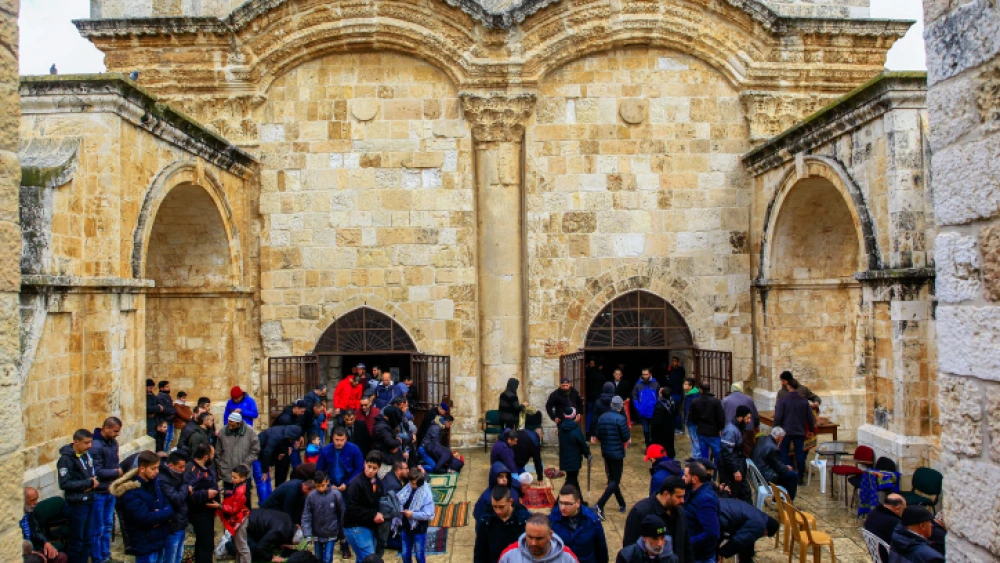
The Islamic Waqf Council, the Jordanian-led Muslim religious body that shares control of the Temple Mount with Israeli authorities, openly refused an Israeli court order to close an area Arab rioters opened by force last month.
The court ordered that the “Gate of Mercy” (Sha’ar HaRachamim) be closed by next Monday.
However, Waqf Council chairman Sheikh Abdelazeem Salhab refused, not only vowing the area would “remain open for Muslims to pray,” but demanding that Israeli permit the Waqf to renovate the site. He also demanded that Israeli revoke orders against dozens of Waqf officials and guards who have been banned from the Temple Mount.
Jordan’s Royal Committee for Jerusalem Affairs, which oversees the Waqf in Jerusalem, decreed that the Israeli court order was an “escalation of the attack on Bab al-Rahma [the gate’s name in Arabic],” with the committee head calling it “aggression against Jerusalem and holy sites for electoral purposes.”
Israeli authorities sealed the “Gate of Mercy” in 2003 due to the managing group’s ties to Hamas and illegal excavation by the Waqf, which resulted in the destruction and loss of priceless antiquities and archaeology. Critics of the crude tractor work at the world’s holiest site for the Jewish people accuse the Islamic organization of undertaking the project to deliberately eradicate evidence of the Holy Temples and Jewish history at the location.
Last month, immediately following the ascension of seven local Arab religious and political leaders to the Waqf council, the group went to the “Gate of Mercy” and held a prayer session, contrary to the status quo as set with Israel.
Israel subsequently planned to call members of the Waqf in for questioning, but was rebuffed by Jordan. Arab rioters subsequently descended on the site and forcibly kicked open the gate. Israeli riot police stormed the site, arrested violent protesters and sealed the Temple Mount for approximately three hours.
The Temple Mount was subsequently reopened, and Muslim worshippers were permitted to continue to arrive.