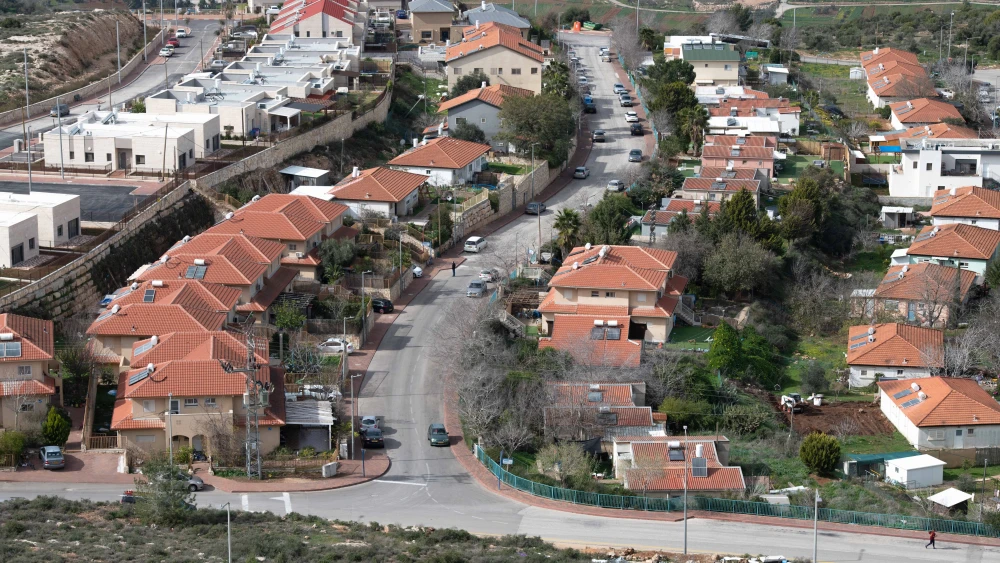
The Israeli government gave its final approval on Wednesday for the construction of more than 1,000 new housing units in the southern Samaria community of Eli, according to the Binyamin Regional Council.
“Since the first terror attack at the gas station two years ago, we have worked together with the government on the issue, and now—after many objections had been submitted to the plans—thanks to the tremendous work of [Finance] Minister Bezalel Smotrich’s team, the final approvals have been granted,” said council head Israel Ganz.
Eli’s gas station, situated along the Route 60 highway, was targeted twice by Palestinian gunmen within just two years. On June 20, 2023, Hamas terrorists killed four civilians at the site, including two teenagers. On Feb. 29, 2024, two more people were killed, including a 16-year-old.
Wednesday’s decision allows for the construction of 414 new homes in Eli’s Nof Harim and Hayovel neighborhoods, and another 650 in the Nofei Eliraz neighborhood, effectively doubling the town’s size.
Ganz said the Binyamin Regional Council was working with Smotrich, who also serves as a minister in the Defense Ministry with responsibility for civilian matters in Judea and Samaria, to OK another 347 units in Eli’s Palgei Mayim neighborhood.
“May we continue to share good news and rejoice in the building of the Land [of Israel],” Ganz concluded.
Israel’s Security Cabinet recently approved 22 new Jewish communities across Judea and Samaria, including two in northern Samaria that were uprooted by Israeli forces as part of the 2005 Gaza disengagement.
Some of the approved communities are existing outposts that had thus far been unauthorized under Israeli law, while others are new villages.
“We made a historic decision for the settlement: 22 new communities in Judea and Samaria, renewing settlement in the north of Samaria and reinforcing the eastern axis of the State of Israel—the State of Israel’s defensive shield,” Smotrich said last week.
“With God’s help, we have returned Israel to a path of building, Zionism and vision. Settlement in our ancestral homeland is the protective wall of the State of Israel—and today, we took a major step in fortifying it,” continued Smotrich, who led the initiative in the Security Cabinet.
Meanwhile, the Israeli government has recently warned some European nations that unilateral recognition of a Palestinian state on their part could prompt Jerusalem to extend sovereignty to parts of Judea and Samaria.
Israeli Foreign Minister Gideon Sa’ar and Strategic Affairs Minister Ron Dermer reportedly told France, the United Kingdom and others that recognition of Palestine could lead Israel to annex Area C of Judea and Samaria and legalize outposts.
“Unilateral moves against Israel will be met with unilateral moves by Israel,” Sa’ar told his counterparts, the Israel Hayom daily reported.