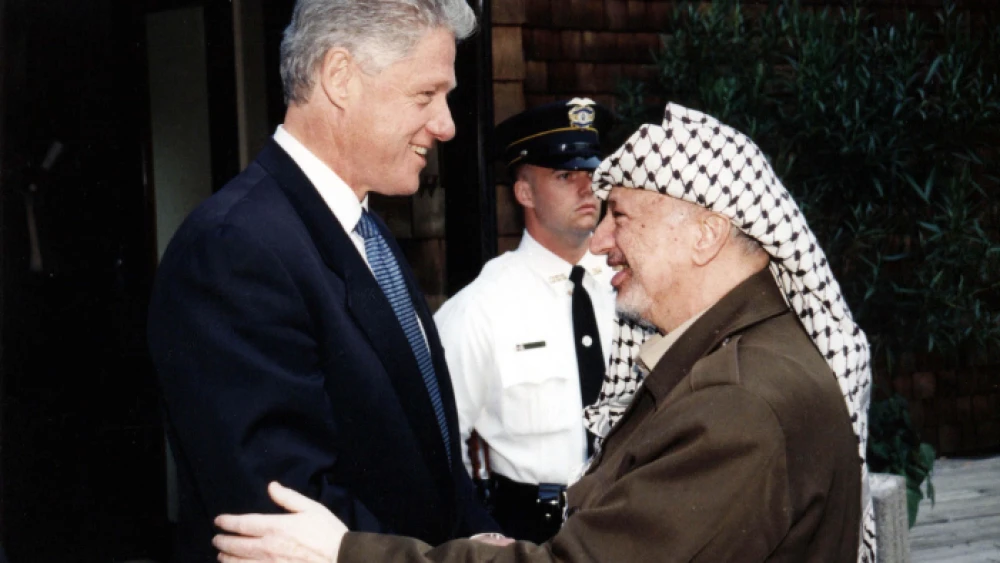
The Barak administration agreed to give up part of Israel’s sovereignty in the Old City of Jerusalem and the Temple Mount in December 2000, according to an official response to a Clinton administration proposal published for the first time by the Israel State Archives on Sunday.
Israel agreed to relinquish its sovereignty over the area of the mosques on the Temple Mount, Ynet reported.
Among the comments written in Hebrew in the margins of the Clinton administration proposal: “de facto division of sovereignty on the Temple Mount.”
Israel demanded continued sovereignty over the Western Wall, the Western Wall tunnel, the Makhkame building overlooking the Temple Mount, the Siloam Tunnel (aka Hezekiah’s Tunnel), the City of David and the Mount of Olives.
Israel expressed reservations regarding the U.S. suggestion to give the Old City’s Armenian Quarter to the Palestinians, saying, “Armenians aren’t Arabs.”
Israel suggested instead that “everything from the Jaffa Gate straight and to the left [the Christian and Muslim quarters] will be Palestinian, and everything to the right [the Jewish and Armenian quarters] will be Israeli.”
Israel demanded to keep 80% of the Israeli residents of Judea and Samaria under Israeli sovereignty, which amounted to retaining only 8% of the area. It also agreed to retain no more than 2% of the Gaza Strip, Ynet reported.
Israel failed to receive a favorable response to a number of its requests, the document shows.
Israel expressed concerns that the “Palestinian recognition of the Jewish narrative regarding the Temple Mount was not accepted.”
Israel gave up its demand that Palestinian sovereignty in Arab-majority neighborhoods would be limited to the neighborhoods adjacent to the Old City.
Its demand that Palestinian sovereignty in the Jordan Valley be postponed until the end of the final-status negotiations was described as having “no chance” of being accepted.
Furthermore, Israel’s demand that an international force be deployed only along the Jordan Valley and the Gaza border with Egypt was not accepted. The U.S. proposal was that the force would also be deployed on the border between the Palestinian state and the State of Israel.
President Bill Clinton’s negotiators also didn’t accept Israel’s proposal that Hebron, Rachel’s Tomb outside Bethlehem, Joseph’s Tomb in Nablus and other holy places would remain under its sovereignty.
The document, an official Israeli response to Clinton’s ideas, is part of the archival file of the late Noah Kinarti, who was an adviser to the minister of defense for settlement matters and a member of Israel’s negotiating team.
The document includes an English language letter sent in January 2001 by Prime Minister Ehud Barak’s Chief of Staff Gilead Sher to Clinton’s National Security Adviser Sandy Berger.
In the letter, Sher said that Israel views the outlines as “a basis for discussion, provided that they remain, as they are, a basis for discussion acceptable to the Palestinians.
“Israel will request a number of clarifications concerning matters of vital interest to Israel,” Sher added.