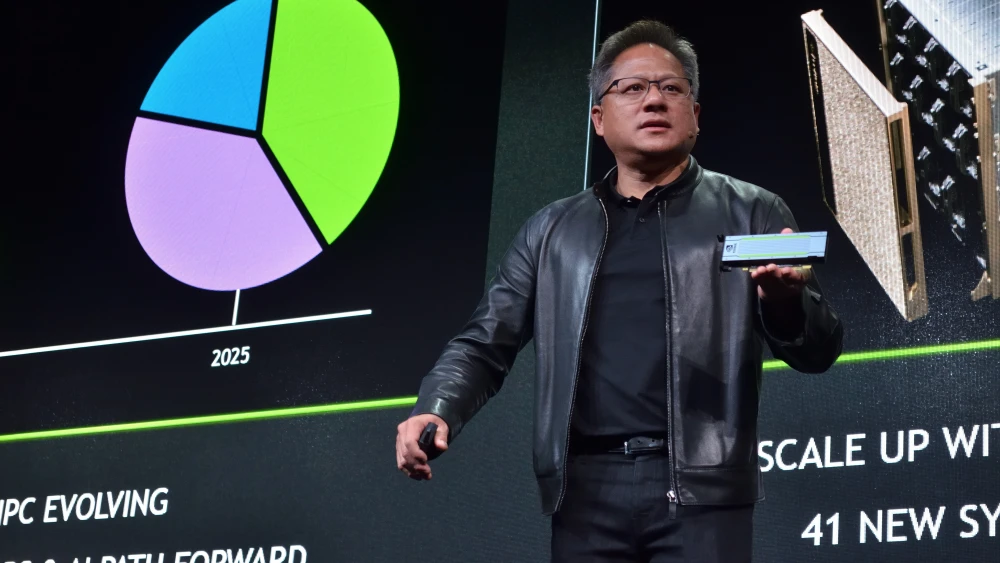

When Jensen Huang stepped down as CEO of NVIDIA, investors were forced to confront a question few had seriously considered: Could the company at the center of the artificial-intelligence revolution continue its trajectory without the visionary who had led it for more than three decades?
The market’s response was swift. NVIDIA shares fell more than 40% from their peak as investors reassessed the future of one of the world’s most important technology companies. What began as a leadership transition quickly became a referendum on the value of visionary leadership itself.
The story became even more remarkable when NVIDIA’s board quickly restored Huang to the company’s leadership. Investors responded immediately, driving the stock nearly 30% higher and recovering much of the earlier decline. The episode raised a larger question. Was Jensen Huang simply a successful CEO, or had he become one of the rare founders whose vision had become inseparable from the future of the company he built?
The irreplaceable founder
The closest modern parallel to Jensen Huang may be Steve Jobs. Jobs transformed Apple from a computer company into the creator of the iPod, iPhone and mobile ecosystem. Huang transformed NVIDIA from a graphics-chip manufacturer into the dominant platform powering artificial intelligence.
In both cases, investors viewed the founder not simply as an executive but as the architect of the company’s future.
Founder-led companies create a paradox. Public corporations are designed to outlive their founders, yet history occasionally produces leaders whose vision becomes inseparable from the organizations they build. Investors clearly viewed Huang as such a figure.
The question was never whether NVIDIA possessed capable executives. It was whether anyone else could replicate the foresight that positioned the company at the center of the AI revolution.
To understand NVIDIA’s rise, one must also understand Israel’s role in its evolution. The pivotal moment came with NVIDIA’s acquisition of Mellanox, whose high-performance networking technology became a critical building block connecting the massive clusters of GPUs that now power artificial intelligence. As AI models grew larger and more computationally demanding, moving data rapidly between processors became nearly as important as the processors themselves.
Today, NVIDIA’s presence in Israel is no longer an acquisition story. It is a strategic dependency story.
Thousands of Israeli engineers contribute to networking, infrastructure and AI technologies that sit at the heart of NVIDIA’s future. Despite persistent doubts about Israel’s technology sector, NVIDIA has continued to deepen its investment. The company’s actions suggest a simple conclusion: Talent matters more than headlines.
Leadership, ethics and human failure
The most important question raised by Jensen Huang’s return is not whether NVIDIA made the right business decision. It’s whether society still believes in redemption.
Few would argue that extraordinary achievement should excuse personal misconduct. Yet history is filled with innovators, entrepreneurs, statesmen and visionaries whose accomplishments coexisted with human failings. The challenge for boards, investors and society is determining whether a person’s worst moment should define an entire life, or whether accountability and growth remain possible after failure.
NVIDIA’s board was ultimately forced to confront a question that reaches far beyond Silicon Valley: Under what circumstances can trust be rebuilt?
There is a general recognition that extraordinary vision is difficult to replace.
The late Rabbi Jonathan Sacks often observed that one of Judaism’s most revolutionary ideas is that greatness does not belong to perfect people. Abraham, Jacob, Moses and King David were extraordinary leaders whose flaws are recorded alongside their achievements. The Torah does not conceal their failures because its purpose is not to create heroes beyond reproach, but to teach that moral growth remains possible.
Rabbi Meir Soloveichik has similarly argued that Jewish leadership is defined not by freedom from failure, but by the willingness to confront it honestly and emerge wiser because of it. This is the essence of teshuvah—not the erasure of mistakes, but the difficult work of accountability, repair and renewal.
Viewed through that lens, the central question surrounding Huang is not whether he is flawless. The more important question is whether his response demonstrates the humility, responsibility and character necessary to regain trust. Leadership ultimately requires more than vision and brilliance. It requires accountability and the capacity for redemption.
In the end, NVIDIA’s board was forced to answer a question that many investors had already answered. Could the company that sits at the center of the AI revolution afford to move forward without the individual who had spent more than three decades building it?
The market’s reaction suggested deep skepticism. When the 63-year-old Huang departed, investors punished the stock. When he returned, they rewarded it. The message could not have been clearer; many believed NVIDIA’s future remained tied to the vision of its founder.
Yet NVIDIA’s decision was about more than shareholder value.
The board had to balance accountability, governance, employee confidence, customer trust and the company’s long-term interests. There was no perfect answer. Bringing Huang back would invite criticism. Leaving him out could undermine the leadership that transformed NVIDIA into one of the world’s most important companies.
The board may have concluded that succession and replacement are not the same thing. Capable executives can run a company. Visionaries rarely come along twice.
The lesson for Israel
The immediate debate surrounding Huang’s return will focus on corporate governance, accountability and whether NVIDIA’s board made the right decision. Yet the larger lesson extends far beyond a single executive.
For months, many observers predicted that uncertainty in Israel would eventually cause technology companies to slow investment, reduce exposure or look elsewhere for talent. NVIDIA’s actions tell a very different story. Despite market turbulence, leadership upheaval and geopolitical uncertainty, the company has continued to deepen its commitment to Israel and to the engineers, researchers and innovators who have become integral to its success.
NVIDIA did not retreat. If anything, it reinforced its belief that Israeli talent remains a strategic asset at the center of the AI age.
That may be the most important lesson of all. NVIDIA’s decision to restore Huang was, at its core, a recognition that extraordinary vision is difficult to replace.
The same principle applies to nations. Countries that consistently produce exceptional engineers, entrepreneurs and innovators create advantages that transcend headlines and political cycles. Just as NVIDIA concluded that its future was stronger with the visionary who helped build it, the company continues to invest heavily in Israel because it recognizes the enduring value of the people who help drive its innovation. In the end, Jensen Huang’s return was not simply a vote of confidence in one man.
It was an affirmation of a belief that has guided NVIDIA’s success for decades: extraordinary outcomes are created by extraordinary people. That conviction explains both Huang’s return and NVIDIA’s enduring commitment to Israel.