


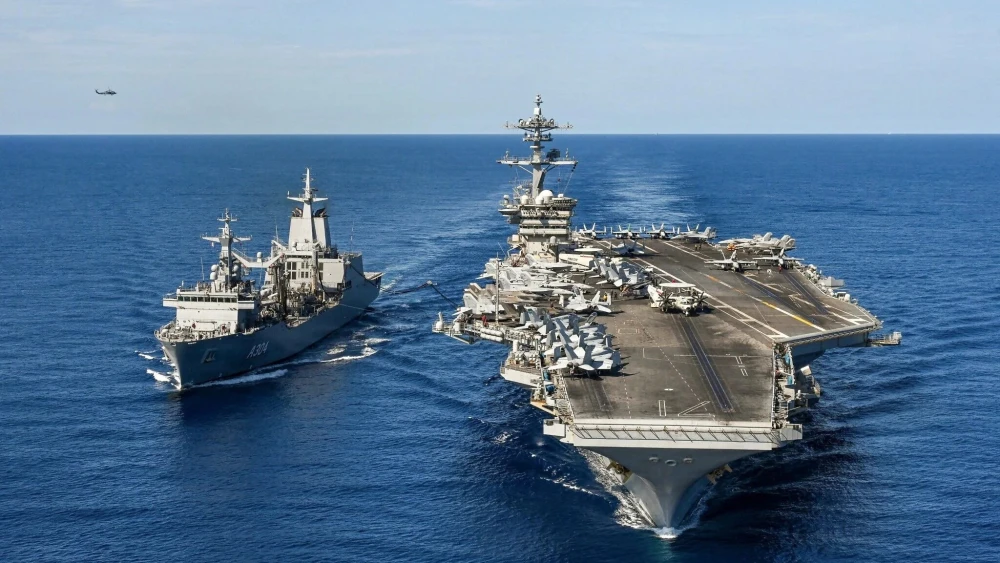

The USS Theodore Roosevelt arrived in the Middle East on Sunday, Nov. 15, preparing to replace the departing USS George Washington as American forces maintain a substantial naval presence near Iran.
The deployment comes as Iranian forces intensify attacks on American military installations across the Persian Gulf and shipping in the Strait of Hormuz, prompting retaliatory U.S. strikes against Iranian military infrastructure.
The escalation marks one of the most active periods of fighting since August.
“The situation is definitely unstable, and any of the recent strikes can lead to an escalation. Very likely, at some point an escalation will happen, but it is very difficult to tell when it will come,” Brig. Gen. (res.) Yossi Kupperwasser, director of the Jerusalem Institute for Strategy and Security (JISS), told JNS.
A cool war
The current confrontation follows the collapse of the June Islamabad Memorandum of Understanding, intended to end fighting that began with the joint American-Israeli offensive against Iran in February.
Mediated by Pakistan, the agreement committed Washington to lifting its naval blockade and easing economic restrictions in exchange for an end to hostilities and Iranian guarantees of freedom of navigation in the Strait of Hormuz.
However, it left critical disputes over Iran’s nuclear program, sanctions relief and control of the strait unresolved.
The agreement began unraveling almost immediately. Iran continued asserting its authority over maritime traffic through Hormuz, while attacks on commercial vessels resumed in late June.
Following further attacks in early July, American forces launched retaliatory strikes. On July 13, U.S. Central Command (CENTCOM) announced the restoration of the naval blockade, ending the brief diplomatic reprieve.
Washington subsequently intensified its economic and military pressure campaign.
On Aug. 24, the Treasury Department launched “Operation Economic Outcast,” expanding sanctions against Iranian financial institutions, oil-trading networks and foreign entities facilitating sanctions evasion.
Treasury Secretary Scott Bessent declared, “Our objective is to sever every economic lifeline that sustains this tyrannical regime until Tehran stands alone.”
According to CENTCOM, the blockade has prevented more than $25 billion in Iranian crude oil exports.
On Nov. 7, CENTCOM announced Task Force Iron Gate, an interagency initiative targeting the movement of sanctioned materials, military equipment and illicit revenue across Iran’s land borders and the Caspian Sea.
The initiative followed a Reuters investigation identifying at least $2 billion in military-related imports reaching Iran through alternative routes since January 2025. The task force aims to disrupt these networks without physically closing Iran’s land crossings.
Recent escalation
Iranian attacks have intensified in recent weeks, increasingly targeting commercial shipping and American military installations across the Persian Gulf.
According to the International Maritime Organization, 138 incidents involving commercial vessels had been confirmed since the conflict began, resulting in 25 seafarer fatalities as of Nov. 17.
On Nov. 17, a tanker operated by the United Arab Emirates’ ADNOC Logistics and Services was struck while transiting the Strait of Hormuz, leaving one crew member missing and 11 injured.
The attack followed several incidents earlier in November, including a Nov. 4 strike on the Velos Sapphire near Qatar that killed a seafarer.
Iranian forces also struck U.S. facilities in Bahrain on Nov. 13 and 15 before targeting an American radar installation on Nov. 17.
The following day, Iran launched additional attacks against Bahrain and Ali Al Salem Air Base in Kuwait, the first strikes on Kuwaiti territory since September. Kuwaiti authorities reported intercepting incoming drones.
The expanding attacks appear intended to increase the costs of maintaining Washington’s blockade.
“Iran is trying to prove that the collapse of the Memorandum of Understanding costs Washington more than Tehran,” Aviram Bellaishe, vice president of the Jerusalem Center for Security and Foreign Affairs (JCFA), told JNS.
American military operations against Iran have also continued throughout November, although Washington has largely confined its actions to limited strikes rather than a renewed large-scale offensive.
On Nov. 2, American aircraft struck Iranian military installations on Qeshm Island in the Strait of Hormuz, targeting air-defense capabilities that U.S. officials said threatened American aircraft.
Further strikes were reported against Iranian coastal infrastructure near Sirik in mid-November, although details remain disputed.
On Nov. 17, American fighter jets again struck Qeshm Island, targeting an Islamic Revolutionary Guard Corps missile-launch site following Iranian drone attacks against U.S. facilities in Bahrain.
American intelligence officials have meanwhile warned that the Iranian threat extends beyond the Middle East.
Testifying before the House Homeland Security Committee on Wednesday, Director of National Intelligence Jay Clayton said Iranian threats against American personnel and civilians had increased substantially.
“Our women and men here in the United States are under greater threat,” he warned.
The threats have prompted heightened security precautions in Washington. Bessent recently relocated to military housing over security concerns, while several other senior administration officials also reside on military installations.
CNN reported that U.S. intelligence had identified indications of possible Iranian plans to target senior American officials in Washington using radioactive or chemical weapons.
However, officials have not established that an attack is imminent, and Secretary of State Marco Rubio said Wednesday that he did not believe Washington faced an immediate threat.
Iran on the brink
The widening confrontation is unfolding alongside a deepening domestic crisis in Iran, where months of military strikes, international sanctions and disrupted trade have compounded longstanding economic problems.
According to figures released by Iran’s Statistical Center on Oct. 28, consumer prices had risen 88.7% year-on-year, while average inflation over the preceding 12 months reached 76.8%.
The International Monetary Fund projects that Iran’s economy will contract by 7.6% in 2026, with annual inflation averaging 78.6%.
According to the World Bank, Iranian non-oil exports declined by 28% during the first five months of the Iranian fiscal year, while imports fell by 26%.
Damage to industrial and energy infrastructure, restrictions on international commerce and declining investment have further weakened the economy.
Economic hardship has also contributed to growing domestic unrest.
On Nov. 17, hundreds of demonstrators gathered in Abdanan, western Iran, following a road accident that killed 13 workers employed by an oil and gas company.
Initially demanding accountability, protesters broadened their demonstrations into anti-government rallies, chanting slogans including “death to the dictators” and “Long live the Shah.”
Speaking to the Associated Press on Wednesday, Mai Sato, the United Nations special rapporteur on human rights in Iran, warned that recent domestic instability has led to “a renewed wave of arrests, resulting in severe sentences, including death sentences.”
Maj. (res.) Alexander Grinberg, an Iran expert at JISS, told JNS that the protests do not pose a significant threat to the regime but could divert its attention and resources.
“Without an organized clandestine movement inside the country, you cannot orchestrate regime change from abroad unless you are prepared to put boots on the ground,” he said.
“The regime is increasingly preoccupied with preventing an internal uprising. When so much attention and so many resources are devoted to repression, it inevitably comes at the expense of the regime’s other capabilities,” he added.
Kupperwasser offered a similar assessment.
“The economic difficulties and the protests you are seeing now in Iran do not have a predictable effect on the war. They are unlikely to affect the Iranian regime’s strategy except maybe stronger crackdowns,” he said.
A new political reality
While Iran faces mounting economic and political pressures, recent elections in the United States and Israel have weakened the domestic positions of its principal adversaries.
The results raise questions about whether U.S. President Donald Trump and Israeli Prime Minister Benjamin Netanyahu, facing greater constraints at home, might increasingly focus on confronting Iran.
In Washington, Republicans lost control of both chambers of Congress in the Nov. 3 midterm elections, with the unpopular Iran war contributing to their defeat.
Trump had pledged to avoid another major offensive before the elections but has since repeatedly raised the possibility of renewed military action.
Following a Nov. 5 meeting with his national security advisers, he said he was considering additional strikes to prevent Iran from rebuilding its nuclear program.
On Nov. 12, he again warned that he would not hesitate to use military force if necessary.
“Whoever in Tehran reads the Republican defeat as a brake may discover that it actually frees him. After the loss, he is in the position of someone with nothing to lose. He will not run again, and what remains for him is his legacy,” Bellaishe observed.
In Israel, Netanyahu faces a more immediate political challenge.
His bloc secured only 53 seats in the Oct. 27 election, while Israeli President Isaac Herzog entrusted opposition leader Gadi Eisenkot with forming the next government.
Despite his uncertain political future, Netanyahu has maintained an increasingly assertive position on Iran.
In an Oct. 21 address to military officers, he argued that eliminating the Iranian nuclear threat ultimately required overthrowing the regime in Tehran.
Following the election, he renewed warnings about Iran’s nuclear activities and urged Eisenkot to join a national unity government.
Netanyahu’s caretaker government retains the legal authority to authorize military operations, even without Eisenkot’s approval.
“A caretaker government in Israel keeps full authority, including the authority to go to war, and opposition to an Iranian nuclear program is shared by every political camp in Israel. Moreover, Iran built its strategy on the assumption that Washington will restrain Jerusalem. A transition period, when Israeli decisions are less predictable, is precisely the time when that assumption is least safe,” Bellaishe noted.
Military and intelligence consultations between Washington and Jerusalem have also intensified.
On Nov. 13, Mossad director Roman Gofman traveled to Washington for meetings with senior administration officials, including CIA Director John Ratcliffe.
Reuters subsequently reported that Gofman advocated renewed joint American-Israeli strikes, while Netanyahu confidant Ron Dermer separately pursued discussions with American officials.
On Wednesday, CENTCOM commander Adm. Brad Cooper visited Israel, meeting IDF Chief of Staff Lt. Gen. Eyal Zamir and Gofman in Tel Aviv to discuss regional developments and military coordination.
The intensified consultations come as diplomatic efforts to contain the confrontation have produced little tangible progress.
Despite renewed contacts between Tehran and regional mediators, the fundamental disputes that undermined the June agreement remain unresolved.
“Any agreement to American demands would be interpreted by the regime’s supporters and enemies alike as a surrender. This is not an ordinary negotiation between two parties looking for a compromise and is unlikely to lead to a successful result,” Grinberg explained.
Concerns about Iran’s nuclear program also persist.
Addressing the International Atomic Energy Agency’s Board of Governors on Wednesday, Director General Rafael Grossi reported that inspectors still lacked access to most declared Iranian nuclear facilities and could not verify the status of previously declared nuclear material.
Without renewed cooperation, he warned, “The Agency will not be able to conclude that there has been no diversion of declared nuclear material.”
The renewed military exchanges in the Gulf, mounting economic pressure on Iran, political uncertainty in Washington and Jerusalem, and continued diplomatic deadlock suggest that the confrontation is becoming increasingly difficult to contain.
Although neither side has formally committed to another major offensive, the growing frequency of limited exchanges raises the danger that a miscalculation or unexpected incident could trigger a much broader conflict.
“The current situation is unsustainable. It’s impossible to say when, but sooner or later there will be an escalation and a return to large-scale fighting,” Grinberg told JNS.


