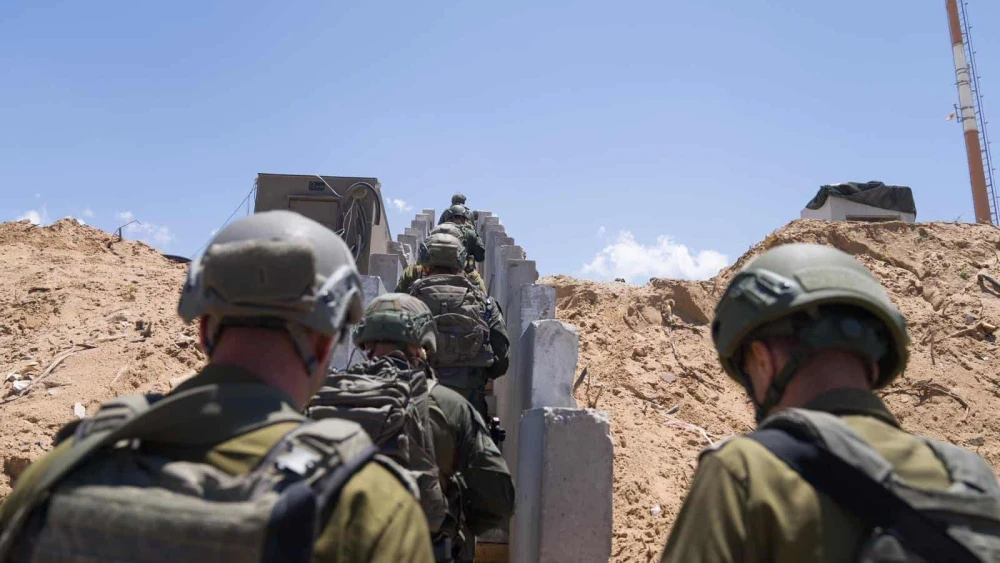
Hamas started the war with Israel and is responsible for perpetuating the conflict by refusing to lay down arms and release the hostages, Israel Defense Forces Spokesman Rear Adm. Daniel Hagari said on Thursday.
“Hamas started this war on Oct. 7. Hamas is choosing right now to continue this war by refusing to release our hostages, continuing to attack Israel and vowing to continue to do so as long as it can,” said Hagari in a rare English-language video statement.
While the IDF is doing everything it can to cause “minimal harm to those Gazan civilians Hamas is hiding behind,” the Palestinian terrorist group wants noncombatants to get caught in the crossfire, stated Hagari.
“We’re protecting Gazan civilians in Rafah from being a layer of protection for Hamas, by encouraging them to temporarily evacuate to humanitarian areas like we’ve done with around one million civilians in Rafah until now, who have moved out of harm’s way,” he said of the IDF’s ongoing military operation in the terrorist stronghold along the border with Egypt.
“We’re not smashing into Rafah; we’re operating carefully and precisely,” Hagari reiterated. “The IDF is committed to operating in accordance with international law and will continue to keep that commitment.”
Israel took control of the Gaza side of the Rafah border crossing with Egypt on May 7, as tanks from the 401st Armored Brigade rolled right up to the station.
A day earlier, Jerusalem’s War Cabinet decided unanimously to “continue the operation in Rafah to exert military pressure on Hamas in order to promote the release of our hostages and the other goals of the war.”
The Rafah operation, which Israel estimates will last some two months, is being carried out in phases as opposed to a full-scale invasion. The phased nature of the operation allows for it to be paused should a hostage release deal be reached between Israel and Hamas.
Hagari said of the battle in Gaza’s southernmost city, “Hamas is in Rafah; Hamas has been holding our hostages in Rafah, which is why our forces are maneuvering in Rafah. We’re doing this in a targeted and precise way.”
On Wednesday, the Hostages and Missing Families Forum released a new video of Hamas terrorists abducting female IDF spotters on Oct. 7.
“Those who may have forgotten how savage and barbaric Hamas is have received a chilling reminder when they saw the horrifying footage of our girls being held in captivity,” Hagari said in his statement on Thursday.
He added, “They need to come back home to their families. We must do everything to fulfill our critical mission of bringing all our hostages home and ensuring an enduring defeat of Hamas. We’re going after Hamas. We’re going to release our hostages from Hamas.”
Hagari noted that Israel shared its battle plans with Biden administration officials and vowed to continue this “productive dialogue,” including getting humanitarian aid into the coastal enclave.
“While Hamas has been bombing humanitarian crossings, damaging water pipes and stealing aid from the people of Gaza, Israel has been opening new aid crossings, fixing the water pipes in Gaza, and paving roads so that humanitarian aid reaches the people of Gaza in need,” he stated.
Earlier on Thursday afternoon, Israeli Defense Minister Yoav Gallant announced Jerusalem’s decision to deploy additional Israeli Air Force squadrons and IDF ground troops to the Rafah area.
“We are adding additional air and ground forces in Rafah,” Gallant stated during a visit to the Gaza coast. “Alongside the elimination of [Hamas’s] military capabilities, we are doing everything to create the conditions for the return of the hostages,” he said.
Many of the 128 hostages still in the hands of Hamas after 230 days are believed to be held in Rafah. Two captives were rescued from the city by special forces in a military operation in February.