


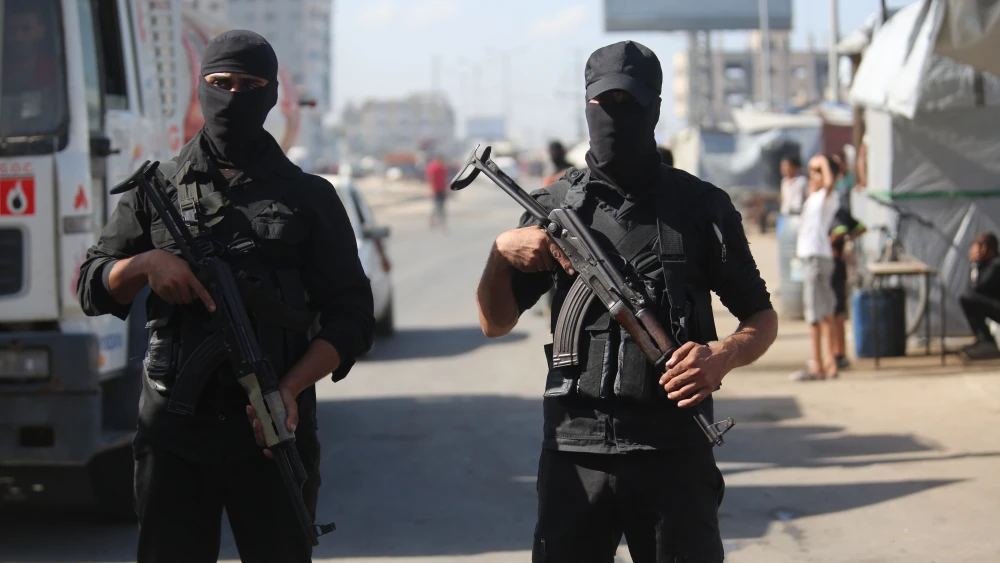
Hamas intends to transfer just four of 28 bodies of hostages to Israel on Monday in a “blatant breach” of the ceasefire agreement, the Hostages and Missing Families Forum stated.
The group said that implementation of the agreement must halt “until the full and complete release of all the deceased.”
The four bodies that Hamas intends to return are reportedly those of Guy Illouz, Yossi Sharabi, Bipin Joshi and Daniel Perez.
Israel Katz, the Israeli defense minister, said that Hamas failed “to meet commitments.”
“Any delay or deliberate avoidance will be considered a blatant violation of the agreement and will be responded to accordingly,” he said.
A spokesman for the Israeli military said that “efforts are being made at all levels today to continue the release of the abductees, who were killed beyond the four that Hamas announced.”
“Regarding the mission of returning the fallen hostages, we hope that as many as possible will be returned today, and we know there will be many who remain and whom we will need to work to bring back in the coming days,” stated Maj. Gen. (res.) Nitzan Alon, head of the Israel Defense Forces’ command center to return the hostages.
The Red Cross is on its way to the meeting point in the southern Gaza Strip, where several coffins of deceased hostages will be transferred into its custody, the IDF said.
The Hostages forum said it was “shocked and dismayed” to learn of Hamas’s breach.
“We expect Israel’s government and the mediators to take immediate action to rectify this grave injustice,” it said. “The families of the deceased hostages are enduring especially difficult days filled with deep sorrow. We will not abandon any hostage. The mediators must enforce the agreement’s terms and ensure Hamas pays a price for this violation.”
The hostage families were shocked and dismayed to learn that only 4 deceased hostages will be returned today, out of 28 held by Hamas.
— Bring Them Home Now (@bringhomenow) October 13, 2025
This represents a blatant breach of the agreement by Hamas. We expect Israel’s government and the mediators to take immediate action to rectify…
According to the first stage of the ceasefire deal, Hamas agreed to release all remaining 48 hostages, alive and deceased, on Monday.
The bodies of the deceased are expected to be draped in Israeli flags and transported to Re’im, where they are to be met by an honor guard and a prayer led by a military rabbi.
Israel agreed to release thousands of Palestinian terrorists from its prisons after all 48 are redeemed.
On Monday morning, Israel all 20 living hostages return from Gaza two years after Hamas kidnapped them on Oct. 7, 2023.
The hostages were released in two waves, the first was Matan Angrest, twin brothers Gali and Ziv Berman, Guy Gilboa-Dalal, Omri Miran, Eitan Mor and Alon Ohel.
The seven, accompanied by IDF and Israel Security Agency officers, crossed into Israel at about 9:30 a.m. local time, per the IDF.
Hours after the initial release, Hamas turned another 13 Israeli captives over to the Red Cross in the southern Gaza Strip.
The second group was Elkana Bohbot, Rom Braslavski, Nimrod Cohen, brothers David and Ariel Cuneo, Evyatar David, Maxim Herkin, Eitan Horn, Segev Kalfon, Bar Kupershtein, Yosef-Haim Ohana, Avinatan Or and Matan Zangauker.



