Newsletter
Newsletter Support JNS

Israel Elections 2022: Informal coalition negotiations get underway

Netanyahu ally Yariv Levin has begun holding talks with leaders of the right-wing bloc.

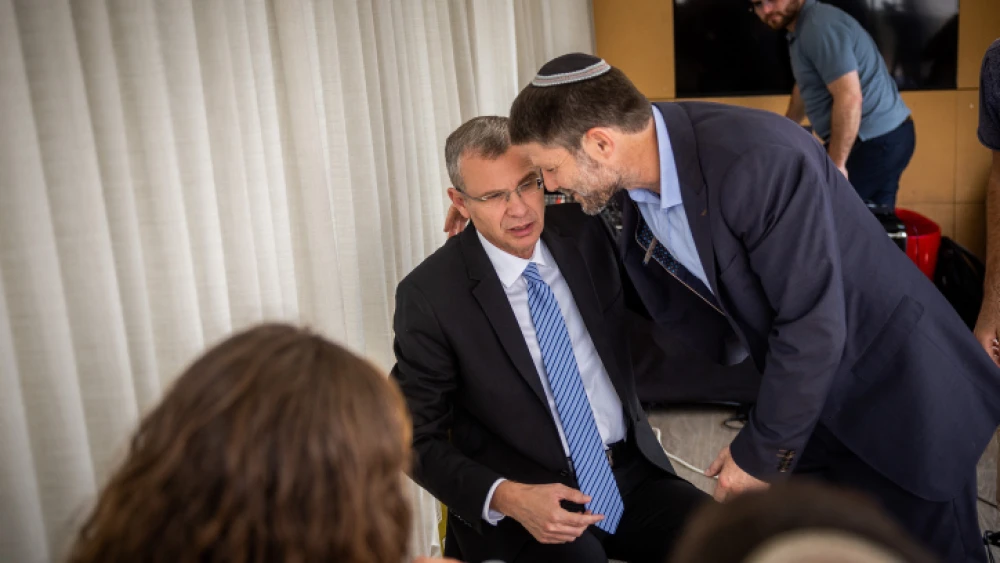
Likud MK Yariv Levin and Religious Zionism Party head Bezalel Smotrich at a conference ahead of the upcoming Israeli general elections, outside the Supreme Court in Jerusalem, Oct. 30, 2022. Photo by Yonatan Sindel/Flash90.

Israeli opposition leader Benjamin Netanyahu has tasked Likud Party ally Yariv Levin with beginning coalition negotiations, Israeli media reported on Thursday.

Levin has already started reaching out to the party heads in Netanyahu’s right-religious bloc, which includes the Religious Zionism Party, Shas and United Torah Judaism, according to the Channel 12 report.

With 99% of the ballots from Tuesday’s national elections counted, the bloc is predicted to secure a 64-seat majority in the 120-member Knesset.

Official negotiations between the parties will only begin after final results are released, which is expected to happen on Thursday.

Levin is considered to be Netanyahu’s closest associate in the Knesset, and often spearheads legislative initiatives as he is viewed as a savvy dealmaker able to bridge gaps between disparate factions.

He is also the architect of the Likud’s judicial reform proposal.

Israeli media reported on Wednesday that Netanyahu will attempt to form a governing coalition in just two weeks, by Nov. 15, the date of the swearing-in of the new Knesset.

According to Israel’s Basic Law: The Knesset, Central Elections Committee chairman Justice Yitzhak Amit must present the final results of the elections to President Isaac Herzog by Nov. 9.

Thereafter, Herzog will have a maximum of seven days to hold consultations with the leaders of parties elected to the 25th Knesset—a process that will be broadcast live on Israeli television in accordance with the law–before tasking a candidate, almost certainly Netanyahu, with forming a coalition based on their recommendations.

“We don’t need it. We need to teach real, honest history,” Sonja Shaw, school board president of Chino Valley Unified School District, told JNS.
The Israeli ambassador accused Vanessa Frazier, the U.N. special representative for children and armed conflict, of amplifying antisemitic content and unverified claims about Israel, and called for a review of her continued suitability for office.
A federal judge found that efforts to remove Hassan Suleiman Khalaf to Gaza or an Arab village in Judea and Samaria via Israel remain viable.
Speaking to local authority leaders, the Israeli premier said bold military decisions changed the regional balance of power and averted existential threats.
“Here is one more institution of government in Canada, one of our six national museums, again failing the Jewish community, leading to a rupture in the Jewish community,” Mark Berlin told JNS.
Peter James Bloomfield allegedly wrote online threats to kill FBI agents and “blow up the White House,” while investigators say he also made antisemitic threats in his posts.
Benny Gantz, JNS editor-in-chief Jonathan S. Tobin, Gilad Erdan, Mosab Hassan Yousef, Nissim Black and leading voices in security, diplomacy, media, law and Jewish communal affairs headline the summit’s third day in Jerusalem.