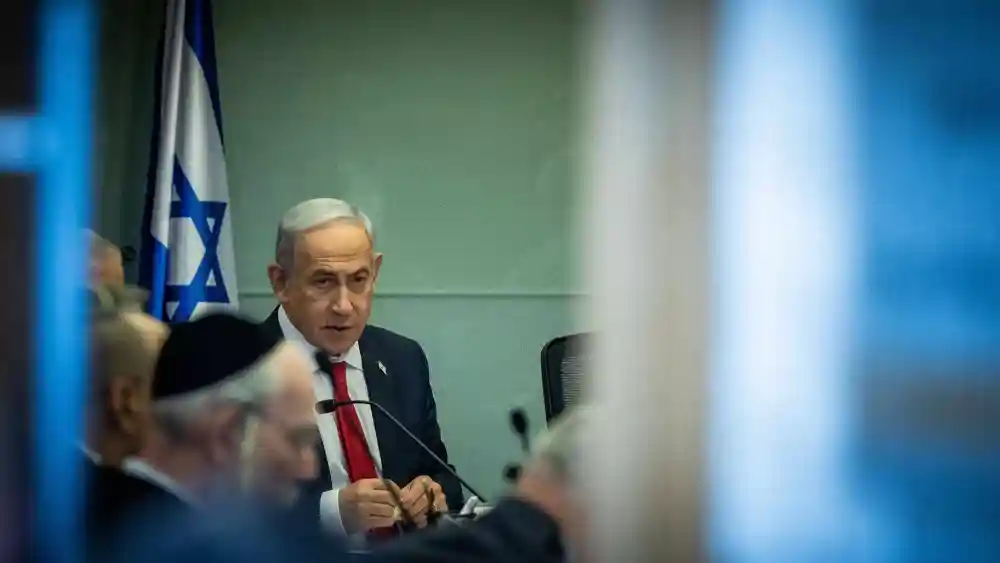
Israel struck Hezbollah in its Beirut stronghold in ways the group never anticipated, Prime Minister Benjamin Netanyahu declared on Sunday, speaking after an airstrike killed a senior terrorist leader in the city and days after thousands of operatives were wounded in attacks attributed to Jerusalem.
“If Hezbollah did not understand the message, I promise you: It will understand the message,” the prime minister said in remarks shared by his office.
Israel dealt Hezbollah “a series of blows it couldn’t have imagined,” he said.
“We are determined to return our residents to their homes in the north safely. No country can tolerate shooting at its residents, shooting at its cities, and we—the State of Israel—will not tolerate it either,” Netanyahu said.
Israel’s government remains determined to do “everything necessary to restore security” along the country’s northern border, he added.
אם חיזבאללה לא הבין את המסר, אני מבטיח לכם - הוא יבין את המסר. pic.twitter.com/63naM1ouIY
— Benjamin Netanyahu - בנימין נתניהו (@netanyahu) September 22, 2024
Earlier on Sunday, Defense Minister Yoav Gallant during a visit to an IAF base said that the Iranian-backed Lebanese terrorist army had begun “to sense some of the capabilities of the Israel Defense Forces.
“Our moves will continue until the goal is achieved. We will use everything necessary to fulfill the mission, until we reach a situation where we can return the residents of the north to their homes safely,” he said.
Thousands of terrorists were wounded and at least dozens were killed when their pagers and radio devices exploded across Lebanon on Tuesday and Wednesday, respectively, with Hezbollah immediately blaming the Jewish state’s intelligence agencies for both attacks.
The IDF has declined to comment on the two waves of explosions—the first of which came hours after the Israeli Cabinet added the return of residents displaced from their homes in the north to the country’s war goals.
On Friday afternoon, the IDF took credit for a targeted airstrike that killed senior Hezbollah commander Ibrahim Aqil—alias Al-Hajj Abdul Khader—in the Dahiyeh neighborhood of Beirut, a Hezbollah stronghold.
Aqil was a high-ranking member of Hezbollah’s top “military” body, the Jihad Council, which is subordinate to the Shura Council and under the direct control of Secretary-General Hassan Nasrallah.
Israeli President Isaac Herzog revealed in an interview with Britain’s Sky News on Sunday that Aqil and his associates were targeted as they were discussing plans for an Oct. 7-style invasion of Israeli territory.
Hezbollah “has been armed to its teeth by the Iranian empire of evil, and all of these leaders who were eradicated on Friday by the Israeli attack, all of these leaders, were meeting together in order to launch the same horrific, horrendous attack that we had on Oct. 7 by Hamas,” Herzog said.
Hezbollah has attacked Israel nearly daily since Oct. 8, 2023, firing thousands of rockets, missiles and drones. The attacks have killed more than 40 people and caused widespread damage. Tens of thousands of Israeli civilians remain internally displaced due to the violence.
Several people were hurt when Hezbollah launched more than 100 rockets and drones at northern Israeli towns and cities in waves of attacks overnight Saturday and Sunday morning.
In addition, a 17-year-old boy died in a car crash on Sunday believed to have been caused by a driver distracted by air-raid sirens.
Hezbollah took responsibility for the launches, saying that it had sent “dozens of Fadi 1 and Fadi 2 missiles” at the Ramat David Airbase and a Rafael Advanced Defense Systems facility near Haifa. This reportedly marked the first time that it has used this type of weapon since Oct. 8.
Hezbollah said that the projectiles launched were “in response to the repeated Israeli attacks that targeted various Lebanese regions and led to the fall of many civilian martyrs,” in reference to last week’s device blasts.