Newsletter
Newsletter Support JNS

US blames Iran for vessel attacks; defense secretary says Iranian threat ‘on hold’

“That doesn’t mean that the threats that we’ve previously identified have gone away,” said U.S. Acting Defense Secretary Patrick Shanahan. “I think our response was a measure of our will and our resolve that we will protect our people and our interests in the region.”

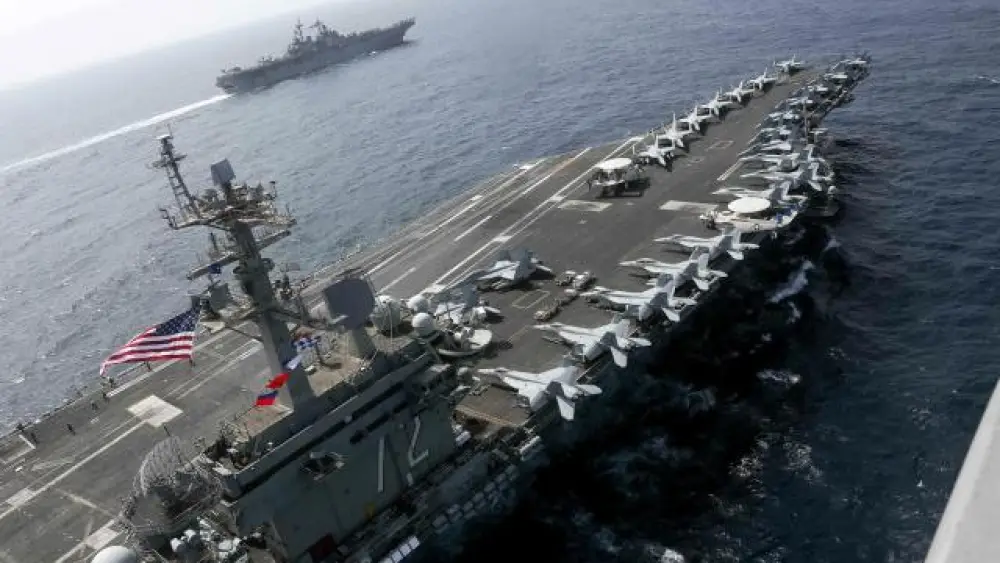
USS Abraham Lincoln
The “USS Abraham Lincoln” aircraft carrier sails in the Arabian Sea near the amphibious assault ship “USS Kearsarge,” equipped with vertical landing and takeoff aircraft and more than 1,600 Marines, May 15, 2019. Credit: U.S. Navy.

The United States blamed Iran for being behind attacks against four commercial vessels off the Emirati coast, a U.S. official told ABC News on Tuesday.

Two oil tankers owned by Saudi Arabia and two others—one owned by the United Arab Emirates and another by Norway—were sabotaged last week.

The accusation comes as U.S. Acting Defense Secretary Patrick Shanahan and U.S. Secretary of State Mike Pompeo briefed members of Congress on Capitol Hill on Tuesday behind closed doors.

Shanahan told reporters outside the Pentagon on Tuesday that the Iranian threat is “on hold” due to additional American forces in the Gulf, including a carrier striker group and a Patriot missile battery.

“Our prudent response, I think, has given the Iranians time to recalculate,” he said before meetings with presidents of Micronesia, Palau and the Marshall Islands.

“That doesn’t mean that the threats that we’ve previously identified have gone away,” added Shanahan. “I think our response was a measure of our will and our resolve that we will protect our people and our interests in the region.”

The Islamic Republic forced Washington to “retreat both on the battlefield and at the negotiating table,” said Mohammad Bagher Ghalibaf.
The Iran-U.S. Memorandum of Understanding underscored Tehran’s ongoing support for the terror group, Abbas Araghchi told Basem Naim.
The launch pads were established under the cover of the ceasefire with Hamas, according to the Israeli military.
An all-women panel at the JNS International Policy Summit highlighted the voices of ordinary Iranians.
Ilana Gritzewsky, a former Hamas captive, told the U.N. Human Rights Council she is “living proof” of sexual violence, challenging rapporteur Reem Alsalem.
“There is an understanding here that Israel has a problem with Hezbollah and that something needs to be done about it,” said the Dutch defense chief.
Benny Gantz, JNS editor-in-chief Jonathan S. Tobin, Gilad Erdan, Mosab Hassan Yousef, Nissim Black and leading voices in security, diplomacy, media, law and Jewish communal affairs headline the summit’s third day in Jerusalem.