Newsletter
Newsletter Support JNS

US defense chief underscores Israel’s right to self-defense

Meanwhile, House Foreign Affairs Committee chair Gregory Meeks (D-N.Y.) approved $735 million in precision-guided missiles to Israel.

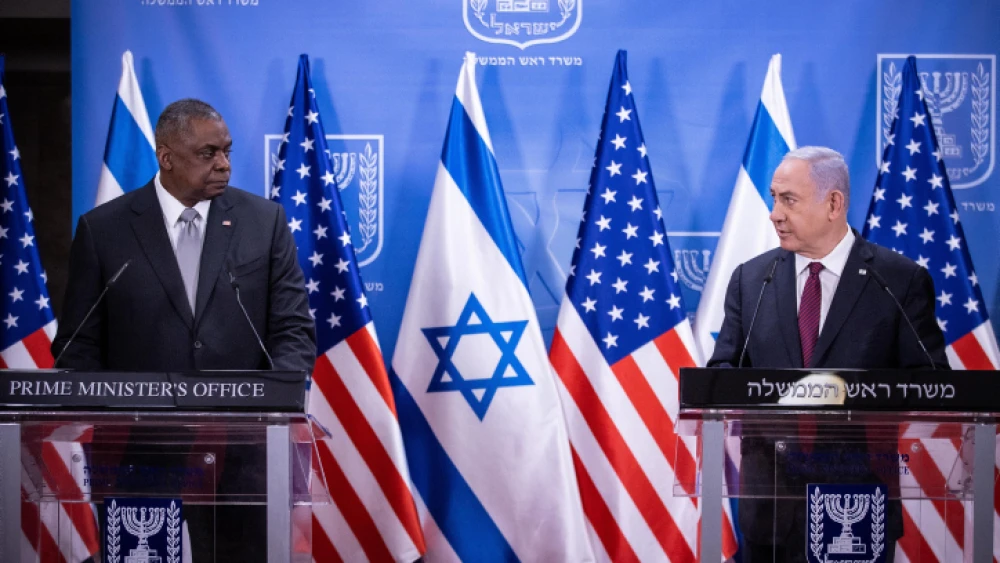
U.S. Secretary of Defense Lloyd Austin and Israeli Prime Minister Benjamin Netanyahu hold a joint press conference at the Prime Minister's office in Jerusalem on April 12, 2021. Photo by Yonatan Sindel/Flash90.
U.S. Secretary of Defense Lloyd Austin and Israeli Prime Minister Benjamin Netanyahu hold a joint press conference at the Prime Minister’s office in Jerusalem on April 12, 2021. Photo by Yonatan Sindel/Flash90.

U.S. Secretary of Defense Lloyd Austin reiterated to his Israeli counterpart, Defense Minister Benny Gantz, that Israel has a right to defend itself amid the ongoing conflict with Hamas and other terror groups in the Gaza Strip.

According to a readout from the Pentagon, Austin “underscored his continued support for Israel’s right to defend itself, reviewed assessments of Israel’s military campaign in Gaza and urged de-escalation of the conflict.”

The pronouncement comes after U.S. President Joe Biden told Israeli Prime Minister Benjamin Netanyahu earlier on Wednesday that he wanted to see a “significant de-escalation” in the Gaza conflict. Netanyahu responded that there is no timeframe for the end of the fighting.

Meanwhile, House Foreign Affairs Committee chair Gregory Meeks (D-N.Y.) approved $735 million in precision-guided missiles to Israel on Tuesday. Meeks had faced significant pressure from progressive Democrats to delay the sale.

The Strait of Hormuz has been closed in the wake of the Israeli Air Force’s pummeling of Hezbollah, an IRGC-affiliated news agency reported.
President Trump had the power to “cripple Iran’s entire economy in minutes. But he chose mercy,” the defense secretary said.
“Never underestimate President Trump’s ability to successfully advance America’s interests,” Karoline Leavitt stated.

“If they negotiate in good faith, we will be able to find a deal,” the U.S. vice president said.
The U.S. president hailed the two-week ceasefire agreement with Tehran, suggesting the deal could mark the beginning of a ‘golden age’ in the Middle East.
Pakistan’s prime minister said that diplomatic talks to resolve the conflict will take place in Islamabad.
