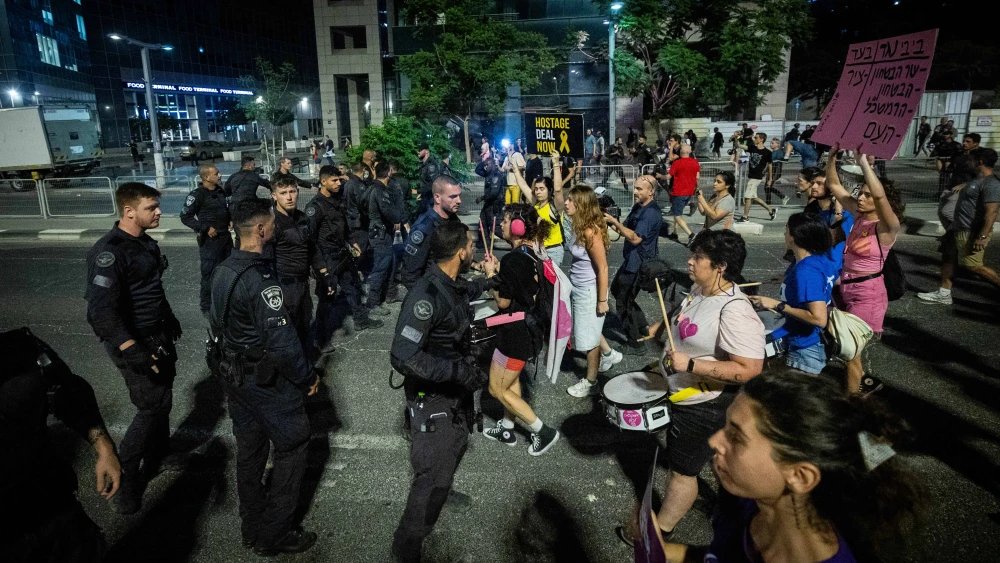
The Israel Police has told organizations of anti-government they will no longer be allowed to hold their regular Saturday-night protest at Tel Aviv’s busy Kaplan Junction.
Authorities informed organizers on Wednesday that recent rallies were too small to justify blocking the key intersection, demanding that future demonstrations be held on the nearby Begin Road, closer to the Kirya military headquarters.
Police said they will reassess the location of the rallies if there is a large number of attendants at the protest.
This Saturday, activists plan to hold their first mass rally since the IDF removed all limitations on large gatherings in central Israel in light of the ceasefire in the war with Hezbollah in Lebanon.
Organizers have said the smaller turnout was due to the now-removed IDF Home Front Command restrictions and vowed to fight the decision.
Shortly after Prime Minister Benjamin Netanyahu shelved his judicial reform plans following the Hamas-led massacre in southern Israel on Oct. 7, 2023, protest groups returned to the streets, demanding the government’s resignation.
In October, Nava Rozolyo, head of the Shame Guard Corps protest group whose purpose is to harass elected officials at their homes, said the goal of the rallies is not to convince voters of a need for political change, but rather to have Attorney General Gali Baharav-Miara and the security establishment remove Netanyahu from power without an election.
Rozolyo explained, “The purpose of the demonstrations is to strengthen and speak to everyone who, in the end, is able to pressure those who can overthrow the government.”
In July, Yair Golan, the leader of Israel’s far-left Democrats Party, urged activists to change direction. “Unfortunately, Saturday night protests are not enough. For this government to understand that we are serious, we need to be active all week, every day,” Golan said at an economic conference in Tel Aviv.
Accusing the opposition of “narcissistic” politics, he urged Israelis to “tell the government that we will not continue to pay taxes according to the law, go to work and perform all the duties imposed on us so that this government can take our money, steal it and invest it in places without national consensus,” according to a readout published by Calcalist.