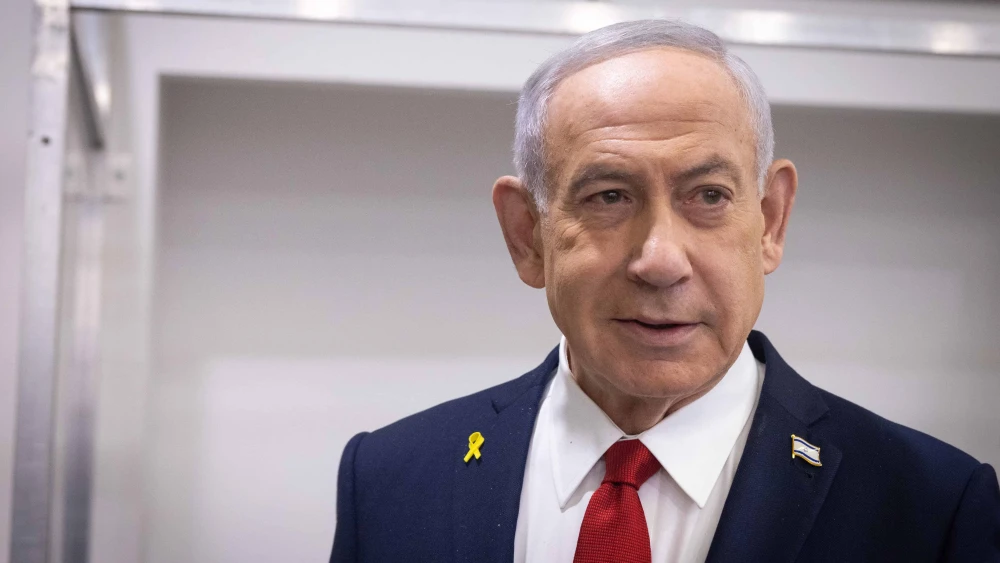
Israeli Prime Minister Benjamin Netanyahu on Sunday blamed Military Advocate General Maj. Gen. Yifat Tomer-Yerushalmi for “perhaps the most severe public relations attack the State of Israel has experienced since its establishment,” after she admitted to leaking video recordings allegedly showing the mistreatment of terrorist detainees from Gaza.
The video of the alleged incident at the Sde Teiman detention center in the Negev “caused immense damage to the image of the State of Israel and the [Israel Defense Forces], to our soldiers,” the premier told reporters on Sunday, speaking ahead of the weekly Cabinet meeting in Jerusalem.
Netanyahu said the public-relations damage Jerusalem suffered due to the leak was more “focused with such intensity” than any previous assault on Israel’s international legitimacy that he could recall.
“This requires an independent, impartial investigation, and I expect such an investigation to take place,” the premier added.
In July 2024, IDF Military Police arrested nine IDF reservists guarding the makeshift detention center as part of a probe into an incident of alleged abuse of a imprisoned Hamas terrorist.
“Following a suspicion of serious abuse of a detainee who was held in the prison facility, an investigation by the Military Police was opened by order of the Military Advocate General’s Office,” the IDF said at the time.
During the investigation, security camera footage allegedly documenting an assault on the terrorist by five reservists stationed at Sde Teiman was leaked to Israel’s Channel 12 News.
On Wednesday, Tomer-Yerushalmi went on leave pending an investigation into her office.
On Friday, Tomer-Yerushalmi acknowledged in a resignation letter that she had signed off on the leak, claiming that she had done so in an attempt to “fend off false propaganda directed against military law enforcement authorities.”
The reservists’ arrest sparked outrage among many right-wing Israelis, and protesters, including several members of Knesset, subsequently burst through the gates of two IDF bases to vent their rage.
Police have said they will summon Tomer-Yerushalmi, along with other staff from her office, for questioning under caution—formal police interviews—in the coming days.
On Saturday night, Israeli Justice Minister Yariv Levin ordered outgoing Attorney General Gali Baharav-Miara and her office to refrain from participating in the investigation into the leak, citing an alleged conflict of interest.
In a letter to Baharav-Miara, Levin wrote that her alleged “personal involvement in matters under investigation” and the “high likelihood” she could be called to testify in the affair warranted her exclusion.
Levin said that Baharav-Miara and members of her office might have obstructed or interfered with the probe over recent months, including by making false statements to the High Court of Justice.
He pointed specifically to Baharav-Miara’s statement to the High Court saying all investigative avenues had been exhausted and the leaker could not be identified—an assertion Levin suggested was misleading.
Baharav-Miara rejected Levin’s demand in a response on Sunday afternoon, calling it “lacking any factual or legal basis.”
“You have no authority to strip the attorney general of the enforcement powers referenced in your letter and transfer them to another official,” Baharav-Miara wrote Levin. “You also lack the authority to instruct the attorney general or enforcement bodies subordinate to her to refrain from dealing with matters within their powers and responsibilities.”
The Cabinet in August unanimously passed a motion to dismiss Baharav-Miara, though the High Court of Justice subsequently ordered the decision frozen pending legal proceedings against the move.