Ruth Halperin-Kaddari, a law professor at Bar-Ilan University, has pressed for years for greater recognition that sexual violence can be a weapon of war. The Dinah Project co-founder told JNS that women’s concerns are again being pushed aside as war in Iran escalates.
“Whenever there is a larger issue that overshadows everything else, less attention is given to those subjects that seem to be more particular,” Halperin-Kaddari said.
The founding academic director of Bar-Ilan’s Rackman Center for the Advancement of the Status of Women told JNS that “in general, women’s concerns get shoved back whenever there is a national security issue that’s on the rise.”
The Dinah Project is an independent, female-led group that seeks recognition and justice for victims of sexual violence in wartime. Halperin-Kaddari, a former member of the United Nations Committee on the Elimination of Discrimination against Women, talked to JNS days after a U.N. event in New York City that the Dinah Project held on March 13.
The event, co-sponsored with the Czech mission to the global body and with several nonprofits, gathered legal and human-rights experts to discuss accountability for conflict-related sexual violence in Israel, Ukraine, Iran and other conflict zones.
A 34-year-old Iranian woman identified as “Maral,” whose face was digitally altered via artificial intelligence to protect her identity, spoke via prerecorded video at the event.
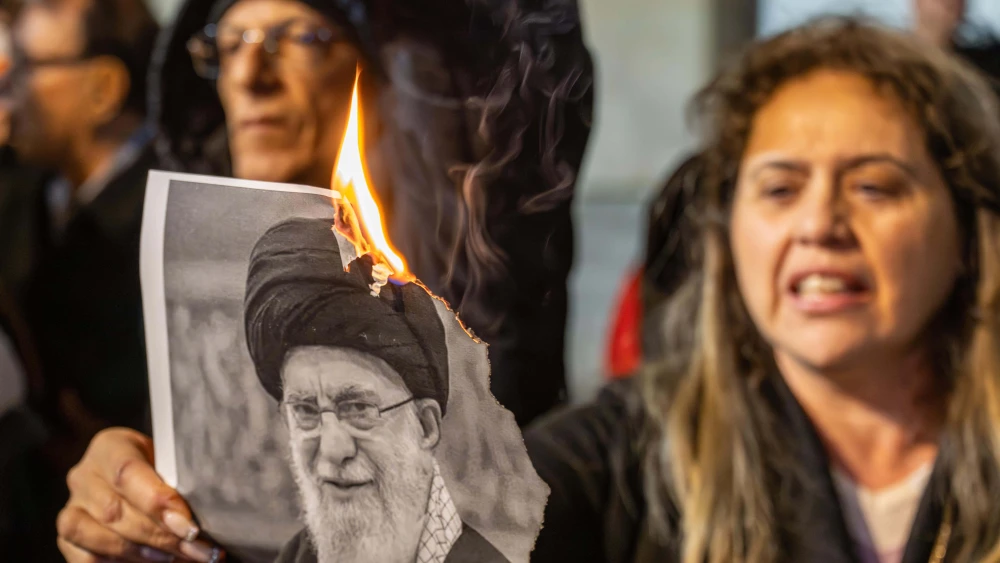
During the anti-regime uprising in Iran in late December 2025, Maral said that she and seven or eight other women were arrested and that Iranian members of a Shiite Afghan militia raped her and the others several times over the course of a week.
The attackers referred to them as “halal” and “spoils of war,” she said at the event.
Maral’s account is one of many that have emerged from Iran, where women, men, children and even medical staff have described security agents detaining them and subjected them to torture, repeated gang rape and other forms of abuse in custody.
Since the start of protests in late December, tens of thousands of protesters have reportedly been arrested. The regime has also killed thousands, and according to some accounts tens of thousands, of people.
Halperin-Kaddari told JNS that the way that Washington is framing Operation Epic Fury as a way to help Iranian women could backfire if a new leadership, which is as extreme as the current regime, takes over.
“Even though the rhetoric used to justify this war and calls for regime change are being attributed to the need to act for the sake of Iranian women, I’m afraid it could actually lead to the opposite result,” she told JNS.
If Mojtaba Khamenei, apparently the leader of the Iranian regime after U.S. and Israeli strikes killed his father, Ali Khamenei, on Feb. 28, is seen as “even more extreme” than his father was, “then women’s lot is just going to get worse,” Halperin-Kaddari said. (It’s not clear if Mojtaba is alive or running the country, U.S. officials have said.)
“I think that the rule that women always pay the price could sadly, unfortunately, materialize here as well,” the legal scholar told JNS.
The Dinah Project was founded shortly after Oct. 7, 2023, in response to widespread accounts of Hamas’s use of sexual violence during the attacks and on hostages it took captive.
It is named for the biblical figure, and daughter of Jacob, who was the victim of the first recorded account of sexual violence in the Torah.
Col (Res.) Sharon Zagagi-Pinhas, a former chief military prosecutor in the Israel Defense Forces, and Nava Ben-Or, a former judge on the Jerusalem District Court and former deputy state attorney for criminal matters, founded the group with Halperin-Kaddari.
Zagagi-Pinhas told JNS that one of the group’s central aims is to address the gap between the scale of accounts of conflict-related sexual violence and the rarity of prosecutions and justice for victims.
“If you look at the phenomenon of sexual violence as a weapon of war, you see that it’s very widespread, but there are very few indictments and lawsuits,” she said. “There’s almost no accountability.”
The reason, she said, is that survivor testimony is often difficult to obtain, because the victims have either been killed or may be too traumatized to testify or unable to identify individual perpetrators.
“If you’re only relying on testimonies from survivors, then you will seldom find this kind of testimony,” Zagagi-Pinhas told JNS. “If you’re only relying on it, you will never be able to indict or convict perpetrators.”
The Dinah Project does not collect evidence directly but monitors and analyzes already verified information about sexual violence on Oct. 7 and in its aftermath. By sorting reports, survivor accounts and other material by evidentiary weight, the group has identified patterns across locations and incidents, which it uses to develop a legal framework for pursuing accountability in cases where direct survivor testimony is limited or unavailable.
The group published those findings in July 2025 in the book A Quest for Justice, Oct. 7 and Beyond.
The Dinah Project’s work on Oct. 7 is ongoing, but Zagagi-Pinhas said that it is also in contact with groups in other conflict zones and hopes its legal framework can help support accountability efforts globally, including in Iran.
Like many cases of conflict-related sexual violence, allegations in Iran may be especially difficult to pursue, because survivors may be reluctant or unable to report them due to trauma, fear or religious pressures, she said. And avenues for justice inside the country remain limited.
“In countries that use it to oppress the people that oppose them, you have to do it outside,” Zagagi-Pinhas said. “You have to maybe create special international courts in order to deal with it and get accountability, but it’s very, very difficult.”
Another major obstacle, she said, is underreporting, both by survivors and the media.
“In our work at the Dinah Project, we try not to place additional pressure on survivors or force them to testify before they are ready,” Zagagi-Pinhas told JNS. “Survivors need the chance to recover. Those who are able and willing to come forward will do so, but our goal is to advance indictments and accountability through other forms of evidence, rather than relying solely on survivor testimony.”
She said that the lack of testimony and Jew-hatred have fueled widespread denialism, including of allegations of sexual violence after Oct. 7.
“Deniers point to the absence of large numbers of survivor testimonies as supposed proof that no sexual violence occurred, even though underreporting is a well-known feature of these crimes,” she said.
“We saw that in Israel,” Zagagi-Pinhas told JNS. “We saw it in Syria a few months ago, when there were no reports of sexual violence against the Druze community, and now we must hope that in Iran it will not be like this.”
Halperin-Kaddari told JNS that sexual violence in war should be understood as more than just an assault on an individual.
“It can also take place when an oppressive regime turns against its own people,” she said. “Sexual violence can become one of the harshest methods used to oppress, repress protest and achieve total control.”
“It is equivalent to torture. It is a form of torture,” she said. “It is one of the symptoms of trying to suppress an uprising.”