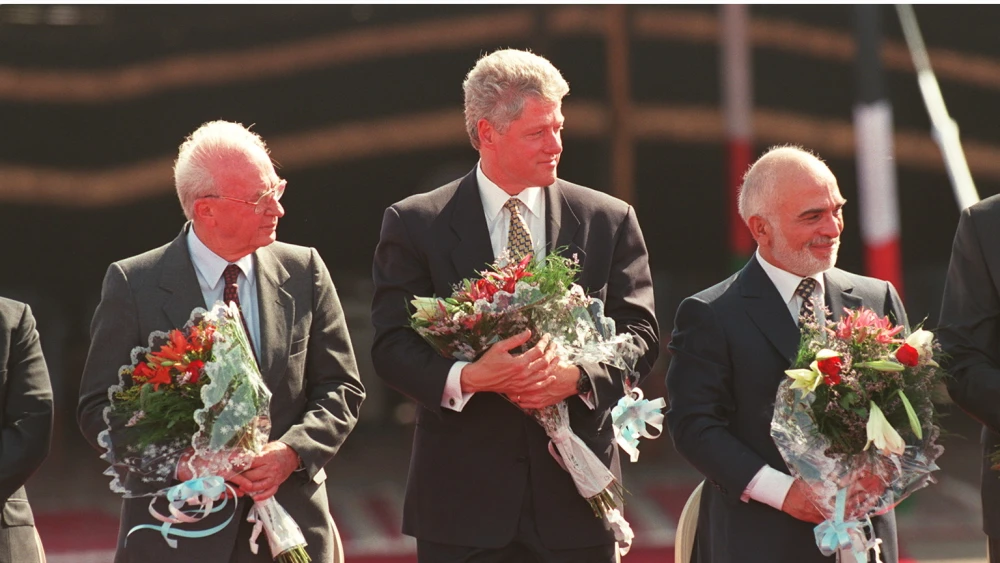
Israel’s Foreign Ministry on Monday marked the 32nd anniversary of the signing of the peace treaty with Jordan, describing the agreement as a cornerstone of regional stability.
“Today, we mark 32 years since the signing of the Israel–Jordan Peace Treaty: a historic milestone that laid the foundation for dialogue and cooperation between our two countries,” read a ministry statement posted to X.
🇯🇴🇮🇱 Today, we mark 32 years since the signing of the Israel–Jordan Peace Treaty: a historic milestone that laid the foundation for dialogue and cooperation between our two countries.
— Israel Foreign Ministry (@IsraelMFA) October 26, 2026
Especially during challenging times, the strategic treaty remains a cornerstone of regional…
“Especially during challenging times, the strategic treaty remains a cornerstone of regional stability and a solid platform for future mutually beneficial initiatives,” it added.
The Oct. 26, 1994 agreement made Jordan the second Arab country to establish diplomatic relations with Israel, following Egypt in 1979.
Relations have nonetheless been strained. Last month, Israel’s Foreign Ministry sharply criticized Jordan’s King Abdullah II after he accused Israel of pursuing expansionist policies during a U.N. General Assembly address, urging countries to consider sanctions, embargoes and diplomatic isolation. The ministry accused Jordan of hypocrisy, citing its 1988 decision to revoke the citizenship of Palestinians living in Judea and Samaria.