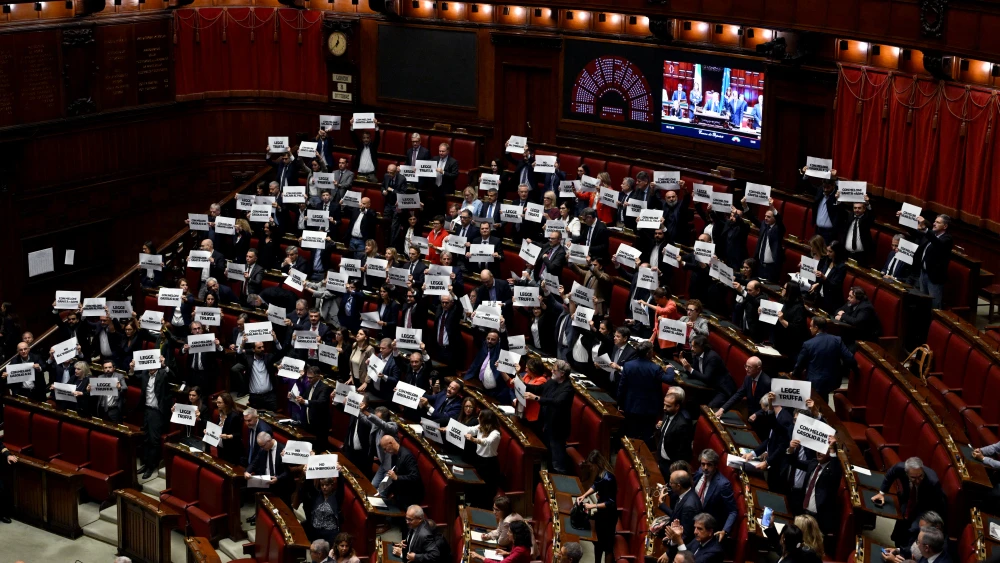

Divorce is difficult, especially after a long and loving marriage. In Italy, we are witnessing a crucial stage in the painful separation between the Jewish people and the political left.
The occasion is the Italian parliament’s approval of legislation combating antisemitism, despite the scandalous opposition of the Democratic Party (PD), the Five Star Movement (M5S) and the Greens and Left Alliance (AVS).
The Chamber of Deputies approved the law on Tuesday by 147 votes to 93, with five abstentions. Several members of the Democratic Party, including veteran politician Piero Fassino, broke with their party’s position by abstaining.
The legislation adopts the working definition of antisemitism developed by the International Holocaust Remembrance Alliance (IHRA), including its examples of contemporary antisemitism. It also establishes measures for monitoring antisemitic incidents, promoting education and strengthening the national response to anti-Jewish hatred.
Yet the left voted against it.
This opposition is a moral outrage in the face of the monstrous wave of antisemitism that has swept the world since the Hamas massacre of Oct. 7, 2023. The supposed defense of freedom of expression has become, in my view, a populist excuse for refusing to confront racist hatred.
Thus, on the question of fighting antisemitism, the divorce between Jews and the left is becoming final.
For some time now, the left has not merely abandoned the fight against antisemitism. Through its obsessive hostility toward Israel and Zionism, it has become one of the driving forces behind its international resurgence.
The dispute over the Italian legislation centers on the IHRA definition, which identifies certain forms of hostility toward Israel as potential expressions of antisemitism. These include applying double standards to the Jewish state and comparing contemporary Israeli policies to those of Nazi Germany.
The definition explicitly recognizes that criticism of Israel comparable to criticism of any other country cannot be regarded as antisemitic.
The new Italian law does not create additional criminal offenses or penalties. Nevertheless, its opponents claim that adopting the IHRA definition could restrict legitimate criticism of Israel.
What, then, are they afraid of?
Perhaps they fear losing the freedom to describe Israel as Nazi Germany, or to repeat the accusation of “genocide” against the Jewish state.
The late historian Robert Wistrich identified the antisemitic phenomenon of Holocaust inversion: portraying Jews, the victims of Nazi extermination, as the perpetrators of an equivalent crime.
This is precisely the inversion that has become so prominent since Oct. 7, when Hamas attempted to carry out another massacre of Jews.
Democratic Party leader Elly Schlein has chosen to pursue the support of the pro-Palestinian movement, apparently believing that figures such as Francesca Albanese can help deliver political consensus.
Perhaps she is right about the electoral calculation. But she must understand two fundamental realities.
There is no Jewish identity without Israel
The first is that there is no Jew without Israel, whatever his or her political opinions.
Judaism is not simply a religion or a nationality. It is Am Yisrael, the people of Israel. The connection between the Jewish people, their sacred texts and their ancestral land is fundamental to their existence.
Writing in Il Riformista, Fassino explained why he could not vote against the antisemitism legislation. He nevertheless insisted on distinguishing between defending Jews and defending Israel, noting that many Jews are pacifists and some belong to the political left.
But that distinction misses the essential point.
There is no Jew anywhere in the world, even among Israel’s fiercest Jewish critics, whose historical, territorial and religious identity can be separated entirely from Israel.
The Jewish people are Judaism.
Antisemitism and anti-Zionism are, in their contemporary political expression, inseparable. Israel is the Jewish people’s defense against both.
The collapse of an old alliance
The second reality is that the idea that Judaism naturally belongs to the left—or that the left is inherently part of Jewish identity—has come to an end.
For generations, the association seemed natural. Jewish universalism, the pursuit of justice and the experience of persecution under Nazism and fascism helped draw many Jews toward socialist and liberal movements.
Figures such as Moses Hess, Ferdinand Lassalle, Eduard Bernstein, Rosa Luxemburg and Leon Trotsky were associated with different strands of socialist thought.
Jewish political history also produced the Bund, a Jewish socialist movement, and Labor Zionism, whose most famous leader was David Ben-Gurion.
These movements differed profoundly, particularly over Zionism, but they reflected the powerful relationship between Jewish intellectual life and the political left.
That relationship was betrayed by communist antisemitism.
The Soviet Union increasingly portrayed Israel as an imperialist and capitalist enemy, while persecuting Jews who sought to preserve their identity or immigrate to the Jewish state.
Natan Sharansky became one of the most prominent symbols of that persecution.
The Jewish principle of tikkun olam, repairing the world, once appeared to offer common ground between Jewish values and progressive politics.
Today, that principle has slipped from the hands of a left that has moved from support for the Palestinian cause to actively obstructing efforts to defend Jews against antisemitism.
To persecute Israel is to persecute the Jewish people.
We see this hostility, in different forms, in the politics of Zohran Mamdani and Abdul El-Sayed in the United States, Pedro Sánchez in Spain, Keir Starmer in Britain, Anthony Albanese in Australia and the left in Italy.
In New York, Mamdani’s approach to policing and the protection of Jewish institutions has raised serious concerns about the security of a community facing an extraordinary proportion of the city’s hate crimes.
In Britain, Starmer has promoted sanctions against Israel. In Spain, Sánchez has called for suspending the European Union’s association agreement with the Jewish state.
And in Italy, the left has voted against legislation designed to strengthen the fight against antisemitism.
Against the Jews.
The political alliance that once seemed so natural has become a confrontation.
It is open warfare.