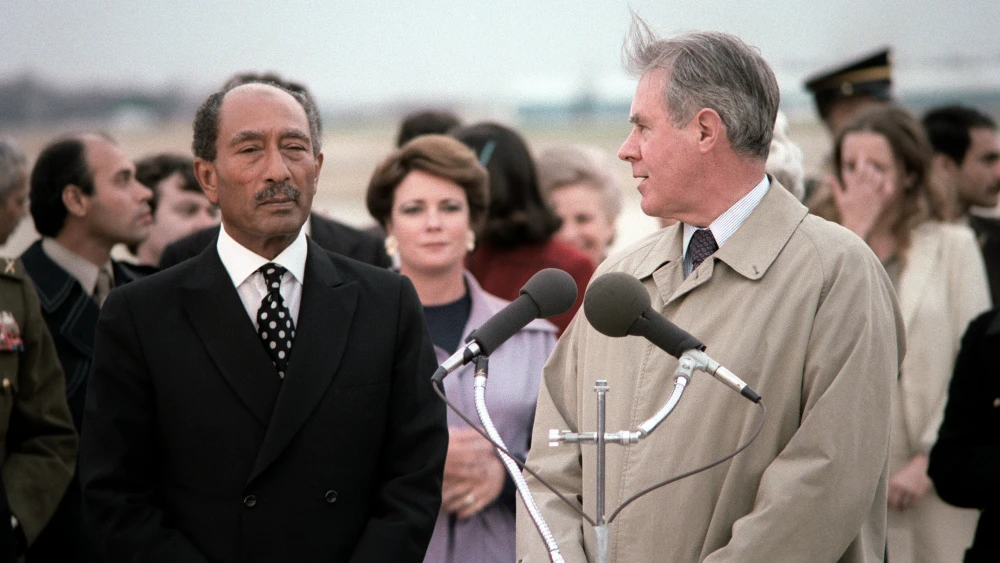
Former Egyptian president Anwar Sadat received a posthumous Congressional Gold Medal, the highest civilian award that the body gives, on Wednesday.
Sadat forged peace with Israel, highlighted by his 1977 visit to Jerusalem, the 1978 Camp David Accords and the 1979 Egypt-Israel peace treaty. Egyptian Islamic Jihad assassinated him in 1981.
Sadat’s vision led to isolation from the Arab world but drew Cairo closer to Washington, and out of the Soviet sphere.
Sadat’s son, Gamal Saat, accepted the award on behalf of his family.
“This honor means today that peace can be achieved at any time. Back then, it seemed impossible. It took strong people to do it, and they did it,” he told JNS.
“I still believe peace can be possible among Israel and all its neighbors,” he said. “We’re all human beings, and everybody deserves to live in peace.”
The ceremony at the U.S. Capitol’s Statuary Hall drew elected officials, diplomats and dignitaries. A U.S. Marine band performed Laylat Hob, meaning “a night of love,” by the late Egyptian singer and composer Mohammed Abdel Wahab.
House Speaker Mike Johnson (R-La.) presented the award.
“We are proud to give it to him,” Johnson told JNS.
The House speaker said that Anwar Sadat “was a great model, and we certainly hope there’s more of that to come.”
“Hopefully, we can expand the Abraham Accords and work on peace in the region,” he said. “It’s important to the whole world, so we’re committed to that.”
Sen. Jim Risch (R-Idaho), chair of the Senate Foreign Relations Committee, told JNS that what Sadat did “was nothing short of miraculous.”
“Most Americans, indeed most people around the world, really don’t have a real appreciation where he put everything on the line in order to establish the peace between Israel and Egypt, which lasts today,” he said.
Risch told JNS that Sadat “gave his life for it eventually, but we need to sincerely appreciate what he did and hopefully inspire someone else to step up and do the same thing to finish the very few problems that are left.”
“They’re big problems, but there’s only a few left,” the senator said. “Somebody needs to step up like that and do the same thing and bring this all to an end.”
Robert Silverman, charge d’affaires for the U.S. embassy in Egypt, attended, as did Massad Boulos, senior adviser to the U.S. president on Arab and Middle Eastern affairs, and Mohamed Hamdy El Mella, Egyptian ambassador to the United States.
Several current and former members of Congress were also on hand.
“Egypt’s stability, diplomacy and unwavering commitment to the cause of Middle East peace have advanced regional security and complemented American interests for decades,” Egyptian Foreign Minister Badr Abdelatty told attendees at the Capitol.
“We will remain a steadfast partner, a credible mediator and a nation that regards peace not as a slogan but as a strategic commitment,” he said.
Abdelatty and Gamal Sadat talked about Egypt backing the Palestinian cause.
During Israel’s war against the Hamas terror organization, Cairo refused to allow free Gazan emigration and fortified its border with the Gaza Strip.
No Israeli government representative attended the ceremony. (JNS sought comment from the Israeli embassy in Washington.)
Daniel S. Mariaschin, who retired recently after decades as CEO of B’nai B’rith International, told JNS at the Capitol that Sadat’s legacy extends to Israel’s recent normalization with its Arab neighbors.
“It was more than an icebreaker when all of this happened at the end of the 1970s,” Mariaschin said.
“We talk today about the Abraham Accords. There would have been probably less of a chance of the Abraham Accords had not President Sadat made the courageous step, along with Menachem Begin, to break that ice and move toward peace between the two countries,” he told JNS.