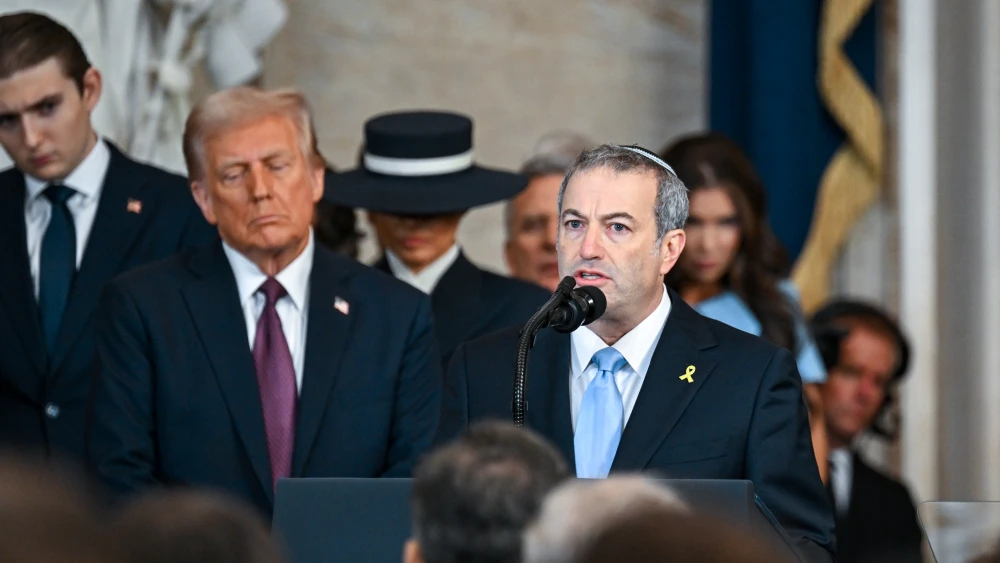
Rabbi Ari Berman, president of Yeshiva University, made history this week after delivering a blessing in the Capitol in Washington before the U.S. House of Representatives.
By serving as guest chaplain in the House on Tuesday, he became the first rabbi to give blessings to both chambers of Congress and at a presidential inauguration, according to Howard Mortman, author of “When Rabbis Bless Congress: The Great American Story of Jewish Prayers on Capitol Hill.
“Rabbis have offered prayers as part of the official proceedings of presidential inaugurations 10 times,” Mortman told JNS.
Berman was the most recent one to do so, in 2025, according to Mortman. Rabbis have served as guest chaplains in the House or Senate 653 times, he said.
The Yeshiva president delivered a prayer in the Senate on Sept. 10, 2025. The one he gave to the House this week amounted, for him, to a “trifecta,” according to Mortman.
“Before Berman, there have been two rabbis who prayed both at a presidential inauguration and also in one chamber of Congress,” Mortman told JNS.
Both delivered Senate prayers before inauguration prayers.
For those keeping score, Berman thus has set three records, according to Mortman.
He was the first rabbi to pray at the presidential inauguration and in both chambers of Congress, the first to pray at an inauguration and in the House of Representatives and the first to deliver an inauguration prayer before subsequently praying in Congress.
Berman told JNS that he knew that he had experienced the “trifecta” before Mortman posted about it on social media.
“It’s so humbling to think about in the 250-year history of America, to be able to deliver a blessing at each of the House, the Senate and at the president’s inauguration,” Berman told JNS.
“It’s really an example of how Jews are a blessing to America,” he said. “God said to Abraham that ‘Through you, all the families on earth will be blessed.’ And when I stand up there, I’m just a representative of the entire Jewish people who, collectively, are a blessing to this country.”
Being able to deliver a blessing to political leaders of the country is both historic and a chance to introduce moral considerations into political discourse, according to the rabbi.
“I call it the ‘diplomacy of prayer,’ which is to frame the current discourse in moral terms,” Berman told JNS. “There’s something that unites us.”
Americans are understandably concerned about issues like economic security, but political and religious leaders must recognize deeper concerns than that.
“The needs are for belonging and shared purpose,” he said.
Berman incorporated references to America’s founding documents, including the Constitution and Federalist Papers, alongside Jewish scripture in his prayers.
In his House prayer, he also drew on James Madison’s description of the House as a body whose members maintain an “intimate sympathy” with their constituents through frequent elections.
Berman believes that political leaders must be especially mindful of the ways that their language affects the country and warned about using hatred for political gain.
“One of the areas of deep concern is how hate has spread and been used by political campaigns,” he told JNS. “We need our politicians to reject the political expediency of hate. Even if it can work for a cycle, ultimately, it’s damaging to America.”
Bringing people together, rather than diminishing others for immediate political gain, is how the country can achieve its greatest purpose, according to the Yeshiva leader.
Standing at the House podium, where some of the country’s most consequential speeches have been delivered, was emotional for him.
“You certainly felt the power emanate from that spot,” he told JNS. “I felt grateful to Hashem, grateful to God, for having the opportunity to voice the blessings, to channel the blessings that the Jewish people feel, and our hopes and aspirations for America.”
Several lawmakers spoke on Berman’s behalf during the proceedings, including his sponsor, Rep. Adriano Espaillat (D-N.Y.), and Reps. Elise Stefanik (R-N.Y.), Virginia Foxx (R-N.C.) and Ritchie Torres (D-N.Y.).
House Speaker Mike Johnson (R-La.) welcomed Berman and the lawmakers into his private chambers, where they took photographs, after the blessing.
Berman told JNS that the response from the Jewish community had been “joy,” “pride” and “purpose.”
“I always get a feeling that I am just a small representative example of everything that the Jewish people have done throughout history,” he said.
Before addressing the House, Berman thought of his grandparents, who fled from Europe to escape the Holocaust and came to the United States.
“Could they have ever imagined, when they came to this country, that their grandson would be a rabbi with the possibilities to be their mouth, to be their voice, for the benefit and goodness of the future of this country?” he said.
Berman also thought of his late father, whose memory he carries with him, and about the future facing younger generations. “Wherever I walk, his face is within my heart,” he said.
A recurring theme in his prayers is the search for meaning and purpose, particularly among young people, for which he thinks there is a present “hunger.”
“There’s a real yearning for something more meaningful and for belonging—to be part of something greater,” he told JNS.
The Yeshiva leader said that fighting Jew-hatred is important, but it can’t be the community’s focus in its identity.
“We cannot define our mission by what we’re against,” he told JNS. “It needs to be what we’re for.”
“We take God’s Torah values, we live and we embody them and we spread them through our interactions, through our words and through our example,” he said.
He hopes that his prayers can contribute, even in a small way, to a greater sense of shared humanity in the country.
“Each individual is created in God’s image,” Berman said. “We serve God most when we serve each other best.”