


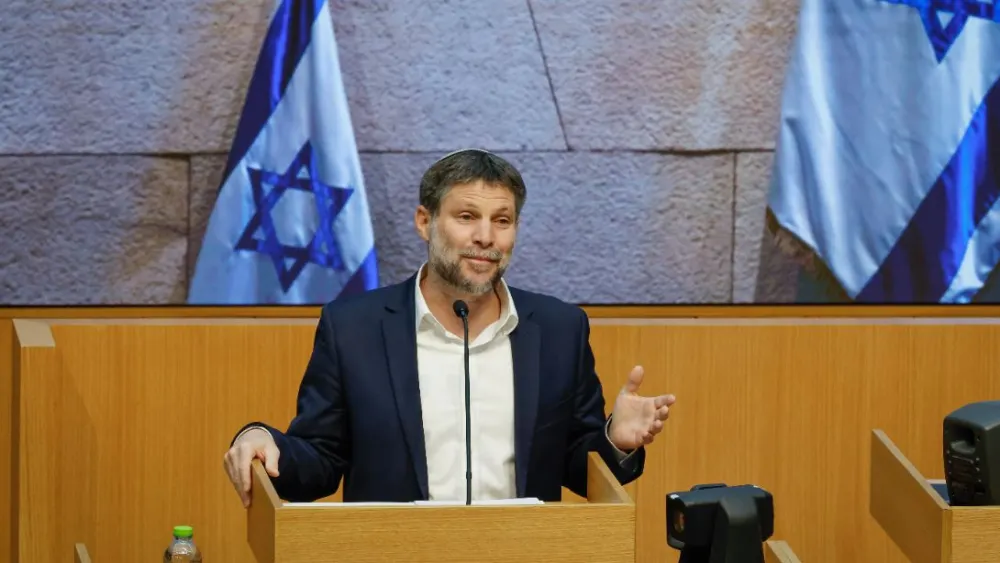
The Knesset plenum, after a marathon session, on Monday passed the state budget for fiscal year 2026 by a vote of 62-55. It is the largest in the state’s history at 850.6 billion shekels (~$270 billion).
“Even in times of war, we care for all the citizens of Israel without exception,” said Finance Minister Bezalel Smotrich.
In a tweet celebrating the budget’s passage, he stressed key achievements, including a 143 billion shekel (~$45 billion) defense budget, an addition about 30 billion shekels ($9.5 billion) to account for “Operation Roaring Lion"; 32 billion shekels (~$10 billion) for the rehabilitation of the “Gaza Envelope” and northern communities; 6 billion shekels (~$2 billion) for IDF reservists, an addition to 20 billion shekels (~$6 billion) allocated since the start of the war; and funding for health services, education, welfare and transportation.
The budget’s passage took place less than 48 hours before a deadline that would have triggered the dissolution of the Knesset and early elections.
Since 1992, no Israeli government in Israel has succeeded in passing a budget in its fourth year. Coalition members said Monday’s vote was proof of the coalition’s stability.
Likud Knesset member Ofir Katz, the coalition whip, said, “Tonight we passed a budget with good news for the State of Israel and its citizens, in security, welfare, education and health, [and] for the sake of the reservists and for the residents of the borders, against all the predictions and commentaries in the studios that said, ‘We won’t get there.’ We are strong.”
Likud MK Hanoch Milwidsky, chairman of the Knesset Finance Committee, said, “I would like to thank all the members of the committee and the Knesset employees who worked quite a lot around this event, and the [committee’s] legal adviser Shlomit Erlich.”
During the vote, ultra-Orthodox members of the coalition, from Shas and United Torah Judaism, raised reservations, leading to the inclusion of hundreds of millions in additional shekels to the budget for their educational institutions. Milwidsky agreed to include the additions as part of the budget.
The opposition criticized the move and the budget as a whole.
Yesh Atid Party Chairman Yair Lapid, head of the opposition, said, “There has never been anything like this in the history of the Knesset. The coalition added hundreds of millions of shekels at the last minute to the ultra-Orthodox parties beyond the budget framework.
“This is a wretched group of thieves who are detached from the people, who are plundering the citizens of Israel. You hope that the public is stupid and doesn’t understand that this is not a budget, it’s a robbery. This is the biggest theft in the history of the state: 6 billion shekels [~$2 billion] in coalition funds that this government is distributing to itself, to corruption and [draft] evasion,” he said.
Labor MK Gilad Kariv said that the voters will hold the government accountable at the ballot box and in the High Court of Justice for approving the additions.



