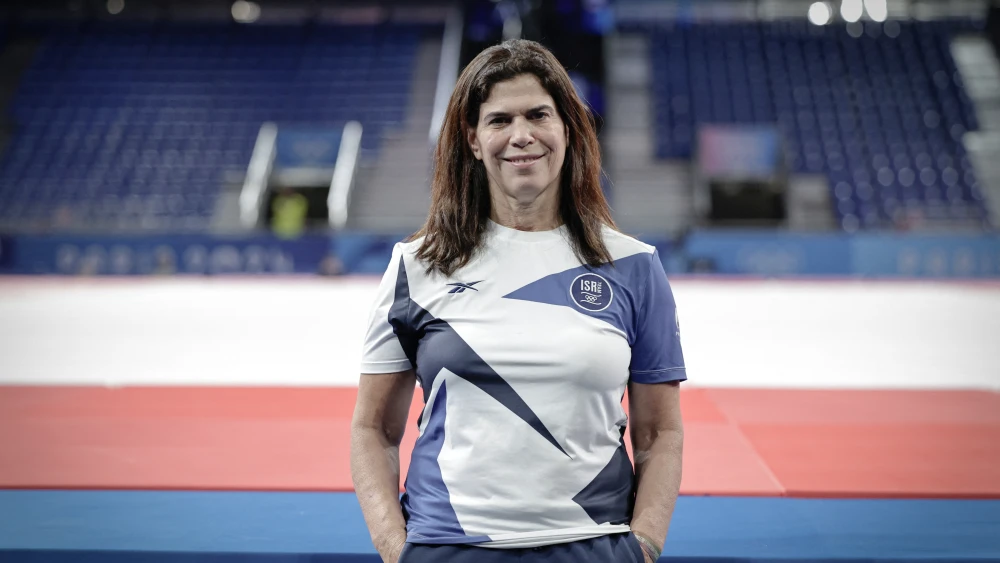
No Israeli athlete had assumed the podium at the Olympic games before Yael Arad won a silver medal in judo at the 1992 summer games in Barcelona.
More than 30 years and 20 Israeli medals later, the legendary judoka, who is now president of Israel’s Olympic Committee, is traveling across the United States to raise support for Israeli athletes ahead of the 2028 Summer Olympics.
“We feel that Israeli athletes are doing much more than sports,” Arad, 59, told JNS on a visit to New York.
She was in town meeting with Jewish leaders and philanthropists to raise money for programs ranging from mental-health support and security to cycling technology and new sailing boats.
“It’s a lot about being ambassadors of the Israeli spirit and the Jewish spirit,” she told JNS.
Arad, who also manages commercial rights of Paramount Global in Israel, said that her Olympic work is all on a volunteer basis. In recent weeks, much of her focus has been on strengthening ties with the U.S. Jewish community ahead of the Los Angeles games.
“This is our opportunity, like we did in Paris and Tokyo, to really show Israel the way we believe it is,” she told JNS, after a series of meetings in Los Angeles, Miami, Chicago and New York.
“That’s why we’re engaging leaders of the Jewish community, philanthropists, businesspeople and organizations,” she said. “Not only to support the journey but to be part of it and cheer us on.”
JNS asked the former Olympian why the Israeli delegation, expected to include 70 athletes in Los Angeles, needs additional fundraising from a volunteer.
The budget which the Israeli government provides is “never enough” for its athletes to reach their highest potential, she told JNS.
“We’re a small country competing against 205 other delegations,” Arad said. “When we come from a country dealing with such difficult times, even with support from the government and in terms of budget, it’s never enough if you really want to maintain your abilities, move the needle and succeed.”
Arad has been part of Israel’s Olympic Committee since 2013 and has served as its president since 2021. Under her leadership, Israeli athletes have recorded some of the strongest Olympic performances in the country’s history, winning seven medals at the 2024 Summer Olympics. It previously won four at the Tokyo games and two in Rio.

U.S. philanthropy is already helping support 11 programs tied to Israel’s Olympic preparation, including in judo, sailing, beach volleyball and cycling, as well as wider investments in innovation, technology and sports science, according to Arad.
A UJA-Federation of New York spokesman told JNS that it is not involved in fundraising for the upcoming Olympics, which it said tends to come from corporate sponsorships. JNS also sought comment from the Jewish Federations of North America.
Philanthropic funding helped purchase four new boats in Los Angeles for Israeli sailing athletes to train ahead 2028, eliminating the need to repeatedly transport equipment from Europe to California, according to Arad.
She told JNS that extra effort has gone into supporting the mental health of athletes after the Hamas-led Oct. 7 terror attacks and after Israeli athletes had to compete in the 2024 Paris Olympics amid anti-Israel protests, online harassment and repeated threats to their safety.
Prior to Oct. 7, Israel’s Olympic Committee had spent years building a mental resilience program that pairs athletes and coaches with psychologists and mental trainers throughout the athletes’ Olympic preparation and competition. Since Oct. 7, funding for the program has increased to about $500,000 annually, according to Arad.
“What started as a normal sports mental-health program became much more important after Oct. 7,” she told JNS. “We realized how important it is to support the coaches and the athletes beyond the sport itself.”
The Israeli delegation was prepared not only for competition at the Paris games but also for protests, media attention and the pressures surrounding the Jewish state’s participation in the games, according to Arad.
Ahead of the competition, French authorities placed Israeli athletes under constant police protection following reported threats against the athletes’ lives, she added.
“The fact that we won seven Olympic medals and 10 Paralympic medals during such a difficult time showed the resilience of these athletes,” she told JNS. “They brought a lot of pride to Israel and to Jewish people around the world.”
Arad said that security for Israeli athletes is coordinated between the International Olympic Committee, local authorities and the Israeli government.

Israel has also brought its own security to the Olympics since the 1972 Munich massacre, when eight Palestinian terrorists infiltrated the Olympic Village, took hostages and murdered 11 Israeli athletes and coaches, Arad told JNS. Two decades later, she said that the silver medal that she won was in honor of those victims.
“I dedicated my Olympic medal and success to the memory of the athletes murdered in Munich,” she told JNS. “For me, it felt like closing a circle in Israeli sports.”
“Today, we always come with our own security, and we cooperate with the organizing committee, local police, federal security and the Israeli government,” she said. “It’s low profile and behind the scenes, but we put a lot of effort into making sure our athletes are safe at every competition and training.”
JNS asked Arad if she believes that the International Olympic Committee does enough to protect Israeli athletes. The organization is “doing everything needed,” she said.
Arad described Israel’s relationship with the committee as “very good cooperation.”
“They are allowing us to have everything we need,” she told JNS. “They listen to all our needs.”
Arad hopes that politics can remain separate from sports.
“You have to look at it in a few layers,” she said. “First, there are the athletes themselves. We work very hard to remind them that they are athletes, and that the Olympic values are about building bridges between people and nations, not political arguments.”
The delegation is certainly “proud” to represent the Jewish state, but the committee teaches athletes to focus on competition, not outside pressures.
“Of course, they feel very strongly about Israel, and they are very proud to represent the country,” Arad told JNS. “It gives them a lot of motivation, especially during these times. But we teach them to keep politics out of their relationships and discussions with others.”
“We want them to focus completely on their sport,” she said. “We believe that by showing the Israeli spirit and the bright side of Israel to the world, they are already making a very strong statement.”
For Arad, politics were never a central part of her athletic career. Raised in Tel Aviv in the 1970s by two journalists, she described herself as a “tomboy” with endless energy.
When one of her three brothers began taking judo lessons, Arad tagged along to what she said was the only judo club in Tel Aviv at the time.
“I was 8-years-old, and from the very first training, I fell in love with judo,” she told JNS. “I loved throwing the boys on their backs, and I was quite talented from the beginning.”
Her coach noticed her abilities early, and by age 9-and-a-half, she was already competing in her first Israeli championship.
“A year later, I became Israeli champion,” Arad said. “From there, training went from twice a week to four times, then six times. I became addicted to judo, to the camaraderie and to the club.”
At 16, she decided she would become “the best in the world.”
She soon began traveling and training internationally, including solo trips to Japan and a stint at a European training camp.
Judo, at the time, was still a relatively small sport in Israel, according to Arad.
“Step by step, more children started joining clubs, but it was only after I won my Olympic medal that judo really became a major sport in Israel,” she told JNS. “It still is today.”
Being Israeli didn’t affect Arad’s experience rising through the ranks of international judo.
“In the sports world, athletes build relationships,” she told JNS. “You compete against each other, but at the same time you travel together, train together and become friends. People judge you by your personality and your abilities.”
“I was an athlete. It was pure sport,” she added. “It was already difficult enough trying to become the best in the world when you came from such a small country, with no real history in the sport. Nobody expected us to win.”
She said becoming an Olympic medalist had long felt like an impossible dream, even to many around her. The moment still feels difficult to put into words to her.
“To know you’re going to the Olympic final, that you’re about to become one of the best in the world, and then to win the first Olympic medal in Israel’s history—it was something incredible,” she told JNS.
“It’s impossible to really describe in words. It was a mixture of my own dream and destiny, together with the pride of being Israeli,” she said.
Arad hopes that the next generation of Israeli athletes will experience that same feeling.
“I want them to fulfill their dreams,” she told JNS. “I believe we can do great things.”