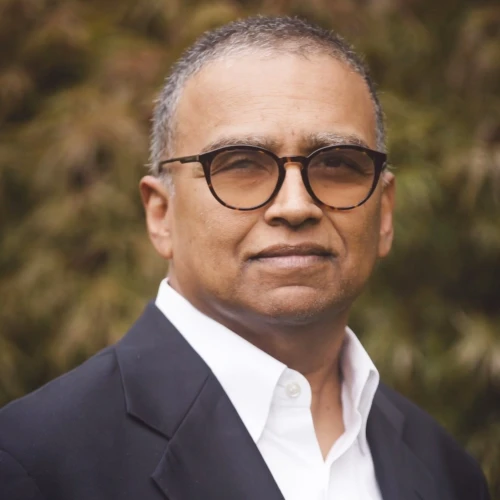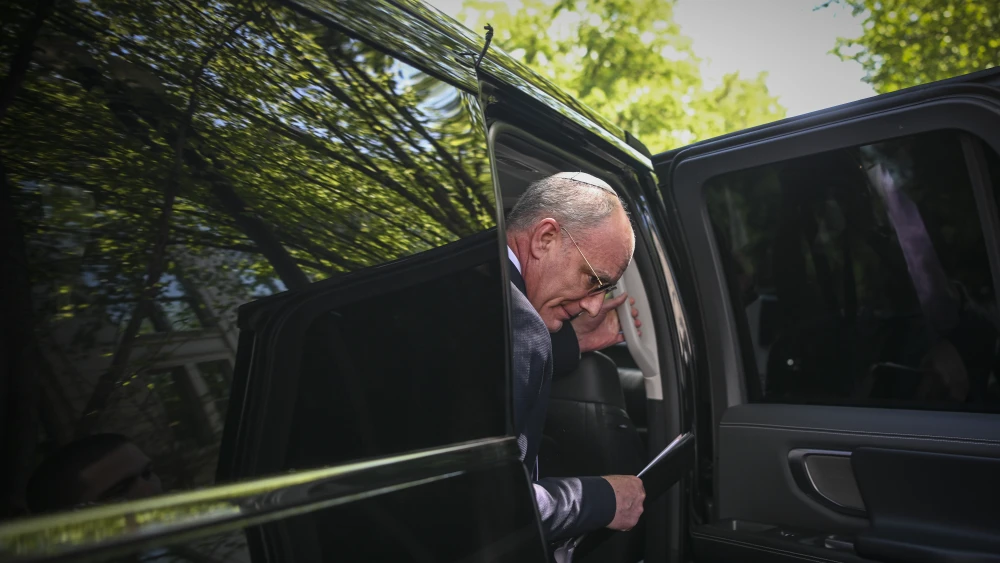
Amid much uncertainty surrounding talks between Israel and Lebanon at the Pentagon and U.S. State Department, where a fifth round of discussion is expected to last three days, Yechiel Leiter, Israeli ambassador to the United States, intends to draw on the “resilience” that he had to develop mourning his son Moshe Leiter, 39, whom Hamas terrorists killed in battle shortly after Oct. 7.
“Talk about resilience. Where do you have a greater example of resilience than Oct. 7? Thousands of young men and women did something that normal human beings don’t do,” Leiter told JNS, of what he said is “the greatest generation of the Jewish people that ever lived.”
Israelis grabbed their personal weapons on Oct. 7 and drove in their cars, after communications had broken down, to confront Hamas terrorists and save the country from an even greater massacre, according to Leiter, who is slated to lead the Israeli delegation in discussions with Lebanon.
“Had they not done that, thousands more of these terrorists would have filtered through and gone on to Kiryat Gat and to Ashkelon to Ashdod. We would have had 12,000 slaughtered, not 1,200,” Leiter told JNS. “Why? Because of the resilience that’s in their DNA.”
Leiter spoke at great length—about 25 minutes—in response to a question JNS posed during an event at the Israeli embassy in Washington last week about a new initiative to instill resilience in pro-Israel college students.

JNS asked the Israeli envoy what he needs to get through the difficult days, including his son’s death and the murder of two Israeli embassy staff members, who intended to get engaged and whom a gunman shot and killed outside an American Jewish Committee event at a Jewish museum in Washington, not far from the White House.
“More than anything else, I needed self-awareness,” Leiter told JNS, of the aftermath of his son’s death.
“Most mornings, I couldn’t peel myself off the floor. Those mornings where you just pull the blanket over your head and don’t want to get out of bed,” he said. “He was my firstborn. He was the love of my life. He was my best friend. He left me six grandchildren.”
“Do you go on living now? Not either take your life or not take your life. Do you go on living with gusto?” he said. “Do you find the challenges of life exciting?”
As he struggled with his new reality in late 2023, Leiter received a phone call from Ron Dermer, a former Israeli ambassador to Washington and confidante of Israeli Prime Minister Benjamin Netanyahu. Dermer told him that Netanyahu was about to call him, Leiter told JNS.
The envoy said that Netanyahu caught him off guard when he said, “I want you to go to Washington.”
“What do you want me to go to Washington for?” Leiter asked the prime minister.

Netanyahu told him that it was a job offer.
“I didn’t respond, and I guess he sensed my hesitation,” Leiter told JNS. “Then he said, ‘What would your son say?’ And it was in that one second—it was in that one moment, that I had to make the choice. It wasn’t between going to Washington or not going to Washington.”
The choice was whether to press forward or allow the grief to overcome him.
“I knew that if I’d say, ‘Give me some time to think about it,’ I might lose the battle,” Leiter said. He told JNs that Moshe would have told him to rise above and be resilient.
So he took the job, and the work has been nonstop, often involving calls from Netanyahu late at night in Washington, just as Leiter was preparing to finally go to sleep and as the prime minister was waking up in Jerusalem
“It’s a kind of intensity that you just can’t imagine. Two wars, and we’re still in the middle of the second one,” he told JNS. “Negotiations in and around the wars, preparation for the wars, accusations of starvation and ‘genocide’ that I had to confront, a very partisan atmosphere in Washington between Democrats and Republicans that I have to finesse.”

“We had two of our employees murdered, which sent the whole 150 employees in the embassy into a kind of depression,” Leiter said.
He goes back in his head often to that conversation with Netanyahu about what Moshe would say.
“You can tire and give up and detach, or you can carry on and make a difference,” he told JNS. “I’m not going to bring him back by sulking and by being sad and by crying, even though I’m very often moved to that.”
“Certainly, when I hear a certain musical tune or when I get pictures and his kids call me—you’ve got to take that difficult moment and craft it into something positive and creative and meaningful,” he said.
Leiter told JNS that a posture of resiliency fits into the larger story of the Jewish people, including now, when Israel’s economy is soaring, and its fertility rates are the highest among developed countries, despite—or possibly because of—the strife it has faced over the past few years.

That’s what he meant when he told JNS that the “greatest generation of the Jewish people that ever lived” took up their personal weapons to prevent the Oct. 7 attacks from claiming more innocent lives.
On Jan. 27, 2025, he took over as Israeli ambassador. Netanyahu was scheduled to meet with U.S. President Donald Trump at the White House the following week, and Leiter was in a rush to present his credentials so that he could attend the meeting, he told JNS.
His staff prepared the letter for him to present to U.S. Secretary of State Marco Rubio. Though he told JNS his staff is “the greatest in Washington” and it brought him a “great letter,” he decided it wasn’t his voice.
“I sat back and I thought to myself, ‘How do I open this letter to the secretary of state? This kid who grew up in Scranton, Pa., whose father came to the United States in 1938 as a refugee from Hitler, with a quarter in one pocket and a piece of crusty bread in his other pocket? And now I’m going to go into the Oval Office to sit with the president of the United States. What’s the first sentence I’ve got to write in this letter?” Leiter told JNS.
He said it then hit him what to write in that momentous letter.
“I represent the people indigenous to the land of Israel. Period,” he told JNS that he wrote in the letter.

“Because everything that we’re facing now is the result of the claim that we are colonizers, that we are strangers to the land, that we are conquistadors, that we are settlers on somebody else’s land,” he told JNS. “We are indigenous to the land of Israel.”
“There’s a place for others” and “we’re perfectly happy and willing and wanting to make peace with others in the land,” he told JNS. But every conversation must start with the understanding that “this is ours, and now let’s discuss the rest,” Leiter said.
“We are indigenous to the land of Israel, and that also demands a certain degree of resilience in order to carry that message,” he said.