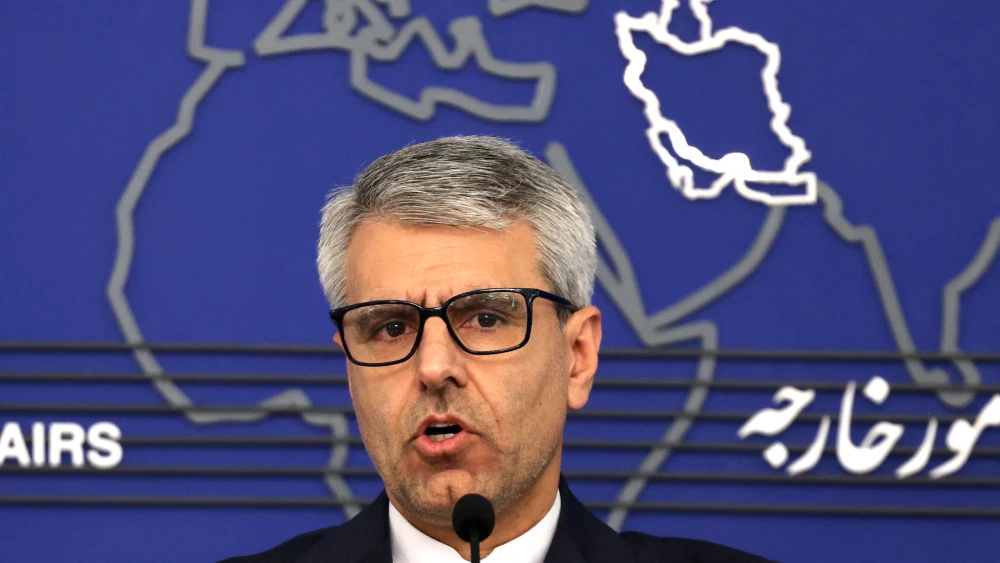
The spokesman for the Islamic Republic’s Foreign Ministry declared victory over the United States and Israel on Wednesday after President Donald Trump signed the memorandum of understanding with Tehran.
“Iran has defeated two nuclear powers that some other countries were also supporting,” Esmaeil Baghaei told reporters in Tehran, according to the Tasnim News Agency, a semi-official outlet associated with the Islamic Revolutionary Guard Corps. He added, “It is not a slogan, but we are truly a superpower.”
The comments were posted on the Iranian Foreign Ministry’s official social media accounts on Thursday morning but were deleted shortly afterward.
Baghaei spoke as Trump signed the deal with the Iranian regime on the sidelines of the June 15-17 G7 summit in Évian-les-Bains, France.
“When the memorandum of understanding is signed by the presidents of the two countries, violating it will be more costly,” the Iranian spokesperson said in his remarks.
Baghaei stressed that the Islamic Republic views Israeli attacks on its Hezbollah terrorist proxy in Lebanon as a violation of the agreement.
“We do not separate America and the Zionist regime of Israel, but their differences in methods and approaches are clearly evident,” Baghaei stated.
Tehran “will not leave its friends alone under any circumstances,” he stressed. “The ceasefire and end of the war in Lebanon were and are as important to us as Iran.”
The upcoming 60 days of negotiations outlined in the MoU will focus “exclusively on the nuclear issue and the lifting of sanctions,” the spokesman continued.
“Iran’s missiles are only for firing, not for negotiation—Iran’s defense capability will not be discussed in any process or with any party,” said Baghaei, in reference to the regime’s ballistic missile arsenal, which was used to attack Israel, Gulf states and U.S. assets in the region during the war. “Our missiles don’t like anyone talking about them at all,” he added.
Baghaei also dismissed as “unacceptable” suggestions that Iran transfer its enriched uranium abroad.
“We have said from the beginning that enriched nuclear materials will not be transferred outside Iran. Dilution of enriched materials is not a new option,” he said.
Regarding the management of the Strait of Hormuz, Baghaei said Iran would be charging “a fee in exchange for services” in the vital shipping lane, despite the MoA barring Tehran from charging a toll or fee.
“This mechanism and arrangements for managing the Strait of Hormuz are being formulated,” he said, declaring that “safe navigation will be ensured by maintaining the sovereignty and sovereignty of the Islamic Republic of Iran over the Strait of Hormuz.”
Baghaei claimed that Iran “did not negotiate only about the memorandum of understanding” but held separate talks with Washington about the release of Tehran’s frozen assets, the lifting of oil sanctions and post-war reconstruction.
“The lifting of the Iranian oil sanctions begins today and continues during the negotiations,” he reiterated. “Iran must be able to sell its oil, not have problems with transportation and insurance, and must receive benefits from oil sales.
According to him, U.S. negotiators expressed Trump’s commitment to removing “all obstacles” during “detailed negotiations” held over the past weeks.
“We have bitter experiences of America’s breach of promise in the past years in the field of releasing the assets belonging to the Iranian nation; all these experiences were taken into consideration in the negotiations to ensure that, this time, America fulfills its commitment,” Baghaei said.
‘Diplomacy of strength’
In separate remarks on Wednesday, Iranian Parliament Speaker Mohammad Bagher Ghalibaf, who headed Tehran’s negotiating team, said he pursued a “diplomacy of strength” in the talks with Washington.
“The difference between the current negotiations and previous periods is that today this banner of battlefield victory, which both enemies and friends have acknowledged, serves as the backing for negotiations,” he told the regime’s Press TV outlet.
He continued, “Every war that ends in victory, if it does not ultimately lead to a legal and political document and those victories are not recorded, will bring no benefit.”
Ghalibaf said the Islamic Republic would not consider any final agreement trustworthy, even if it were endorsed by a U.N. Security Council resolution, adding that Iran’s security ultimately depended on its military might.
He stressed that Iran would implement its obligations only if the U.S. fulfilled its commitments, saying the memorandum was based on the principle of “action in return for action.”
Shehbaz Sharif, prime minister of Pakistan, announced earlier on Wednesday that he was “honored to announce that the historic ‘Islamabad Memorandum of Understanding’ has been electronically signed today between the United States of America and the Islamic Republic of Iran.
“The memorandum has been signed by honorable presidents of both the countries and also endorsed by me as the mediator,” he stated. “The signing of this agreement at the highest level of the respective governments demonstrates the commitment of both sides to a diplomatic resolution of the conflict.” He added that the agreement “shall enter into force with immediate effect and as a first step, Islamic Republic of Iran will instantly reopen the Strait of Hormuz and the United States of America will immediately lift the naval blockade.”
Trump told reporters at the G7 summit on Wednesday that the interim accord was not final, and that he could order renewed military action if Tehran did not “behave.”
“It’s a memorandum of understanding. And if I don’t like it, we’ll go back to shooting at them, dropping bombs on their head,” the president said. “If I don’t like it, if they don’t behave, we’ll go right back to dropping bombs right smack in the middle of their head.”