“Whatever the pressure,” Britain will not contribute to the American effort to blockade the Strait of Hormuz announced by U.S. President Donald Trump, Prime Minister Keir Starmer said on Monday.
“We’re not supporting the blockade,” he told BBC Radio 5 Live as reported by Reuters. “It is, in my view, vital that we get the strait open and fully open, and that’s where we’ve put all of our efforts in the last few weeks and we’ll continue to do so.”
It’s the latest rupture between Britain and the U.S. as Starmer has resisted participating or lending meaningful support to the U.S.-Israel alliance working to defeat the Islamic Republic’s efforts to control the Middle East.
In a speech on March 1, shortly after the current hostilities broke out, Starmer said that his country would not take part in military operations, initially refusing to allow U.S. planes to use Britain’s strategically located Diego Garcia Island airbase in the Indian Ocean.
Trump voiced his disapproval from the Oval Office on March 3. “This is not Winston Churchill that we’re dealing with,” the American president said. “I’m not happy with the U.K.”
On Monday, Starmer reiterated his country’s determination not to take part in the conflict. “My decision has been very clearly that whatever the pressure, and there’s been some considerable pressure, we’re not getting dragged into the war,” he said.
Britain will instead participate with France and other countries to find a diplomatic way to open the strait after the shooting stops. “This week the U.K. and France will co-host a summit to advance work on a coordinated, independent, multinational plan to safeguard international shipping when the conflict ends,” Starmer posted on X on Monday.
He said more than 40 nations will participate.
French President Emmanuel Macron posted to X that the conference, set for the coming days, will work toward a “peaceful multinational mission aimed at restoring freedom of navigation in the strait.”
He described it as a “strictly defensive mission, separate from the warring parties to the conflict,” and “intended to be deployed as soon as circumstances permit.”
Disappointed with NATO
On Sunday, Trump told press that he was “extremely disappointed” with NATO countries. “They weren’t there for us. We pay trillions of dollars for NATO, and they weren’t there for us.”
While NATO countries are now stepping up to assist the U.S., Trump described the effort as too late. “Now they want to come up, but there’s no real threat anymore,” he said, referring to a recent visit to the U.S. by NATO Secretary General Mark Rutte, who was attempting to shore up the alliance. “Allies are doing everything the United States is asking,” Rutte had said.
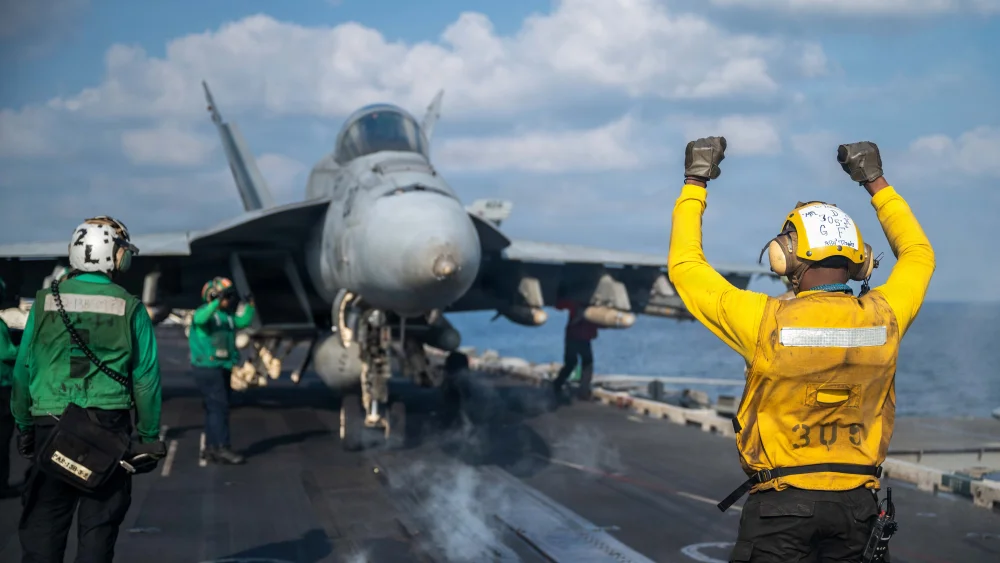
U.S. Central Command said on Sunday that its forces will begin blockading all maritime traffic entering or leaving Iranian ports on Monday, in line with the president’s directive.
Following the collapse of marathon negotiations with Iran aimed at ending almost six weeks of war, Trump posted to Truth Social on Sunday: “Effective immediately, the United States Navy, the Finest in the World, will begin the process of BLOCKADING any and all Ships trying to enter, or leave, the Strait of Hormuz. … Any Iranian who fires at us, or at peaceful vessels, will be BLOWN TO HELL.”
CENTCOM’s operation will cover ports along Iran’s Arabian Gulf and Gulf of Oman coasts and apply to vessels of all nations. Freedom of navigation for ships transiting the Strait of Hormuz to non-Iranian ports will not be affected.
On Saturday, CENTCOM announced that U.S. forces had begun preparing to clear mines from the Strait of Hormuz, with the guided-missile destroyers USS Frank E. Peterson and USS Michael Murphy operating in the area.
Adm. Brad Cooper, CENTCOM commander, said the mission aims to establish a safe passage to “encourage the free flow of commerce.”