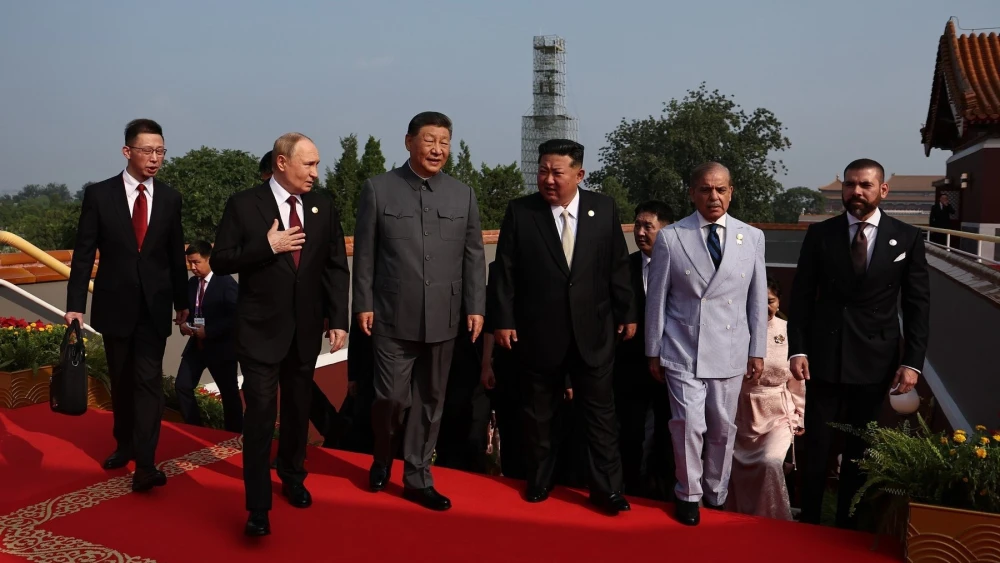

North Korea is learning modern warfare on Ukrainian ground—and Russia is paying the tuition.
In 1240, Mongol warriors led by Genghis Khan’s grandson Batu besieged and destroyed Kyiv. They came for plunder. Almost eight centuries later, another dynastic dictator is sending soldiers to fight over the same ground. He has come for something more valuable: tuition and technology.
On Sunday, U.S. President Donald Trump posted on Truth Social that, based on his “very good relationship with Kim Jong-un,” he had instructed U.S Secretary of Defense Pete Hegseth to substantially reduce joint military exercises with South Korea. North Korea, the president wrote, has been “unthreatening and respectful.”
I’m going to quarrel with that assessment. But first, let me remind you how we got where we now are. On Feb. 24, 2022, Russian President Vladimir Putin ordered his tanks toward Kyiv, expecting a blitzkrieg conquest. His mission was not accomplished.
A year and a half later, North Korea’s leader began sending Russia’s leader millions of rounds of artillery shells and, subsequently, ballistic missiles and other weapons. And by late 2024, roughly 14,000 North Korean troops deployed to Russia, where they fought the Ukrainian incursion into Kursk province.
Ukrainian President Volodymyr Zelenskyy said this month that he has reason to believe that an additional 30,000 to 50,000 North Koreans will soon be on Russian territory.
No less threatening: Ukrainian intelligence says a roughly 90-man North Korean missile unit is deploying to Russia’s 112th Missile Brigade in Voronezh province, which borders Ukraine. Pyongyang is no longer merely supplying Moscow with missiles; it is now deploying missile personnel alongside them.
Thousands of North Korean soldiers have been killed or wounded. But those who survive go home combat-hardened—experienced in a modern, drone-saturated war against a Western-backed military. Such lessons cannot be purchased or simulated. And Kim Jong-un is collecting additional benefits: Russian help with satellite reconnaissance, air defenses and other advanced military technology.
North Korea already possesses about 60 nuclear weapons, thanks to the failure of U.S. diplomacy. The 1994 Agreed Framework and the 2005 to 2007 Six-Party Agreements were heavy on carrots, light on sticks. And Pyongyang cheated.
These missiles can reach not just Seoul, Tokyo, Guam and Hawaii, but also the continental United States. What remains uncertain is not their range but their reliability.
Iranian theocrats built the Shahed drones. Russian neo-imperialists perfected them on Ukrainian men, women and children. Now, they’re being fired at Americans.
From where else does Putin’s help come? Since 2022, the Islamic Republic of Iran has supplied him with hundreds of thousands of artillery shells, Shahed drones and the blueprints to build those drones at home.
According to Ukrainian intelligence, he has reciprocated with satellite imagery and targeting information on American warships, aircraft and bases: 24 Russian satellite surveys across 11 Middle Eastern countries in March 2026 alone, followed within days by Iranian strikes on those sites.
Then the loop closed: Last month, Western intelligence officials said that Iran had used Russian-enhanced versions of the Shahed against American targets in the Persian Gulf.
Restated: Iranian theocrats built the Shahed drones. Russian neo-imperialists perfected them on Ukrainian men, women and children. Now, they’re being fired at Americans.
Beijing is assisting, too—backstopping the Russian economy with increased trade and the provision of components for Russia’s missiles, drones and other weapons.
And Iran is believed to be weeks away from receiving the first of 300 to 400 Chinese shoulder-fired air-defense systems, designed to bring down low-flying American aircraft and drones.
Trump said Xi Jinping had personally assured him that China would not participate in the war on Tehran’s behalf. So much for such assurances.
By the way: The two missiles Tehran fired at the U.S.-U.K. base at Diego Garcia in March (neither of which hit) were Iranian Khorramshahrs, derived from North Korea’s Musudan, itself descended from a Soviet submarine-launched missile.
The evidence presented above leads to this conclusion: The Ukrainians are on the front lines against the anti-American Russian regime that threatens Europe, reinforced by the anti-American North Korean regime whose troops now have boots on the ground in Europe, both backed by the anti-American regimes ruling China and Iran.
Should the U.S. fully support an ally defending itself from this “Axis of Aggressors”—the title of a new Foundation for Defense of Democracies book documenting more than 600 instances of cooperation among the four regimes since 2019? I think the question answers itself.
Some serious analysts disagree. They argue that interceptor production is finite and that every Patriot round spent in Europe is not stockpiled in the Pacific against a Chinese move on Taiwan, a self-governing democracy whose economy is essential to ours.
But you cannot husband munitions against four regimes by capitulating to three. Ukraine is where the axis does its homework. North Korean officers are learning drone warfare to bring home to the divided peninsula. Moscow is passing Beijing combat lessons the People’s Liberation Army needs before any move on Taiwan.
Consider how differently World War II might have gone had President Franklin Roosevelt concluded that America could defeat the Germans or the Japanese, but not both. Instead, he prioritized Europe while holding the line in the Pacific—because a sequence is not a surrender, and he never conceded a theater.
Reducing exercises with Seoul while North Korean crews gain combat experience in Voronezh will not help Trump bolster deterrence—not with Kim Jong-un and not with his axis partners.
I’ll conclude with one more historical note. The Mongol Empire once stretched from Korea to Eastern Europe. Ukraine rejoined Europe by the mid-14th century; Russia remained a vassal of the Golden Horde a hundred years longer.
Today, Ukrainians are fighting so as not to become vassals of the wannabe czar in the Kremlin. Americans face a narrower question: whether we will treat one hostile coalition as one wicked problem, or as four separate and intractable conflicts.
Originally published by “The Washington Times.”