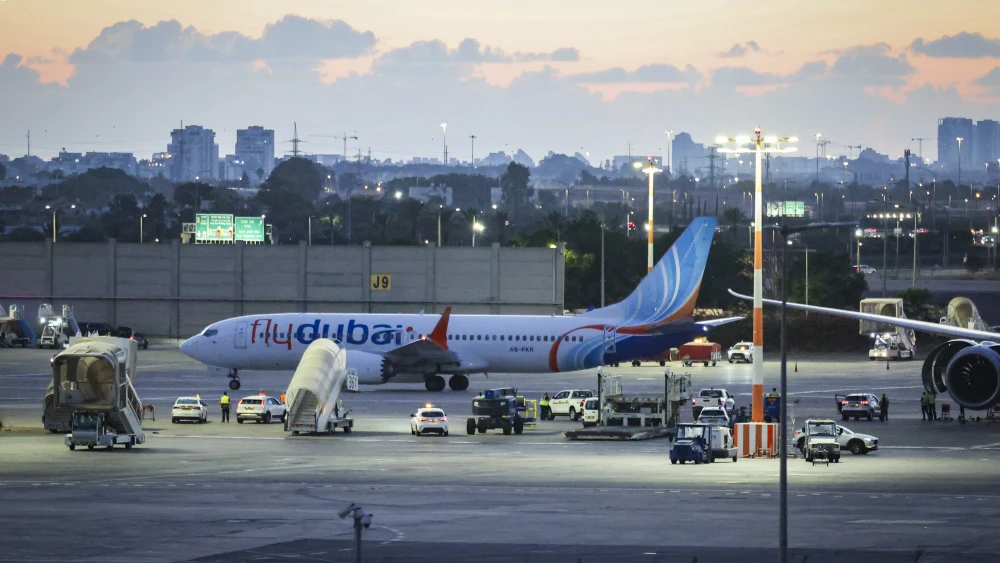

After the attack aboard a flydubai flight from Dubai to Tel Aviv on Sept. 30 was thwarted by Israeli passengers, accusations that Israel had staged the incident quickly began circulating on social media.
The next day, Roya News, part of a private television group in Jordan, brought those suspicions to its English-language website. The article offered no evidence of an Israeli-staged attack. Instead, it assembled commentators’ doubts about the cockpit door, the presence of additional pilots and the incident’s political timing.
Roya promoted the content on its verified Facebook account. As of Oct. 2, the video has accumulated 165,000 views. Speculation had moved from social media to a news outlet and returned to social media carrying the outlet’s authority.
The Roya article questioned whether a severely wounded captain could have opened the cockpit door to allow passengers and crew to intervene. It also presented the presence of two off-duty pilots as an improbable coincidence. These are questions a newsroom can investigate. Yet the article reported the doubts without supplying the reporting needed to assess them. Instead of investigating, the article framed online conspiracy theorists as legitimate watchdogs scrutinizing official accounts.
The distinction matters. Asking a question does not establish that the account being questioned is false. Finding a detail surprising does not make that detail evidence of a conspiracy. A newsroom’s responsibility is to test such suspicions, rather than merely collecting them under a headline suggesting an orchestrated deception.
Roya subsequently published a Reuters report on the flight captain’s account of the incident, during which he was brutally assaulted in the plane’s cockpit by his co-pilot. Speaking to Indian Prime Minister Narendra Modi from hospital, Smit Machchhar said he had opened the cockpit door while under attack. Roya has promoted that report on social media.
This must be acknowledged, but the earlier article remains available without incorporating the captain’s testimony, even though it directly addresses one of the doubts the first article amplified. Publishing the evidence separately does not ensure that those who encountered the conspiracy theories will see it.
Political convictions, audience expectations and competition for attention can all make accusations easier to publish.
The allegation has found another route into journalism: On Oct. 2, Turkey’s Anadolu news agency published a report relaying an accusation from Press TV, Iran’s state broadcaster, that Israeli Prime Minister Benjamin Netanyahu planned the attack to blame Iran and draw the United States into further war.
Anadolu disclosed that the Press TV report relied on an anonymous source and presents no supporting evidence. Attribution tells readers who made an allegation; it does not verify it. That qualification matters, but so does the editorial decision to give the accusation a headline and a distribution channel.
The motives behind the cockpit attack remain under investigation. Recent reports indicate that the goal was a mass casualty attack on Ben Gurion Airport. Nonetheless, while the current uncertainty justifies some caution, it is not evidence that Israel staged the incident. Responsible skepticism requires the same demand for proof from those proposing an alternative explanation as from those presenting the initial account.
False claims on social media can reach millions. Published by the press, they acquire something more: the presumption that professional reporting and editorial scrutiny stand behind them. Readers turn to news organizations precisely because they expect those safeguards.
The relationship between journalism and social media is a circuit. A claim starts online, enters a news report and returns online with a powerful endorsement. Other outlets may then cite or reproduce that coverage, creating an appearance of corroboration without adding independent evidence.
These outlets differ in ownership, editorial practices and relationships with political power. The common issue is how publication lends authority to claims that have not been adequately verified.
An earlier episode involving the BBC and major Brazilian media outlets illustrates that risk.
In May 2025, United Nations humanitarian chief Tom Fletcher told the BBC that 14,000 babies could die in Gaza within 48 hours. The underlying report projected approximately 14,100 cases of severe acute malnutrition among children aged 6 to 59 months over a year. It did not project 14,000 deaths.
Brazilian outlets including Folha de S.Paulo, Terra and television network Band circulated Fletcher’s warning through BBC News Brasil and Estadão Conteúdo reports. A subsequent Estadão Conteúdo report correcting Fletcher’s claims explained the malnutrition projection but retained passages describing possible deaths over a year. Even the attempted clarification carried part of the distortion.
This lesson applies to the flydubai coverage: Someone who sees an allegation shared by a news outlet on Facebook may never read the subsequent report. Correcting or supplementing the record is necessary; reaching the audience that received the earlier account is another responsibility.
Political convictions, audience expectations and competition for attention can all make accusations easier to publish. No coordinated campaign is necessary. When suspicions against Israel face insufficient scrutiny, journalism risks promoting a narrative it should be critically examining.
The media often demands that various parties take responsibility for spreading misinformation. It must hold itself to the same standard, giving corrections prominence and distribution comparable to the original error. People turn to journalism to learn what happened. When editorial conviction replaces verification, the press betrays the trust that justifies its existence.