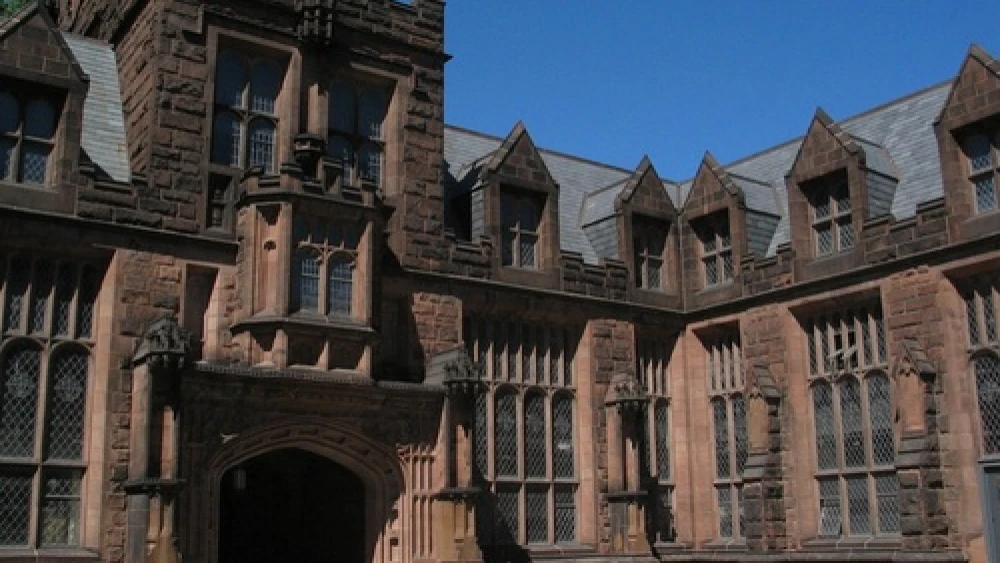

The news broke this week that an upcoming Princeton University humanities course will suggest a book that claims that Israel harvests Palestinian organs. The 2017 book, “The Right to Maim: Debility, Capacity, Disability,” by Jasbir Puar, has drawn charges of antisemitic blood libels and is part of a sample reading list for the class.
According to the Princeton site, the class, “The Healing Humanities: Decolonizing Trauma Studies from the Global South,” is part of a “new project to help illuminate how the humanities itself can offer new paths to understanding trauma and healing.”
In that spirit of improving understanding, I’d like to offer a suggestion to Princeton President Christopher Eisgruber regarding the use of that book.
In a cover story I wrote about Eisgruber several years ago in the Jewish Journal, I referred to a 2019 address he gave titled, “Contested Civility: Free Speech and Inclusivity on Campus.” In that address, Eisgruber argued, among other things, that universities must be viewed as “truth-seeking institutions.”
I feel the same way about the book that claims that Israel harvests Palestinian organs—it must be held to the same truth-seeking standard. The crucial question must be: Where is the truth and where are the lies?
Arsen Ostrovsky, CEO of the International Legal Forum, shared a letter with JNS that he penned to Eisgruber and Behrooz Ghamari-Tabrizi, chair of the university’s Near Eastern studies department, in which he wrote:
“The book in question contains a number of very serious and defamatory accusations, primarily that the Israel Defense Forces is harvesting the organs of Palestinians, including by ‘shooting to maim, rather than to kill,’ in order to create a ‘mass debilitation of Palestinian bodies.’ This charge is not only demonstrably false, but a modern-day antisemitic blood libel.”
This, then, is the moment of truth for Eisgruber and Princeton: It must immediately investigate the charge that Puar’s book is tainted by libelous and dangerous propaganda, which is the opposite of the search for truth. If its findings are in line with Ostrovsky’s, it would have two choices: either use the book to teach the danger of reckless propaganda masquerading as scholarship, or remove the book from the suggested reading list.
The investigation is likely to agree with Ostrovsky.
In his book “Israel Denial,” scholar Cary Nelson asserts that Puar’s work “suffers from basic flaws in the principles and practices that guide it—her methodology, her standards of evidence, her style of argumentation, her lack of interest in opposing views, her penchant for drawing conclusions unsupported by facts, and her willingness to let political convictions guide every aspect of her anti-Zionist project.”
If Nelson’s description is accurate, he is describing a disregard for the truth that is not worthy of a truth-seeking institution. For its own sake and to protect its reputation, President Eisgruber must urgently get to the bottom of this.
Originally published by The Jewish Journal.