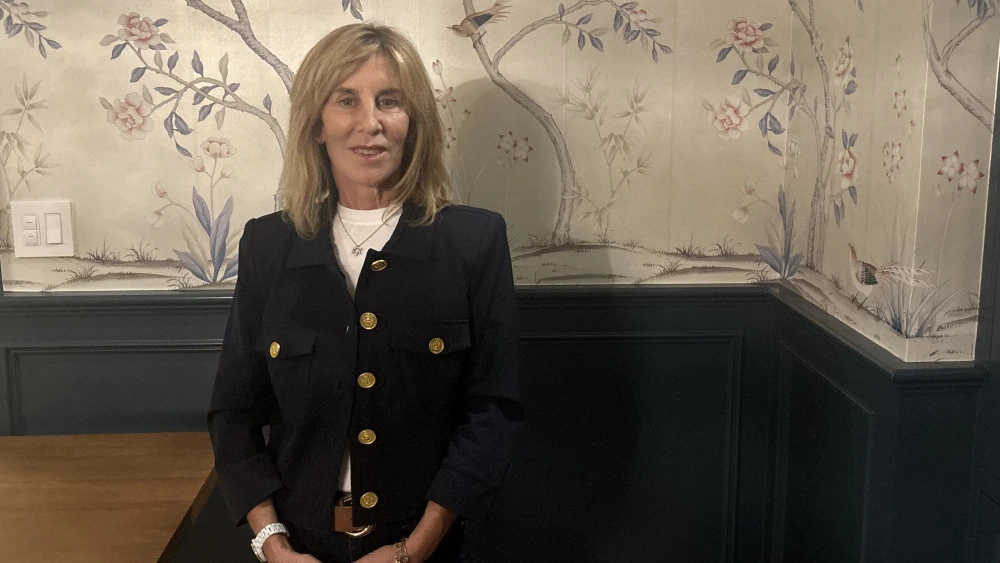
Despite a famous last name, Nancy Spielberg’s 2025 documentary “A Letter to David,” about a former Israeli hostage, was canceled at film festivals, the president of Playmount Productions told JNS.
Spielberg, whose brother is famed filmmaker Steven Spielberg, thinks that anyone from Israel is being blocked and boycotted in the industry.
The documentary that she helped produce “was not even a film that showed any violent footage at all,” but “we were invited and then uninvited” from festivals, she told JNS.
Spielberg was one of four panelists, all of whom spoke to JNS, at a “creative community for peace” event attended by about 150 people at a private residence in Encino, Calif., on Monday evening.
Panelists discussed the rise of anti-Israel documentaries, like “NAZA,” and the challenges that Jewish and Israeli documentaries face.
One of the stars of Spielberg’s documentary is David Cunio. Hamas terrorists kidnapped him and his wife, three-year-old twins, younger brother and eight other relatives on Oct. 7.
David and his twin brother, Eitan Cunio, had played characters previously in a fictional film about a kidnapping.
“He and his brother were the last ones out,” Spielberg told JNS of Cunio and his brother being abducted to Gaza. “This family was torn apart. These two brothers had said they would never separate, so it was a story about humanity.”
“It still got canceled,” Spielberg told JNS.
Jewish and Israeli documentaries face “tremendous challenges,” she said. “We have no option but to fight back.”
“We’ll find our audiences, even though it’s tough right now,” Spielberg told JNS.
Roni Aboulafia, chair of the Israeli Documentary Forum, told JNS that Israeli documentary filmmakers have faced a “cultural boycott” in recent years, making it “very difficult” for them to show their work overseas.
“There’s pressure on film festivals, on broadcasters and all kinds of venues to boycott Israeli films, even Israeli films that are critical of Israel,” she told JNS.
Aboulafia hopes to form “alternative pathways and mechanisms for our films to get out to the world” and to “get the audience back.”
‘People want to see stuff that’s anti-Israel’
Lawrence Bender, who produced “Inglourious Basterds” and “Pulp Fiction,” told JNS that anti-Israel films reflect the “anti-Jew tsunami” that Jews and Israelis face.
“In general, if you’re a liberal, you attach to antisemitism now, because somehow, the Jews go between being the people who are the underdog to people who are the people that rule everything,” he said. “They go back-and-forth. There’s never one thing or the other.”
“Right now we’re the ‘colonizers,’” he told JNS. “So anyone who’s a lefty and a liberal thinks that Jews are the colonizers, that Israelis are the colonizers, so they’re going to immediately bash them.”
Bender thinks that there isn’t the “same desire for people to see truth” in pro-Israel films.
“People just want to see stuff that’s anti-Israel,” he told JNS. “It’s a great way to put yourself out there. You get more hits, you get more social media attention.”
He doesn’t consider his four-part television series “Red Alert,” which is about the Oct. 7 attacks, “particularly pro-Israel.” Instead, he said, it shows “what actually happened.”
Jews and Israelis in cultural areas can show people that it’s “OK to be Jewish” and “we’re not so bad,” he thinks.
“We just got to keep doing it,” he told JNS. “They’re flooding the world with all this antisemitic s*** and it’s going to keep going for a while.”
Wendy Sachs, filmmaker and director of “Oct. 8,” thinks that anti-Israel documentaries like “NAZA,” which she has seen, are popular due to a “cult of Gaza.”
“In so many spaces, people have been captured by this ideology,” she told JNS. “They think they’re on the right side of social justice.”
Hearing “over and over and over that Israel is committing genocide” can lead people to believe that the Jewish state doesn’t have a right to exist, she said.
It’s an “uphill battle” to make films like “Oct. 8,” which probes the rise of Jew-hatred after Oct. 7, and to promote them, because “when all of civil society, globally, believes these lies and the propaganda, the disinformation that’s happening from the other side, it could be hard to present it in the other side of things,” she told JNS.
Sachs sees her films as “lifting up the hood and letting people see for themselves,” not “evangelizing or being on a soapbox.”
This is how “hearts and minds” can be won, she thinks.
“We absolutely did make a difference with that film,” she told JNS.