


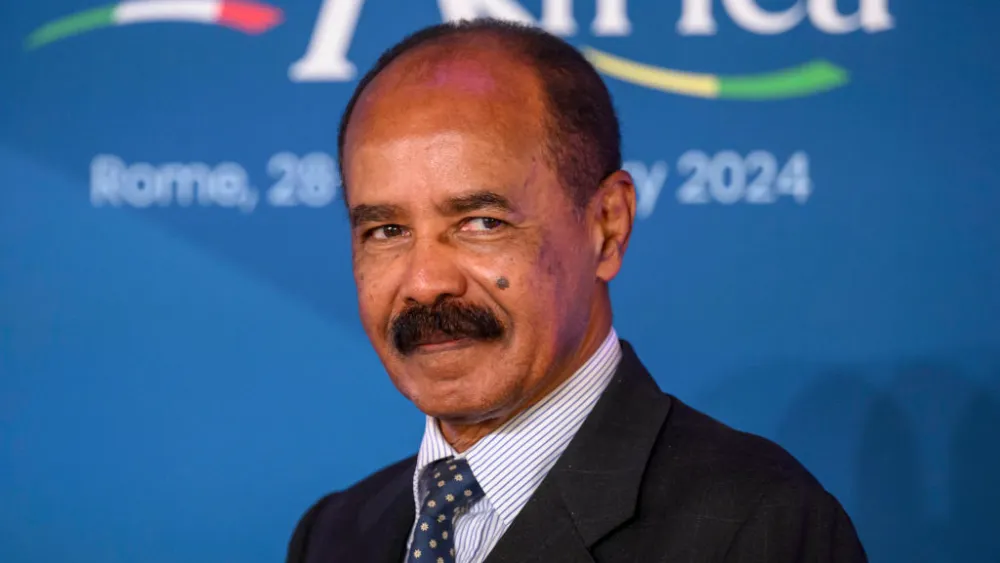

Eritrean dictator Isaias Afwerki has always viewed everything through the lens of his own survival. As a result, he portrayed the United States as a threat to himself and Eritrea, casting Ethiopia as a U.S. proxy. Now he is using Israel and the United Arab Emirates to revive the same narrative, again casting Ethiopia as the proxy in question.
Afwerki has successfully brought together seven Ethiopian armed groups whose political objectives differ sharply but whose opposition to Ethiopian Prime Minister Abiy Ahmed has united them against a common enemy, turning Ethiopia’s internal divisions into a broader proxy struggle amid a contest over the country’s Red Sea orientation.
The seven groups, which call themselves the Ethiopian Peoples’ Forces Alliance for Survival, are the Tigray People’s Liberation Front (TPLF), Amhara Fano National Movement, Oromo Liberation Army (OLA), Ogaden National Liberation Front (ONLF), Afar Revolutionary Democratic Unity Front, Benishangul Peoples’ Liberation Movement and Gumuz Peoples’ Democratic Movement.
These armed groups have no common position on Ethiopia’s political structure, territorial questions or competing national histories and projects. This is the logic behind the Eritrean dictator’s “Tsimdo” strategy: a political and organizational effort to bring disparate Ethiopian opposition forces into a common alignment against a common adversary.
The driving forces behind Tsimdo are Afwerki, whose interest is in destabilizing Ethiopia to maintain his domestic political power, and a faction of the TPLF seeking to consolidate its control over the northern Ethiopian state of Tigray. After an estimated 600,000 people died in the Tigray war, the TPLF is now putting Tigray onto another battlefield.
A coordination meeting in Port Sudan in May 2026 brought together Ethiopian opposition groups, the Sudanese Armed Forces (SAF), Eritrean representatives and others. Another coordination meeting was also held in Kenya, bringing in the remaining groups. These coordination meetings form part of a broader effort coordinated and financed by Afwerki.
The alignment was followed by a dangerous escalation on the ground. On Sept. 23, fighting erupted between the TPLF and federal forces. Tigrayan forces took control of Mekelle’s main airport from federal police, while Ethiopian Airlines suspended flights to Mekelle, Axum and Shire because of the security situation. Fighting was also reported in Afar and Amhara, including alongside Fano forces.
The sequence is significant: The seven-group alliance was announced on Sept. 20; within days, the TPLF was engaged in renewed fighting with federal forces and alongside some of the very groups that fought against it during the 2020-2022 war.
The seven-group alliance is not an isolated Ethiopian development. Its emergence can be understood as part of the Eritrean dictator’s broader regional strategy to destabilize Ethiopia and counter its growing ties with the UAE and Israel, as well as its emerging relationship with Somaliland.
The Eritrean dictator seeks to destabilize Ethiopia and counter its growing ties with the UAE and Israel.
Afwerki has portrayed Ethiopia as a proxy for the UAE and Israel, describing the UAE’s expanding port presence as “port imperialism” and portraying it as part of an Israeli agenda to control the Red Sea and the wider region.
For example, the Eritrean dictator’s mouthpiece, Awel Sied, said on his latest Tsimdo program: “Abiy is not the enemy. He has never been the enemy, and he doesn’t have the capacity to be an enemy. Abiy is a simple proxy. … He is a minion doing his puppeteer’s mission. He doesn’t have his own agenda. The one who directly controls him and orders him is [UAE President] Mohammed bin Zayed. Behind him, who is giving the agenda and ordering is the Mossad. Now, a dangerous time is coming that can crush both opposition and supporters. There are regional powerhouses behind. So, if we are to overcome this impending situation together, we just have to fight hand in hand with Tigray and other neighboring countries. There is no other option.”
Following Houthi attacks that have disrupted maritime security and threatened commercial shipping, Ethiopia—with more than 120 million people and far greater import and export volumes than Eritrea—has major economic interests in the Red Sea. Israel and the UAE also have direct security and economic interests, while Ethiopia’s efforts to secure maritime access through Somaliland are reshaping its position in the region.
The January 2024 Ethiopia-Somaliland memorandum of understanding was a major development, with Ethiopia seeking long-term access to the sea through Somaliland and envisaging a military facility near Berbera.
Somaliland’s strategic importance has since increased further. The UAE has a major presence at Berbera, while Israel formally recognized Somaliland in December 2025, becoming the first country to do so.
These developments, coupled with Ethiopia and the UAE’s cooperation in Sudan, have created an emerging Red Sea network linking Ethiopia, Somaliland, the UAE and Israel.
The regional dimension extends beyond Eritrea and includes Egypt and Sudan among other actors. Their strategic priorities differ from those of Eritrea. Egypt’s confrontation with Ethiopia is rooted principally in the Nile and the Grand Ethiopian Renaissance Dam, while Sudan’s relationship with Addis Ababa is shaped by its own war, border disputes and wider regional alignments.
In what may add fuel to the fire, Washington has also lifted major restrictions on Ethiopia and Eritrea. On Sept. 17, the U.S. sanctions framework imposed after the Tigray war expired, and on Sept. 18, Washington removed sanctions on Eritrea’s ruling party and military. The U.S. has also eased restrictions on arms sales to Ethiopia. This comes as Ethiopia faces renewed fighting and the region is becoming increasingly militarized.
Ethiopia’s internal conflict is therefore increasingly connected to the wider struggle over the Horn of Africa and the Red Sea, and particularly its growing ties with the UAE and Israel and its strategic relationship with Somaliland. At its core, however, this is also a struggle for the survival of the Eritrean dictator and the TPLF faction seeking to consolidate its position in Tigray.


