


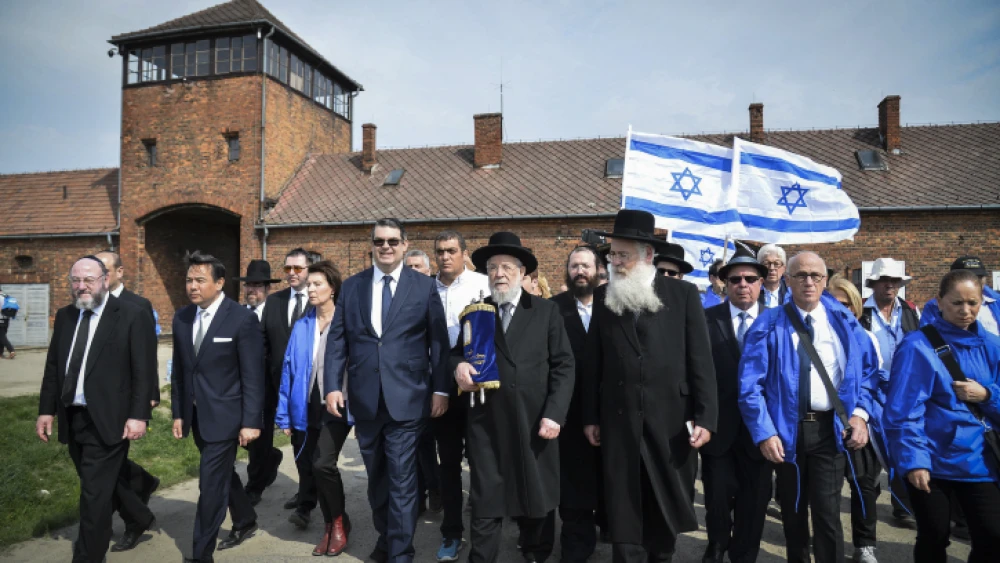

In the 1950s, ’60s and ’70s, many Israelis of Middle Eastern origin felt that the Holocaust was a tragedy that affected European Jewry and had spared Jews who had immigrated from countries in the Muslim world. Prior to the founding of the State of Israel, anti-Semitism in the Muslim world was of a different nature. To be sure, there were pogroms, such as the Farhud in Baghdad in 1941, but nothing like what happened to the Jews in Europe.
In the early years after the founding of the State of Israel, most marriages took place between Jews of similar ancestry. As such, Jews from the Muslim world still perceived the Holocaust as having happened to others.
But as the years passed and more Jews of European origin married Jews with origins in the Muslim world, that feeling began to change. The result of these Jewish “mixed” marriages was a new generation of Israeli Jews emerged whose ancestors were from Jewries of both European and Islamic origins.
As Israeli society began to coalesce, Jews living in Israel were now partially of European origin and partially from the Islamic world. With this integration, the Holocaust became a part of the identity of this new generation of Israelis. Jews from the Islamic world began to take more interest in the Holocaust because their children and grandchildren were now also part of both worlds.
Today, it is rare to find Israeli Jews in their 20s and younger who don’t share ancestors from both worlds. Israelis are so intermarried that the memory of the Holocaust has become part of the collective historical memory of the entire Jewish population of the State of Israel.
So today, as Israel marks Yom Hashoah (Holocaust Remembrance Day), Israeli television ran a singer of Kurdish Jewish origin singing a song about the Jewish life under the Nazis. She was then interviewed and talked about her children. Their father’s father was from Thesaloniki, Greece, and his entire family was shipped off to Auschwitz and gassed. Thus, the Holocaust became part of her children’s heritage, and as their mother, part of her consciousness as well.
As a result, what has emerged is a young generation of Israelis with ancestors of whom are so diverse that now there is one narrative for the entire Jewish people, irrespective of ancestral origin. What happened to the Jews of Europe matters to all Israeli Jews, as do events that happened to Jews under Islamic rule.
The fact that the Holocaust has become part of the historical memory of all Israeli Jews—and not just those of European origin—may well be a result of the prophetic ingathering of the exiles and the re-emergence of one united Jewish people. That’s a phenomena that has not occurred since the ancient northern kingdom of Israel was defeated by the Assyrians in 722 BCE, and its people scattered throughout the ancient world.
Harold Rhode received in Ph.D. in Ottoman history and later served as the Turkish Desk Officer at the U.S. Department of Defense. He is now a Distinguished Senior Fellow at the Gatestone Institute.



