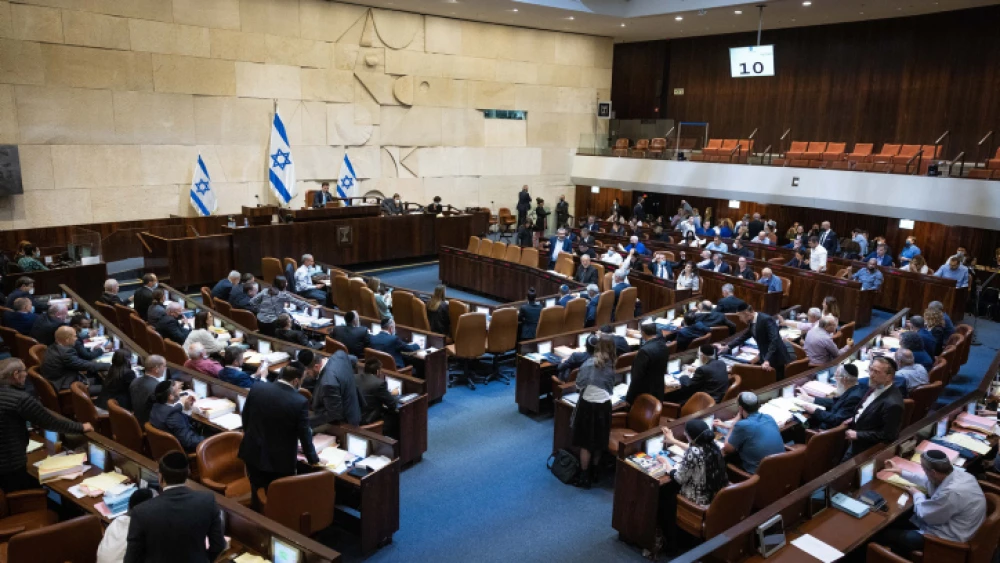
Israelis have recently been told that limiting a prime minister’s term in office is “not foreign to the parliamentary system”—but in reality, there is no parliamentary democracy that has such limits.
The banality with which Israeli democracy is being sacrificed on the media altar is inconceivable. Not only is this politically underhanded move not condemned, but it is also promoted and (absurdly) ruled on by non-democratic parties, in which the chairman’s position is set for seven seats (Yesh Atid) or worse, where there is no mechanism to replace him (Yisrael Beiteinu, Blue and White, Yamina and New Hope).
So what would such legislation actually really do?
First, it could breed political extortion and as a direct result, political instability.
While in a presidential regime the president receives his authority directly from the people, and the completion of his full term is almost guaranteed as it is separate from the elections to the legislature, in a parliamentary regime, the prime minister is a product of a coalition composition, represented by factions.
When a prime minister’s term has a clear expiration date, it is in the interest of the coalition partners to burden his tenure, constantly threatening him with the dissolution of the government, to extort the most they can in exchange for sustaining the government. The result is political chaos. Short-lived governments, wide coalitions seeking to free themselves from hinging on one faction. Less ideology, and much more political extortion and corruption.
Second, the more vulnerable a prime minister is to political extortion, the more he will tend to favor non-democratic parties for his coalitions, those where lawmakers obey him without question. This means that small, fad parties will take the place of their larger, established democratic counterparts, with the former committed only to ensuring the success of one man, who is not committed to serving the public and whose chances of re-election are slim.
Third, this promotes the rule of bureaucrats and the further narrowing of the democratic playing field.
In a country where most bureaucrats are not replaced upon a change of government, limiting the prime minister’s tenure while the entire public service system remains constant means a very limited ability to promote new policy, even if its proponents won an absolute majority in the election.
The end result is a dangerous combination of political blackmail, a collection of small, undemocratic ad-hoc parties, a shaky coalition and a prime minister devoid of the public’s support. Sound familiar?
We must beware of a situation where the political accident of the Bennett government becomes the norm.
Dr. Limor Samimian-Darash is a senior lecturer at the Federmann School of Public Policy and Government at the Hebrew University of Jerusalem.
This column first appeared in Israel Hayom.