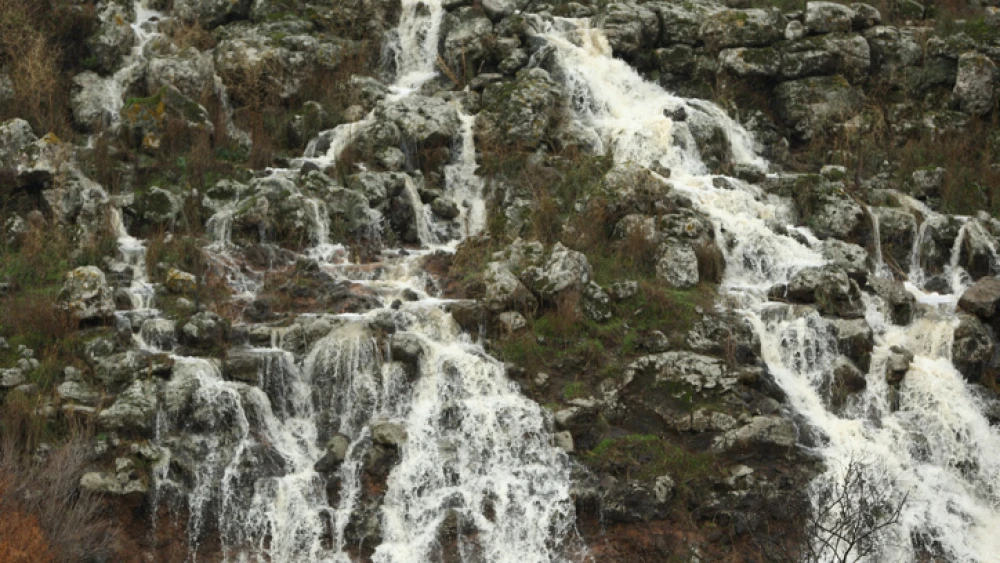
Not since biblical times have so many people lived on Israel’’s coastal plain. This part of the country is susceptible to flooding by its very nature; as part of his prayer on Yom Kippur, the High Priest would ask, regarding the people of the Sharon Plain, “that their homes not become their graves.”
Yet since the dawn of Zionism in the late 19th century, this is where most of the country’s people have chosen to live. Currently, 60 percent of the Jews in the Land of Israel live between the cities of Netanya and Rishon Letzion.
In this narrow strip, which is filling up with urban infrastructure and getting sealed off with concrete and asphalt, open areas are shrinking; not enough is left to absorb and suspend sediment. The ecological system along the coast—which, without urban construction, is also vulnerable to flooding from the mountains—has lost balance and gone out of control. Even what is almost the last remaining green vista in this part of the country—the military-industrial zone between Ra’anana, Hod Hasharon, Ramat Hasharon and Herzliya—is in danger of extinction because of the state’s plan to build some 40,000 new housing units in it.
In addition, the extensive construction to the east of Tel Aviv—in Modi’in, Elad and Rosh Ha’ayin—directly affects the volume of the upper runoff, unnaturally augmenting the flow of the creeks that enter the city’s environs.
In these lands, which have stood open since ancient times, a significant quantity of sediment has seeped into the groundwater. As construction grows, most of the water is transported through the drainage infrastructure to the creeks in a quantity that far exceeds their natural capacity. Something similar is happening in Beit Shemesh, near Jerusalem, which is being expanded into a city of 350,000.
In the Netherlands, a flat country that is always under threat of flooding, the state has set aside sizable areas for artificial flood containment, even when this entails uprooting and relocating residents.
In Israel, by contrast, the National Planning Authority has ordered local planning authorities to plan for the building of an additional 2.6 million apartments by 2040, all within the Green Line.
This is an impossible infringement of the national ecological balance.
The problem is rooted in the National Outline Plan, which does not take into account the potential for construction beyond the Green Line and ignores the fact that everything is being concentrated in a single ecological space—including sediment and sewage that descend westward from West Bank towns and flood the coastal plain, necessitating planning and treatment as a single system.
Restoring the ecological balance requires a basic conceptual change. The Jerusalem district, which, according to the plan, is supposed to add another 300,000 apartments, must direct most of the building eastward toward Mishor Adumim; while Rosh Ha’ayin, which is slated to grow by 40,000 apartments, must be diverted eastward in the direction of Ariel. What is needed is an updated National Outline Plan that envisages the construction of an eastern spine for the state of Israel above the Jordan Valley on the Arad-Gilboa line. Such a fundamental change in planning will save greater Tel Aviv from collapse.
Maj. Gen. (res.) Gershon Hacohen is a senior research fellow at the Begin-Sadat Center for Strategic Studies. He served in the IDF for 42 years. He commanded troops in battles with Egypt and Syria. He was formerly a corps commander and commander of the IDF Military Colleges.
This article was first published by the Begin-Sadat Center for Strategic Studies.