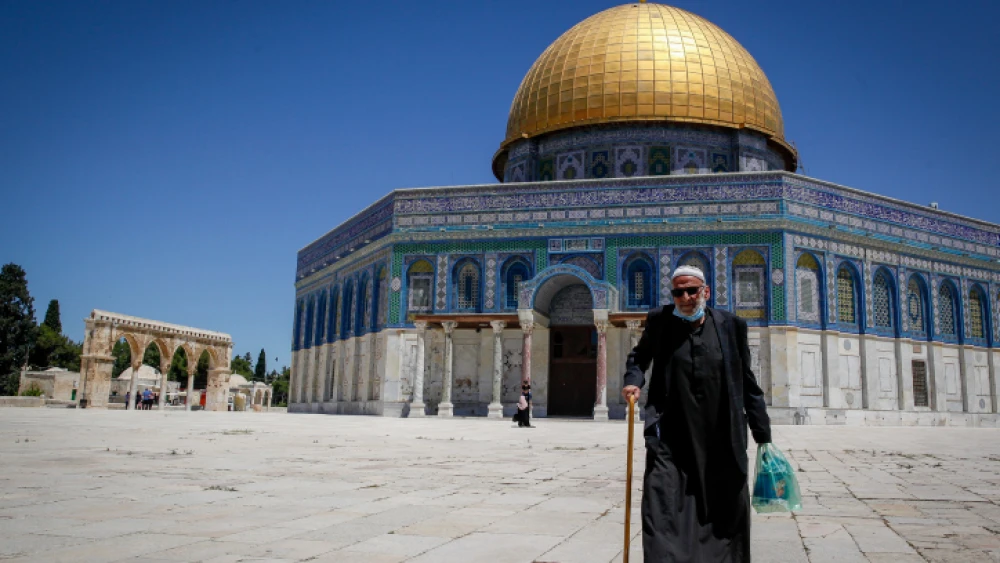
Two events of religious and historical significance that very nearly took place last week point to a deeper layer in Jordan and Saudi Arabia’s struggle for guardianship of Islamic holy places on Jerusalem’s Temple Mount. Israel has now been dragged into this struggle against its will.
Jordanian Crown Prince Hussein, King Abdullah’s son, was about to enter the gates of the Temple Mount on March 10 to perpetuate Jordan’s formal status as the Muslim world’s guardian of the site. However, the visit was canceled at the last minute, supposedly due to a “disagreement over security arrangements.” From the Jordanians’ perspective, this public flag-raising was urgently necessary given the unrefuted reports that another crown prince, from Riyadh, was engaged in negotiations with Israel on whether to meet with Prime Minister Benjamin Netanyahu. When it comes to talks with the Saudis, the Temple Mount is also a priority.
As an Islamic power that already controls Mecca and Medina, the two holiest sites in Islam, Saudi Arabia has shown increasing interest in gaining a significant foothold at the Al-Aqsa Mosque, Islam’s third holiest site. Riyadh is looking to create a new status quo at the site and is willing to invest tens of billions of dollars in Jerusalem and the Temple Mount and agree to some form of normalization of ties with Israel to this end. In return, Saudi Arabia wants a senior role, alongside Israel, in running the mount, instead of or alongside Jordan, among other things. Riyadh is poised to reap huge dividends from such a move. It will gain control of the three holiest sites in Islam, while ensuring the defeat of President Recep Tayyip Erdoğan’s Turkey, who has been unrelenting in his attempts to “liberate” the mount from Israel. Jordan, for its part, is furious at the very notion Saudi Arabia could be given a role at the site. The Hashemite dynasty lost its role as the keeper of Islam’s holy sites in Mecca and Medina after World War I. Secondary guardianship over Islam’s holy sites in Jerusalem was its consolation prize. This status was also reserved for Jordan within the framework of its ties with Israel following the 1967 Six-Day War.
Jordan continued to be involved in the religious management of the mount through the Jordanian Wakf. It earned recognition for its senior status on the mount through the framework of the peace treaty signed with Israel in 1994 and its active and opinionated involvement in a series of issues concerning the site, from the renovation of walls and joint exercises with Israeli rescue forces on the mount to a veto on Israeli plans for the area around the Temple Mount, including the replacement of the Mughrabi Bridge and the removal of construction debris from the “Little Western Wall.”
When then-Saudi King Khaled dispatched emissaries in the 1980s to offer Prime Minister Menachem Begin a fortune for the development of a new Middle East in return for a Saudi flag being installed on the Temple Mount, Begin responded by kicking them out. Things have changed. Netanyahu and his officials are involved in talks on the possibility of affording Riyadh status on the site. This began when plans were being made for former U.S. President Donald Trump’s so-called “deal of the century” and continues to this very day.
Israel has become a kind of traffic cop on the mount. It tries, sometimes unsuccessfully, to look out for its own status as a sovereign, while at the same time regulating the opposing interests of various Arab and Muslim figures.
For Jordan, which affords us a quiet eastern border and extensive bilateral economic and security ties, the mount isn’t just a historical symbol but the anchor that guarantees the stability of the kingdom’s rule; a rule against which radical Islamic forces often rise. And so, Israel finds itself straddling the divide, maneuvering in the inter-Islamic struggle between Amman and Riyadh, sometimes acting to please the Jordanians, at other times, looking to please the Saudis.
Until the time comes when another decision is required—and that day may be soon approaching—Jordan is still Israel’s preferred partner on the Temple Mount. This remains the case even though Amman needs Israel no less and maybe even more than Israel needs Amman.
Nadav Shragai is a veteran Israeli journalist.
This article first appeared in Israel Hayom.