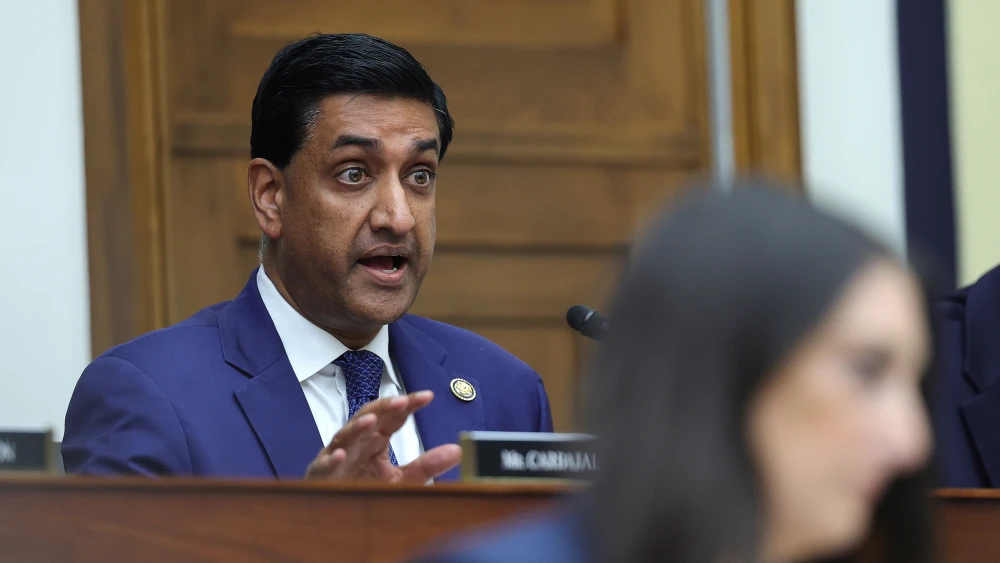

In today’s political environment, setting out to prove you hate Israel more than your opponent appears to be a winning strategy for Democrats. That reality is not lost on someone as politically astute as Rep. Ro Khanna (D-Calif.), as he stakes out the progressive lane for his 2028 presidential bid.
Khanna has been in overdrive of late. Along with a nearly ubiquitous presence on social and traditional media, he has been taking part in early election campaigns and visiting battleground states to build name recognition for his run.
In a highly publicized speech at a U.S.-India strategic partnership summit in late June, Khanna decried the erosion of relations between those two countries under U.S. President Donald Trump, saying the alliance should be primarily rooted in “shared values” and not treated as a “blind transactional partnership.”
This is a far cry from how he views the U.S.-Israel alliance. His relentless criticism of the Jewish state is meant to create distance between the two democracies.
Along with Rep. Thomas Massie (R-Ky.), Khanna co-sponsored an effort to quash a new initiative calling for increased defense technology cooperation between the United States and Israel, blaming the “pro-Israel lobby” when it wasn’t put up for a vote. Additionally, although it failed, Khanna enthusiastically backed a Massie amendment to a fiscal 2027 appropriations bill that would have zeroed out all U.S. military aid to Israel, and urged other Democrats to do likewise.
Along with full-throated advocacy for Maine senatorial candidate Graham Platner until it became politically untenable, in addition to vocal support for New York’s socialist candidates, Khanna has not shied away from appearances with highly controversial social media influencers, saying politicians should engage with audiences across many platforms.
Hasan Piker has been one such influencer. Khanna has appeared on Piker’s podcast several times, including most recently to discuss the congressman’s controversial visit to Judea and Samaria, likely to amplify viewer hostility towards Israel.
Khanna regularly accuses the Jewish state of genocide but has failed to offer substantiation of such an inflammatory charge. His trip to Judea and Samaria seemed designed to elicit a confrontation. As reported, he ignored standard safety protocols and would not coordinate with Israeli officials on a visit to sensitive areas.
When the inevitable happened, Khanna borrowed from the Tucker Carlson playbook by announcing that he had been “detained” and complaining about “violent settlers” whom he described as “hoodlums with American-made machine guns.”
Rep. Josh Gottheimer (D-N.J.) labeled the incident a “publicity stunt.” The media watchdog Honest Reporting was more blunt, saying that “it was a designed provocation, calculated to generate clicks and outrage.”
For Khanna, however, it was mission accomplished. He received a ton of media attention, solidified his progressive credentials regarding Israel, and was able to take advantage of the opportunity by sending a fundraising email shortly after posting about his encounter.
While all of this is concerning, particularly since Khanna was considered pro-Israel just a few years ago, it is background noise when compared with his decision to sign the Track AIPAC PEACE Pledge on June 16. He was the first of three members of Congress to do so and stated he was proud of his decision. The virulently anti-Israel Rep. Rashida Tlaib (D-Mich.) signed two weeks later.
For those not familiar with it, Track AIPAC was co-founded by Cory Archibald, a consultant for former anti-Israel Democratic Reps. Cori Bush of Missouri and Jamaal Bowman of New York. Its ostensible purpose is to act as a counterweight to the pro-Israel lobby AIPAC’s influence.
In reality, its goals are far more insidious. Those who sign on are committing to three basic positions: refusing money from AIPAC or any other pro-Israel organization, including even the liberal J Street; accepting the false claim that Israel committed genocide and backing any future legislation tied to the charge; and supporting an end to all military aid to Israel. But there’s more. The pledge also demands that signers resist any efforts to restrict BDS and oppose any military or intelligence cooperation with Israel.
Track AIPAC is clearly an attempt to intimidate members of Congress. It tracks political donations on social media and issues “red cards” to those who have taken money from pro-Israel organizations or have a pro-Israel voting record. They have a Track AIPAC Hall of Shame and even monitor individual Jewish donors, many of whom have minimal ties to pro-Israel organizations. The group smacks of McCarthyism if not outright antisemitism and is setting a very dangerous precedent. Khanna’s eagerness to sign its pledge speaks volumes.
Left unchecked, this group and others like the Institute for Middle East Understanding and the Justice Democrats PAC will only grow more brazen, leading to a situation not unlike what Jewish students have faced on college campuses since Oct. 7, 2023.
An ominous omen recently occurred in Washington state. According to Jewish Insider, Rep. Adam Smith (D-Wash.), who voted for Massie’s amendment, indicated that—although he has clear issues with the current Israeli government—part of the reason he did so was ongoing personal threats against his family and staff, along with middle-of-the-night protests that disturbed his neighbors. Smith blamed far-left activists, who he said had vandalized his home, set a fire in his driveway and even physically assaulted a staff member.
Virtually every other PAC or advocacy group, even those advocating for changes that would make our nation unrecognizable, is allowed to support its cause and engage in the democratic process without fear of threats or repercussions, but there is a concerted effort to make proponents of the longstanding U.S.-Israel relationship the sole exception. Khanna’s political calculations are helping lead the way.