The phrase “foreign ministry” usually brings to mind one of two scenarios: An emergency command center dealing with some earthquake in some far-flung country, or a fancy-dress cocktail party.
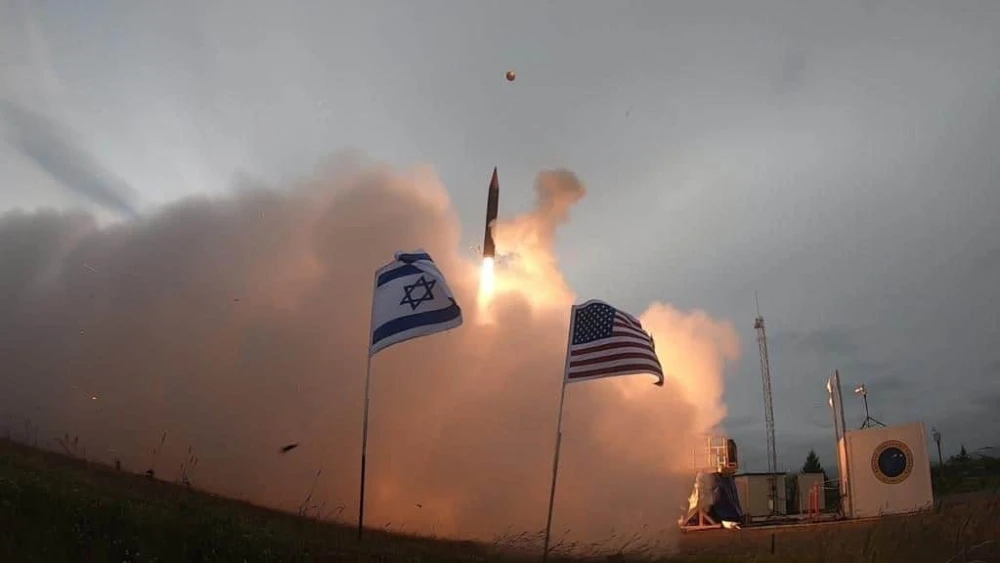
But the Arrow 3 deal announced last week between Israel and Germany, which is likely going to generate some 14 billion shekels ($3.7 billion) for Israel, is a great opportunity to get a behind-the-scenes look at the world of Israeli diplomacy.
With regard to the Arrow 3 deal, this world can be compared to an orchestra whose members have been playing together for more than a year, with perfect synchronization. It comprises security officials and diplomats, whose work will now reap dividends for Israeli citizens on a whole host of levels, from security to the economy and Israel’s overall image.
Why was it such a complicated ordeal? In the wake of the outbreak of hostilities in Ukraine, a special fund was allocated to bolster Germany’s defense, totaling some €100 billion, that would go toward procurement over several years. Since the Arrow is a joint Israeli-American project, several government agencies had to sign off on the deal, both in Germany and the United States. The German Defense Ministry had to issue a recommendation, as did various defense committees in both countries, not to mention the German Parliament and U.S. Congress. Of course, on top of that, Israel’s export agencies had to sign off on the matter. The finalization of the deal marks a phenomenal success for Israel’s diplomacy and defense agencies.
But the complex rhythmic dance of the various actors took time. A lot of time. Throughout this period, and all through this period, there were unsung heroes who laid the groundwork for this: The members of the Israeli diplomatic service. For years, they did their work diligently in Israel’s forward operating bases in diplomatic missions abroad so that this deal could move forward.
The diplomatic dividend is what gives Israel a line of diplomatic credit abroad. Our ability to get support in international forums, in mega deals, in obtaining legitimacy, in cooperation and in scientific collaboration. All these do not happen with countries that the world shuns.
The security-related benefits of the deal are no less important. Alongside the Defense Ministry, the Administration for the Development of Weapons and Technological Infrastructure and the Israel Missile Defense Organization, the Foreign Ministry led the diplomatic effort in a way that could on the one hand increase Germany’s motivation to seal the deal, while on the other providing impetus for the United States to give a green light.
The war in Ukraine and the shifting security paradigm in Germany swayed the balance in favor of the deal, but it was Israeli diplomats in Washington, Berlin and Jerusalem who talked with their counterparts through all available channels and pushed for its completion.
Finally, there is also an economic boon for Israelis, who feel the pinch of the rising cost of living. This deal, which has been pursued by Israeli Foreign Minister Eli Cohen, will automatically translate into a boost of energy for the Israeli economy. Fourteen billion shekels is a lot of money—it would cover a pay hike for all of Israel’s teachers over the next three years. This sum could provide food security and a decent lifestyle to all Holocaust survivors in Israel, for the rest of their life. Every shekel invested in foreign relations will see a large return.
For me, the symbolic aspects of this agreement are of great personal value. Germany’s impact on Israeli history is well-known and substantial. My personal life story has been intertwined with the two countries’ bilateral relations.
My father Ulrich Proskauer left Berlin in 1936; my first diplomatic posting was in Bonn, then West Germany’s capital, and my current assignment as Israel’s ambassador to Germany is a professional dream come true. The fact that the Jewish nation-state, some 75 years after its foundation, has been helping Germany defend itself, is not just a source of national pride but also a generator of real and tangible benefits to Israel on various levels. This is how effective diplomacy is done.
Originally published by Israel Hayom.