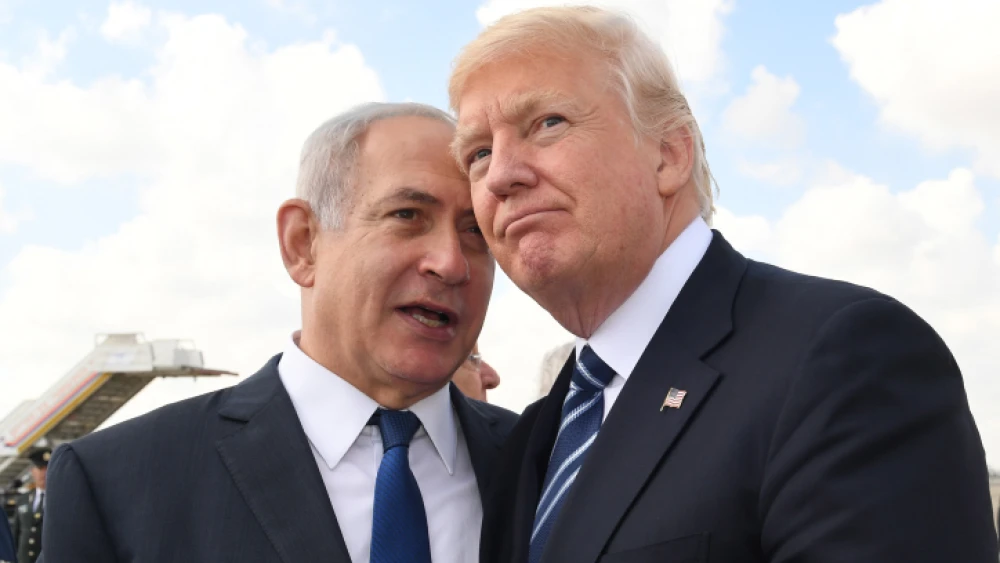
U.S. President Donald Trump wrote on Twitter Saturday that he had spoken to Israeli Prime Minister Benjamin Netanyahu over the phone earlier to discuss the possibility of “moving forward with a mutual defense treaty” between the United States and Israel.
Such a treaty, Trump wrote, “would further anchor the tremendous alliance” between the two countries, adding that he looked forward to continuing the discussion at the United Nations later this month, after the Israeli elections.
I had a call today with Prime Minister Netanyahu to discuss the possibility of moving forward with a Mutual Defense Treaty, between the United States and Israel, that would further anchor the tremendous alliance....
— Donald J. Trump (@realDonaldTrump) September 14, 2019
....between our two countries. I look forward to continuing those discussions after the Israeli Elections when we meet at the United Nations later this month!
— Donald J. Trump (@realDonaldTrump) September 14, 2019
Depending on the results of Tuesday’s elections in Israel, both Trump and Netanyahu are expected to attend the U.N. General Assembly meeting on Sept. 24.
Netanyahu thanked Trump on Twitter, calling him a “dear friend” and the greatest friend Israel has ever had in the White house.
Thank you my dear friend President @realDonaldTrump. The Jewish State has never had a greater friend in the White House. I look forward to our meeting at the UN to advance a historic Defense Treaty between the United States and Israel.
— Prime Minister of Israel (@IsraeliPM) September 14, 2019
Two weeks before the first round of Israeli elections on April 9, Trump recognized Israel’s sovereignty over the Golan Heights, with many viewing the timing of the move as a way to boost Netanyahu’s popularity ahead of election day.
The idea of a mutual U.S.-Israeli defense treaty has been discussed for decades, but recently came to the forefront of conversation as Sen. Lindsey Graham (R—S.C.) presented the proposal for Israel to be added to the list of countries with treaty obligations earlier this summer.
At a dinner hosted by the Endowment for Middle East Truth in June, Graham said, “I think it is important to send a signal in the 21st century: If you are intending to destroy Israel, you have to go through us, and it will not turn out well for you.” Graham also raised the idea during a July visit to Israel.
The Israeli defense establishment has in the past been overwhelmingly critical of the idea of such a defense pact, due to concerns that such a treaty could limit Israel’s freedom of action, requiring Israel to ask for U.S. permission to defend itself.
Former head of IDF Military Intelligence Amos Yadlin, now executive director of the Institute for National Security Studies in Tel Aviv, wrote on Twitter that bringing up the issue ahead of elections is “clearly election propaganda that has not matured into a coherent policy,” and that until Washington and Jerusalem are able to discuss the issue in depth, “the costs outweigh the benefits.”