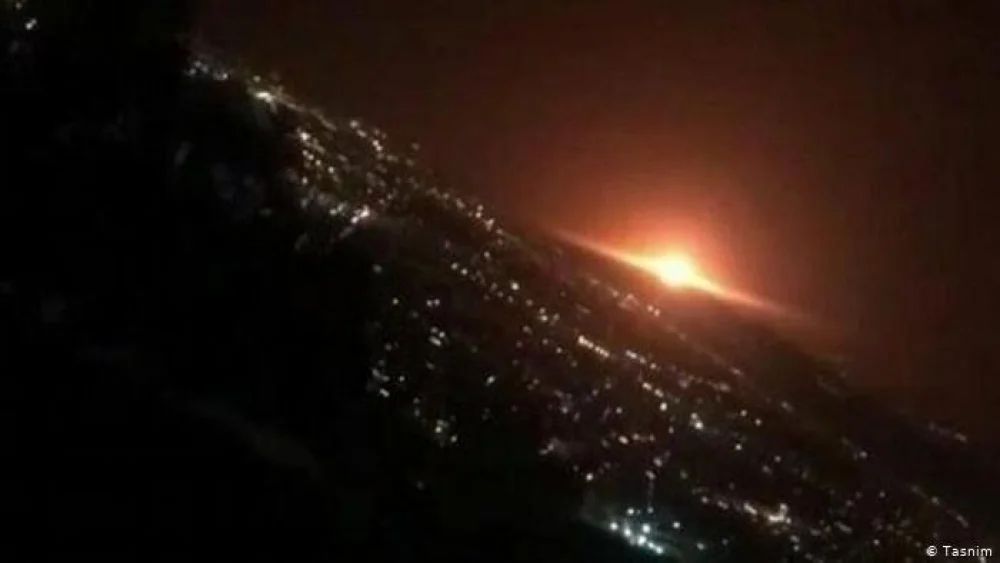
Both Israel and the United States have a clear interest in halting Iran’s dogged quest for the bomb, and both likely possess technological and intelligence capabilities sufficiently advanced to allow them to inflict severe damage on Iran. Thus it cannot be ruled out that one or both were involved in the explosion at Iran’s Natanz nuclear facility on July 2. What’s more, the Stuxnet virus, a malicious computer worm that hit about 1,000 Iranian centrifuges at Natanz in 2010, has been attributed to a joint effort by American and Israeli intelligence agencies.
However, a question mark remains over the source of the July 2 incident, which was one of a series of unexplained fires and explosions across Iran in recent weeks. Was the blast at Natanz, which reportedly destroyed an underground workshop for the development and assembly of advanced centrifuges, triggered by a timing device inside the site or by a cyber attack? If the former, this reinforces the announcement made by the Iranian opposition group “Panthers of the Homeland” that its people were responsible for the explosion.
The Natanz blast embarrassed the Iranian regime, which refrained from pointing fingers at either Israel or the United States. Tehran initially claimed it was an accident, probably over fears of being drawn into a direct confrontation that could expose Tehran’s intelligence, military and economic weaknesses. The regime nevertheless issued a threatening response: “If a regime or a government is involved in the Natanz incident, Iran will react decisively.”
It is not difficult to understand why they would take this tone. The explosion at Natanz struck the flagship of Iran’s nuclear project. In November 2019, the president of the Iranian Atomic Energy Organization participated in the installation and operation of a new array at Natanz comprising 30 advanced IR-6 centrifuges. An Iranian spokesman said at the time, “We can produce 5 percent, 20 percent, 60 percent, or any other percentage of enriched uranium.” (Sixty percent enrichment is the springboard for nuclear weapons).
Because Iran possesses the necessary expertise to make advanced centrifuges and its supply of them was probably not all stored at Natanz, the blast is not likely to have severely disrupted the regime’s advanced centrifuge program. It could, however, slow the deployment of the latest models of these machines by one to two years. Regardless, this was a good time to carry out an attack (if it was one), as the latest International Atomic Energy Agency report revealed that Iran has put a vast amount of effort into developing advanced centrifuges.
If Israel was indeed involved in the Natanz explosion, it was likely meant to signal to Tehran that Jerusalem intends to use all means at its disposal to halt the Iranian nuclear project. Beyond causing immediate damage, a strike of this kind (if that is what it was) signals that Israel’s long arm can reach anywhere in Iran.
This is not an idle threat. Much of the information in Iran’s nuclear archive, which was hijacked by Israel’s Mossad intelligence agency a couple of years ago, relates to Iranian elements involved in the nuclear effort—from individuals in the political, scientific and operational systems to sites where nuclear weapons development activities were carried out. In addition, the spy satellite system Israel operates, which was recently supplemented by the “Ofek 16” satellite, allows Jerusalem to detect any suspicious activity, whether on the surface or below it. With this capability, the Israeli intelligence service will be able to continue to surprise Iran.
IDF Lt. Col. (res.) Dr. Raphael Ofek, a BESA Center Research Associate, is an expert in the field of nuclear physics and technology who served as a senior analyst in the Israeli intelligence community.
This article was first published by the Begin-Sadat Center for Strategic Studies.