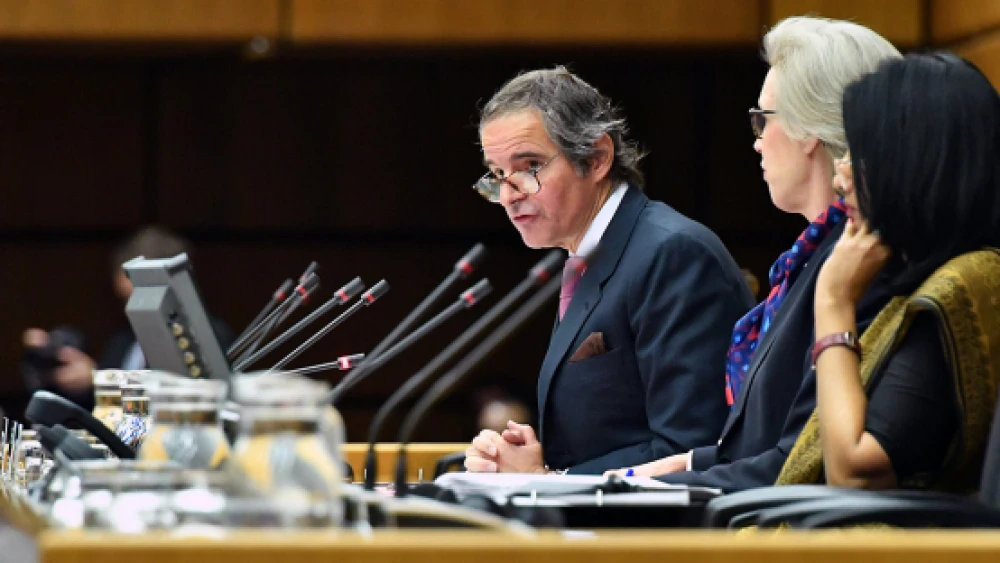
Iran’s nuclear chief said on Tuesday, at a joint press conference in Isfahan, that talks with the International Atomic Energy Agency (IAEA) have been positive.
IAEA chief Rafael Grossi arrived in Iran on Monday to try and bolster oversight of Tehran’s nuclear program, based on a March 4, 2023 “Joint Statement” signed between his group and the Atomic Energy Organization of Iran (AEOI).
Grossi said that the IAEA and Iran have agreed on “tangible and operational steps” to implement the Joint Statement. He dismissed the idea of creating a new agreement.
The March Joint Statement, while short on detail, declared that the IAEA and Iran will carry out negotiations “in a spirit of collaboration;" that Iran would provide “information and access” about its nuclear program; and that it would allow the IAEA to implement “appropriate verification and monitoring activities.”
Standing alongside Grossi, Mohammad Eslami, the head of the AEOI, said he viewed cooperation in line with the March agreement as a positive step.
“However, due to some issues between Iran and the IAEA, the process of cooperation slowed down, and both sides had expressed dissatisfaction with this slow pace,” Eslami said, according to Iran’s semi-official Mehr News Agency.
Eslami said Iran and the IAEA will prepare a draft for the continuation of interactions based on the March statement.
Eslami warned the IAEA of hostile Israeli actions designed to undermine cooperation between Iran and the U.N. nuclear watchdog group.
Grossi promised that the IAEA would not be influenced by pressures from Israel or Western countries, Mehr reported.
After returning from Tehran, Grossi told journalists that the Islamic Republic’s cooperation is currently “completely unsatisfactory” and urged the country to adopt “concrete” measures to address concerns.
“We have to be moving on… The present state is completely unsatisfactory for me. We are almost at an impasse… and this needs to be changed,” Grossi said after touching down at Vienna’s airport.
Iran insists its nuclear program is peaceful, despite all evidence to the contrary. Grossi told German media last month that Iran was “weeks, rather than months,” away from a bomb.
Grossi also met with Iranian Foreign Minister Hossein Amir-Abdollahian in Tehran on Monday.
Grossi’s visit comes amid heightened regional tensions in the wake of Iran‘s April 14 direct attack on Israel.
Israel allegedly responded with a limited strike on an Iranian airbase on April 19. The Shikari Air Base is located close to the Natanz nuclear site in Isfahan, and is reportedly supposed to protect the heavily guarded facility.