


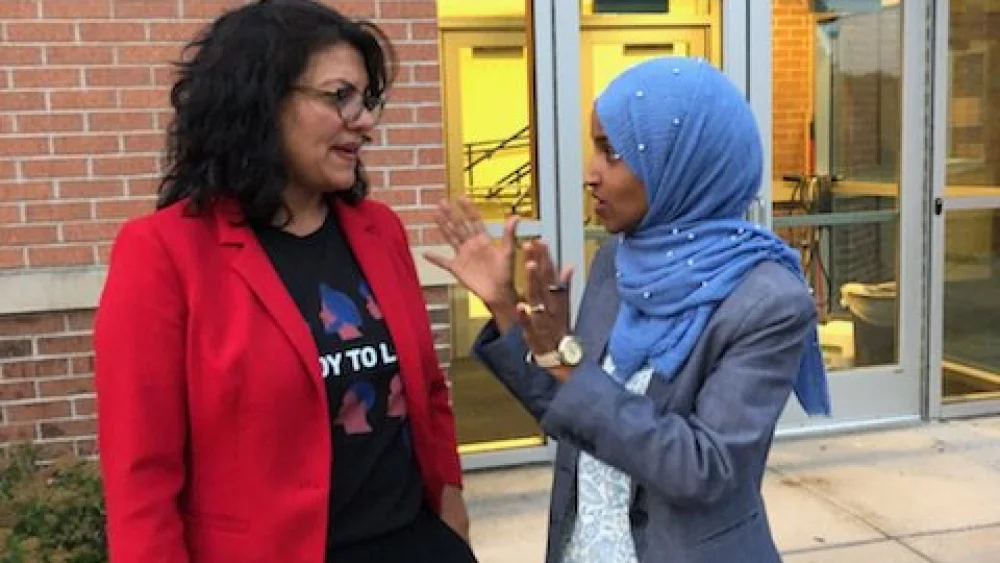
Israeli Ambassador to the United States Ron Dermer said on Friday that the Jewish state will allow U.S. Reps. Ilhan Omar (D-Minn.) and Rashida Tlaib (D-Mich.) “out of respect for the U.S. Congress, and the great alliance between Israel and America, we would not deny entry to any member of Congress into Israel.”
Omar and Tlaib support the anti-Israel BDS movement. The former told Jewish Insider on Wednesday that she will be going to Israel and the Palestinian territories in a few weeks.
“I am going in a couple of weeks, and so I’ll learn more,” Omar told the outlet. “But truly, everything that I hear points to both sides feeling like there is still an occupation.”
“Israel’s Foreign Ministry can recommend diplomatic exceptions for law denying entry to BDS supporters, but due to visit’s sensitivity, the premier would have to make the call,” reported Haaretz.
Since entering Congress in January, Omar has made multiple anti-Semitic and anti-Israel remarks.
In February, she accused the American Israel Public Affairs Committee, the largest pro-Israel lobbying organization, of paying members of Congress to back Israel, saying it was “all about the Benjamins.”
The following month, she pointed fingers at her “Jewish colleagues” for attacking her and Rep. Rashida Tlaib (D-Mich.) for labeling their criticisms as anti-Israel because of the Muslim faith of the two congresswomen, in addition to slamming her critics regarding “the political influence in this country that says it is OK to push for allegiance to a foreign country.”
This led to the passing of a resolution in the U.S. House of Representatives condemning anti-Semitism and other forms of hatred that did not call out Omar by name.
Meanwhile, since entering the House of Representatives, also in January, when she displayed a map with a note posted over Israel that reads “Palestine,” Tlaib has made controversial, anti-Israel remarks.
Shortly thereafter, she attacked Republican lawmakers and opponents of the anti-Israel BDS movement by saying “they forgot what country they represent.”
Moreover, Tlaib met with Hezbollah supporter Abbas Hamideh, who has said that Israel is a “terrorist entity,” even though the congresswoman said that “I do not agree with the statements brought to my attention.”
In May, she said that Palestinians enabled a “safe haven” for Jews after the Holocaust, thereby reiterating her support for a one-state solution.


