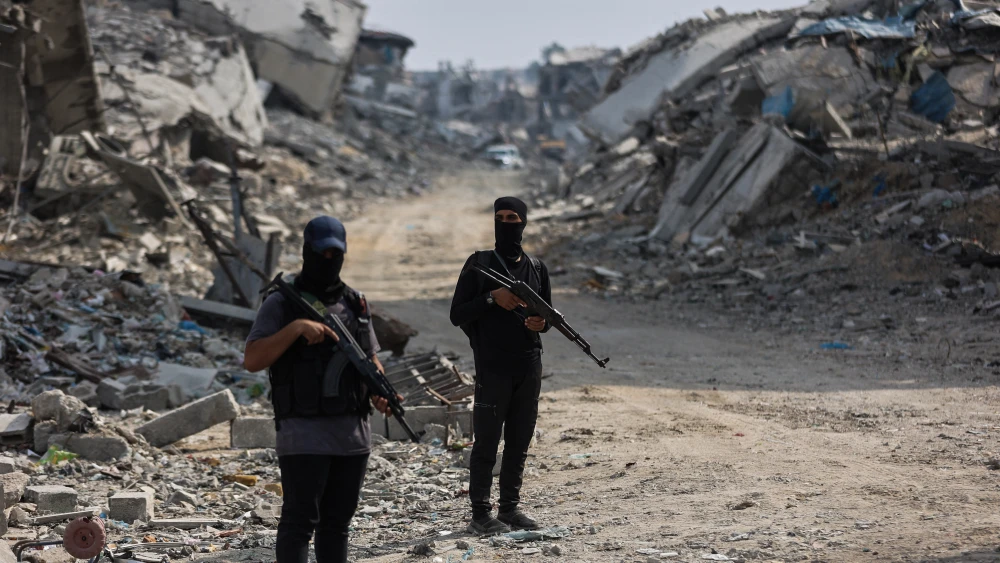

While national attention remains focused on Iran and Lebanon, former Israeli defense officials who are monitoring the Gaza arena caution that action will likely be needed to stop Hamas’s long-term efforts to rebuild a terror army in the Strip.
The Israel Defense Forces inflicted massive damage on the terrorist organization during the Swords of Iron War, and maintains operational control over more than half of the coastal enclave, yet the group is actively exploiting the halt in fighting to rehabilitate its civilian control and re-establish its military footprint.
Former Israeli intelligence officials told JNS that the long-term implications of this reality cannot be dealt with using diplomatic agreements or third-party interventions, adding that these can never disarm a terror organization that retains its grip on the local population.
Shalom Ben Hanan, a fellow at the International Institute for Counter-Terrorism (ICT) at Reichman University and a former Shin Bet (Israel Security Agency) division head, stated, “The starting point is that we stopped the war with Hamas standing on its feet. It was severely damaged, it must be said, and one should not minimize the magnitude of the achievement and what we did there. It lost a large part of its capabilities, some of which, in my opinion, will be difficult for it to restore in the near future.”
The IDF’s presence remains deeply entrenched inside the Gaza Strip. The military actively controls more than 50% of the territory, including critical perimeters and strategic corridors, allowing Israeli forces to carry out extensive counter-terrorist engineering operations, Ben Hanan noted.
“We are actually doing all kinds of things there, some of which may even be irreversible, including destroying tunnels and building outposts,” he said.
Because of this intense Israeli footprint, Ben Hanan cautioned against adopting an overly pessimistic perspective of Hamas’s current standing. However, he warned, the operational reality of Hamas’s surviving capabilities presents a severe, long-term threat to the State of Israel.
“If we look at the half-empty glass,” Ben Hanan said, “We ended the war when Hamas still had 20,000 armed operatives. Currently, they are talking about that rising to 25,000, which makes sense, because the moment they can engage in rehabilitation, they will naturally recruit more. To me, 20,000 or 25,000 is essentially the same thing, and it is a major problem.”
To contextualize the severity of this surviving force, Ben Hanan pointed to the 2007 Battle of Gaza, when Hamas violently overthrew the Palestinian Authority. “They did it with 6,000 fighters,” he recalled. “This means that 20,000 or 25,000 is still a highly significant military force in the Strip.”
The threat profile emanating from Gaza has fractured into two distinct categories: immediate tactical threats and the internal governance that allows the terror group to survive.
Regarding direct cross-border threats, Hamas’s capabilities have been drastically degraded by the IDF’s systematic dismantling of its weapons-production facilities and supply chains, he argued.
“They likely cannot produce rockets now, certainly not at the pace we saw in recent years, if at all,” Ben Hanan assessed. “Smuggling weapons is very, very difficult. It may happen here and there, but I assume it is not on a large scale. Therefore, the threats to the State of Israel, such as rocket fire or the type of ‘air force’ they had with paragliders and drones, are probably harder to rehabilitate.”
However, the second category, the ability to control the civilian population within the Gaza Strip, is where Hamas is currently winning its survival war.
“This, to me, is significant for the long term, because this is essentially the whole story,” Ben Hanan emphasized. “We do not finish the job if we do not end Hamas’s control over the Gaza Strip.”
Despite the massive destruction of its military battalions, Hamas’s civilian administration remains functional and lethal. From the very first day the ceasefire was implemented, the terror group immediately moved to reassert its authority over the Palestinian population using brute force.
“Hamas is renewing its civilian control by force, meaning its ability to collect taxes, to determine where incoming equipment and supplies go,” Ben Hanan detailed. “All these things maintain Hamas’s governance in an area where they are the strongest entity. It is to the point that they can oppose any initiative regarding what was supposedly agreed upon in the truce talks.”
The influx of humanitarian aid, intended to stabilize the civilian population, serves as a primary financial engine for the terror group’s rehabilitation, he said, explaining, “Assistance enters; funds are transferred in various forms; there is smuggling;, there is profiteering. If you want to buy something in Gaza today, you pay taxes to Hamas. Hamas manages the economy. Of course, this is in the less-than-half of the territory that is under their control, and this is an important point to emphasize, because it is a very limited capability with hundreds of thousands of displaced people.”
This economic and administrative stranglehold ensures that Hamas remains the sovereign power on the ground, he said. “As long as it is the ruling entity in the Gaza Strip, its ability to rehabilitate exists—even if it is very, very slow and very partial.”
Ben Hanan drew a direct parallel to the aftermath of the 2006 Second Lebanon War. Following that conflict, Hezbollah sustained heavy losses, but because Israel did not destroy the organization’s core governance and influence in Southern Lebanon, the terror group simply bought time. “It took 10 to 15 years, but it rehabilitated,” he noted.
“The inevitable question is a matter of Israeli decision,” he stated. “When is the right timing to say, ‘Enough is enough; all the possible dates and assessments and babble have passed?’ And secondly, are we truly willing to re-enter a ground maneuver in Gaza?”
Amit Assa, a former senior member of the Shin Bet with more than 30 years of experience, detailed the geographical limitations of Israel’s current operational control.
“Regarding the territory, indeed we control 51% today ... and the ‘yellow line’ limits the area, but when we look at the urban areas, mainly if we destroyed Rafah and went south, and Khan Yunis was also quite destroyed, areas like Deir al-Balah and Gaza City, we barely entered them,” he explained. “When we say we did not enter Gaza City, it means that this area, even if it is a small percentage of the total area we ostensibly control, is a place we have no control over. If there was some infrastructure for weapons manufacturing, for example, which we did not touch at all, and underground infrastructure that we did not deal with, then it primarily constitutes a basis for the continuation of Hamas’s activities.”
Assa further noted that while cross-border smuggling from the Philadelphi Corridor has been severely degraded, localized weapons production has not ceased.
“The production itself continues. How much it continues, at what intensity it continues, I cannot tell you today ... but I can say they continue to manufacture in those same factories, in those same weapons-production facilities they had in the areas we haven’t touched,” he stated.
Meanwhile, the terror group’s complete stranglehold over the civilian economy and the influx of international humanitarian aid continues.
“Hamas has money, and how much money does it have? It is very simple, because Hamas’s takeover of humanitarian aid and the goods passing through brings in a lot of money,” Assa said. “It doesn’t need Qatar’s suitcases to realize this. If we bring in a truck of medical equipment or food, you don’t have to be a great genius to understand that money also enters this way, and Hamas creates a very extensive financial infrastructure for itself.”
Assa also asserted that the terror group simply sells free aid for profit.
The terror group recently demonstrated this civil control during a pilot for municipal elections in Deir al-Balah in central Gaza. Assa explained that while the Palestinian Authority ostensibly managed the elections, Hamas utilized the event as a massive show of force.
“Whoever wins, no matter who it is, will be subject to Hamas’s authority in Deir al-Balah. Furthermore, the guarding of the ballot boxes was actually carried out by armed Hamas personnel,” he stated.
Foreign intervention without prior Israeli military decimation of Hamas will fail, he warned.
“No such entity will be able to enter, and if it does enter, in the form of the Turks, for instance, it will be in full cooperation with Hamas, and we obviously cannot allow that,” he said. “We need to be a bit patient in the near future to see how the event in Iran develops. Hamas will not surrender without very massive physical pressure of conquering the entire Gaza Strip, just as we conquered the 51% of the Strip—to conquer the entire Strip, control it, impose military rule on it—and only then can an external entity be introduced that might be able to manage area.”