


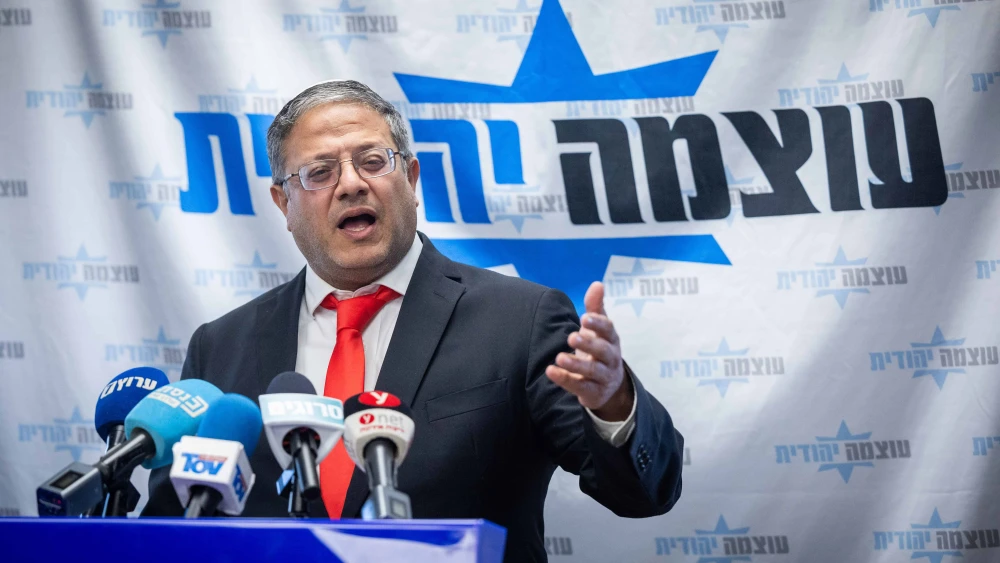
Prime Minister Benjamin Netanyahu must choose between his political allies on the right and “the way of Lapid and Gantz,” Israeli National Security Minister Itamar Ben-Gvir said on Monday.
(MK Yair Lapid is the leader of the opposition and of the Yesh Atid Party, while Minister-without-Portfolio Benny Gantz is head of the National Unity Party and a member of Netanyahu’s War Cabinet.)
“Prime Minister, I know you are at a crossroads today. You can and should choose,” Ben-Gvir said in a statement ahead of a faction meeting of his Otzma Yehudit Party at the Knesset in Jerusalem.
“There is one way, which is the way of the small [War] Cabinet, the way of the [pre-Oct. 7 security] ‘conception’..., the way where we will accept a Palestinian state as a fait accompli, the way that has proven its mistakes time and again,” the right-wing politician explained.
“There is another way, the way of Otzma Yehudit. The way of victory, the way of crushing Hamas, the way of stopping giving them [Gaza] fuel,” Ben-Gvir continued. “To come and say: Do you want humanitarian [aid]? Bring us our hostages.
“I hope that the prime minister will decide and choose the way of Otzma Yehudit, not the way of Lapid and Gantz,” Ben-Gvir said.
צפו בהצהרה שנתתי בפתח ישיבת סיעת עוצמה יהודית >>> pic.twitter.com/I4VAOVJeXN
— איתמר בן גביר (@itamarbengvir) February 5, 2024
Gantz and party colleague Gadi Eizenkot, both former IDF chiefs of staff, joined Netanyahu’s government from the opposition and became members of the War Cabinet following Hamas’s Oct. 7 massacre of some 1,200 people, nearly all of them civilians, in the northwestern Negev.
Meanwhile, Justice Minister Yariv Levin—considered one of Netanyahu’s closest associates—has reportedly signaled his willingness to give up his position in exchange for Lapid joining the coalition.
Last week, Lapid announced that his party’s 24 lawmakers would give Netanyahu outside backing in the Knesset to approve a possible deal to free Israeli hostages in exchange for releasing thousands of Palestinian terrorists from prison.
Fifty percent of Israelis are opposed to a hostage deal that would see an extended pause in fighting and the release of terrorists from Israeli prisons, according to a Channel 12 poll. Ben-Gvir has threatened to bring down the government if it reaches a “reckless” agreement.
On Sunday, the Otzma Yehudit leader leveled criticism at U.S. President Joe Biden in an interview with The Wall Street Journal, saying Donald Trump as president would have been better for Israel during the current Gaza war.
“Instead of giving us his full backing, Biden is busy with giving humanitarian aid and fuel [to Gaza], which goes to Hamas,” said Ben-Gvir. “If Trump was in power, the U.S. conduct would be completely different.”
On Monday, Ben-Gvir doubled down on his criticism, saying that “the majority of the Israeli public is very troubled by the restrictions and demands that the Biden administration has placed on us.
“Since the publication [in the Journal], I have received thousands of messages from Israeli citizens asking me to continue to say what the Israelis think,” Ben-Gvir claimed.
He reiterated that while America is Israel’s friend and ally, Washington “must stop pressuring us to bring in fuel and humanitarian equipment that ends up going to Hamas.”
Meanwhile, Lapid called on Netanyahu on Monday to restrict Ben-Gvir’s authority over the Israel Police ahead of the volatile Ramadan period, which is set to begin on the evening of March 10.
“We didn’t need the interview in The Wall Street Journal to remind us that Ben-Gvir is a dangerous clown who prefers to light fires instead of putting them out, but during Ramadan, this could cause an all-out conflagration that would cost human lives,” Lapid argued.
“I consider it my duty to warn the government. The country is not ready for this. There is no preparation. There is no plan. There were no operational and political discussions at an adequate level. We are headed for disaster,” added the opposition leader.


