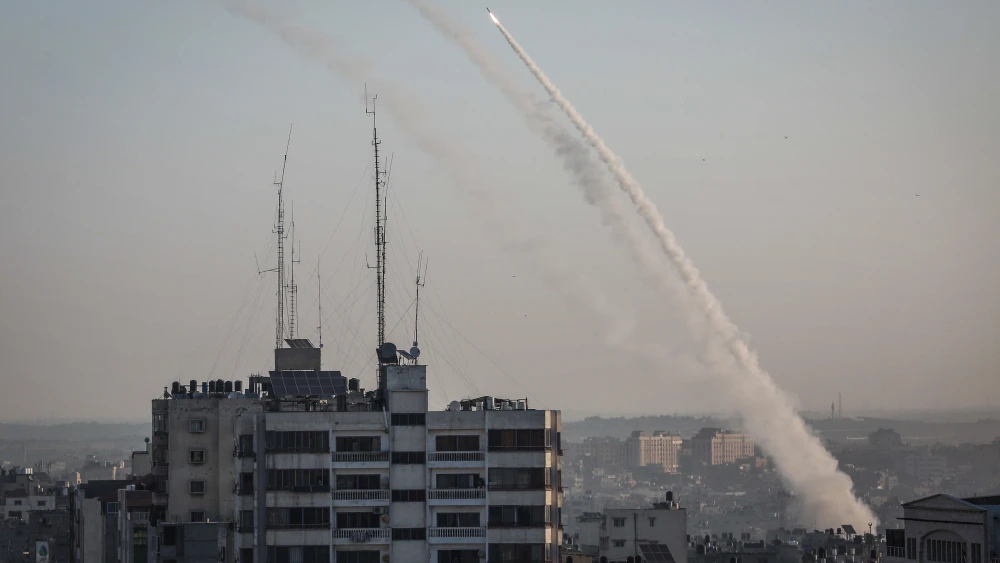

When Israeli forces launched a surprise attack against a senior commander of Palestinian Islamic Jihad (PIJ) in Gaza, four likely reactions were expected to ensure.
One was that the terror group would respond to the taking down of this known killer by shooting rockets at Israel in retaliation. The second was that Hamas, the terror group that governs Gaza as an Islamist tyranny and that is responsible for maintaining the ceasefire with Israel, would soon join Islamic Jihad in war crimes by firing randomly at Israeli civilian targets. The third was that much of the world would blame Israel for its initiating another “cycle of violence” in which the Jewish state would be judged as equally if not more culpable as the terrorists. The fourth inevitable action was that Prime Minister Benjamin Netanyahu’s Israeli and American critics would accuse him of ordering the operation in order to advance his political interests.
Within 24 hours of the death of PIJ’s Baha Abu al-Ata—a man whom Israel’s security services rightly described as a “ticking time bomb”—that is exactly what happened.
Palestinian terror groups fired hundreds of rockets at Israel. Air-raid warnings were sounded throughout southern Israel, causing tens of thousands of Israelis to scramble for bomb shelters. Schools were closed throughout the southern and central parts of the country.
Although its apologists like to describe Hamas as a reasonable player with which Israel should negotiate, its participation in the revenge attacks for Abu al-Ata was a given. That’s because the dynamic of Palestinian politics is such that it always rewards violence. Though it is still committed to Israel’s destruction, Hamas has largely observed the ceasefire that has maintained a relative quiet along the Gaza border in recent months, mainly because it’s worried about keeping the peace internally as the Gazan economy has faltered. Its leaders were probably happy that Israel had eliminated one of their rivals, whose activities posed a threat to Hamas rule. But it cannot not afford to stay out of the fighting for long, lest it be perceived as supporting peace as opposed to endless war against the Jews.
That’s why the calls for “mutual restraint” that are always being sounded by critics of Israel are so disingenuous, as well as undermine hope for peace.
The nature of the conflict is that anytime Israel does anything to defend its people or to cause terror groups to cease operations, its actions are perceived as provocative. That means that those who are calling on Israel not to hit known killers are essentially seeking to give immunity to those whose purpose is to terrorize Israelis and fuel the conflict. They are in favor of Israel’s right to self-defense in principle but always oppose it in practice.
This attitude does Palestinians no favors. As long as each Palestinian group must always look over its shoulder in fear that more violent factions will gain popularity from shedding blood, even the mildest and most theoretical moves towards peace will always be impossible.
By treating Israel and its efforts at self-defense as morally equivalent to the actions of Islamic Jihad and the Hamas terrorist regime ruling Gaza, the Jewish state’s critics are not just undermining Jewish security, but dooming Palestinians trapped in the Strip to continued siege and mistreatment at the hands of their terrorist masters.
Lastly, there is the question of Netanyahu’s alleged cynical manipulation of the security situation for his own political benefit.
At this point, there is virtually nothing the prime minister can do that would not be subjected to criticism. When he demonstrates reluctance to use force, he is accused of being indecisive. When, as is the case now, he acts on the advice of his security chiefs and orders the Israel Defense Forces to eliminate a threat, he is accused not only of inflaming the situation, but of doing so merely in order to gain some tactical political advantage.
Yet after more than 13 years of service as Israel’s leader, if there is one thing widely known about Netanyahu, it is that he is extremely cautious about risking the lives of Israel’s soldiers and more interested in deterring war than in risking an escalation to prove a point or demonstrate his toughness. Criticize him all you like for his policies or his personality, but when he has ordered the armed forces to act, it has only happened after every other option has been tried.
Even if this latest bout of violence does not escalate into all-out war and leads to a temporary calm between Israel and Gaza returns, observers should not ignore the two factors that rest at the heart of the problem: Palestinian rejectionism and Iran.
As long as the culture of Palestinian politics rewards the shedding of blood and punishes peacemaking, the Palestinian Authority, PIJ and Hamas will continue to replicate this scenario. The true cycle of violence isn’t one in which Israel is forever being blamed for causing trouble by killing terrorists, but the one in which Palestinians remain locked in a dynamic of endless war they can’t escape.
Secondly, the Middle East continues to pay the price for President Barack Obama’s appeasement, empowerment and enriching of Iran. Tehran’s fingerprints are all over every escalation of fighting between Gaza and Israel, as well as threats to the Jewish state’s northern border. Its ability to fund and promote PIJ gives it leverage over Hamas and ensures that the conflict with Israel stays as hot as possible. The best way to prevent violence between Israel and the Palestinians is to keep the pressure on Iran by stepping up sanctions that limit its ability to cause trouble in the region and fund terrorism.
The discussion about Israel and the Palestinians in the United States continues to be driven by liberal critics of Israel who think that the conflict is driven by Israeli intransigence and Netanyahu’s belligerence. But this week’s violence is one more reminder that the problem has little to do with those factors and everything to do with a toxic Palestinian political culture, prompted by Iran’s malevolent desire to foment violence.
Jonathan S. Tobin is editor in chief of JNS—Jewish News Syndicate. Follow him on Twitter at: @jonathans_tobin.