As the 2026 school year ends and summer vacation begins, Israel’s high school students are completing an educational journey that has been anything but ordinary.
After beginning their teenage years during the COVID-19 pandemic and finishing them against the backdrop of war, bereavement and national upheaval, 11th- and 12th-grade students in the Ohr Torah Stone Ann Belsky Moranis Arts Program are using art to make sense of a world that often feels chaotic.
The exhibition, titled “Habayta” (“Homeward”), at Ohr Torah Stone’s Katz Oriya High School for Girls in Gush Etzion, south of Jerusalem, showcases original works in visual art, design, film, dance and theater under the theme “Finding Order in Chaos.”
“For these students, ‘home’ is more than a physical place. ‘Habayta’ is about returning to yourself,” said Racheli Komar, who has been at the school for 18 years and directed the 12th-grade arts program for the past 10 years. “The girls have been searching for where they belong after years that have challenged every sense of stability. Home becomes family, identity, faith and the future they hope to build.”
The exhibition carries particular significance for the Ohr Torah Stone community, which has lost more than 20 alumni killed in action since the Hamas massacre on Oct. 7, 2023, and the ensuing war, as well as more than 30 relatives of students and faculty members.
Yet despite those losses, the exhibition is not defined by war.
“What surprised me was the girls chose not to make the war itself their subject,” Komar told JNS on Wednesday. “Instead, they explored what the war revealed about themselves, their families, relationships, hope and the future. The war is present in almost every work, but often indirectly.”
She said this year’s seniors have matured well beyond their years.
“They have lived through COVID, through war, through loss. You see it in the depth of the questions they ask and in the way they create. They are searching for who they are.”
That search produced deeply personal works across multiple disciplines.
Dance students explored grief through movement, including an original piece by a student coping with the loss of her mother to cancer. Others addressed the emotional impact of the war and the Nova music festival massacre through choreography.
Theater students examined questions of identity, family and responsibility in an original film as they prepare for life after years of upheaval.
Visual artists likewise balanced remembrance with resilience.

‘We want to move forward’
Shira Cohen responded to the grief felt across Israeli society, drawing inspiration from the murder of members of the Dee family in the 2023 Jordan Valley terrorist attack. Her four-panel painting depicts a moving car whose side mirror reflects tragedy, capturing the tension between remembering the past while continuing forward.
“We want to move forward, and we must continue, but the heart always remembers the past,” Cohen said.
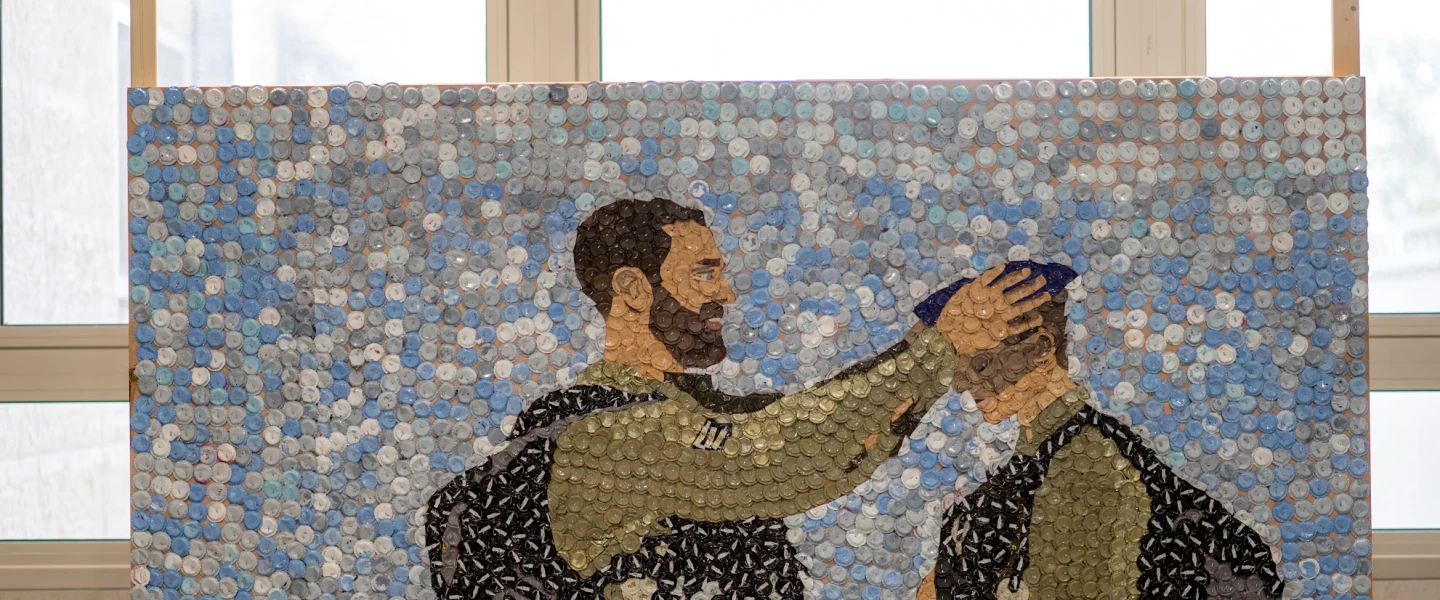
For Hallel Shayon, remembrance took the form of hundreds of beer bottle caps collected over seven years. She transformed them into a portrait commemorating Staff Sgt. Dotan Shimon, 21, who was killed in Rafah, creating a memorial from a collection gathered over time.
Ziva Lanon explored Israel’s social divisions through a work featuring the Israeli flag alongside three figures.
“Because of the arguments and divisions in the country, there is so little communication between people in everyday life,” she said. “My work asks whether identity has to be one thing, or whether we can live between different worlds.”
Komar said the creative process itself is central to the program.
“The girls begin by asking, ‘Who am I? What do I really want to say?’” she said. “They spend months digging deeper, refining their ideas. Some even begin again when they realize they haven’t reached the truth they want to express.”
That process, she said, allows students to communicate experiences that cannot easily be expressed through words alone.
“Painting, dance, film and theater let them show feelings they cannot always explain. Art gives them another language.”

Yonat Lemberger, principal of Ohr Torah Stone’s Katz Oriya High School for Girls, said educating teenagers during wartime has required schools to nurture emotional resilience alongside academic achievement.
“Our responsibility is not only to prepare students for exams,” she said. “It is to help them discover their inner strength and believe they can continue creating, contributing and building despite everything they have experienced.”
Founded more than a decade ago, the Ann Belsky Moranis Arts Program integrates visual arts, theater, film, dance and design into the school’s academic curriculum. Inspired by the teachings of Rabbi Abraham Isaac Hacohen Kook on the spiritual role of artistic expression, the program encourages students to explore questions of identity, faith and community while completing Israel’s matriculation requirements.
For Komar, that journey is ultimately what this graduating class represents.
“They are a generation that has known uncertainty,” she said. “But what I hope they take with them is resilience and the understanding that even in chaos, they can create something meaningful.”
Their exhibition offers more than a showcase of student talent. It provides a portrait of a generation of Israeli teenagers whose formative years were shaped first by a global pandemic and then by war, and who are transforming those experiences into creative expression.