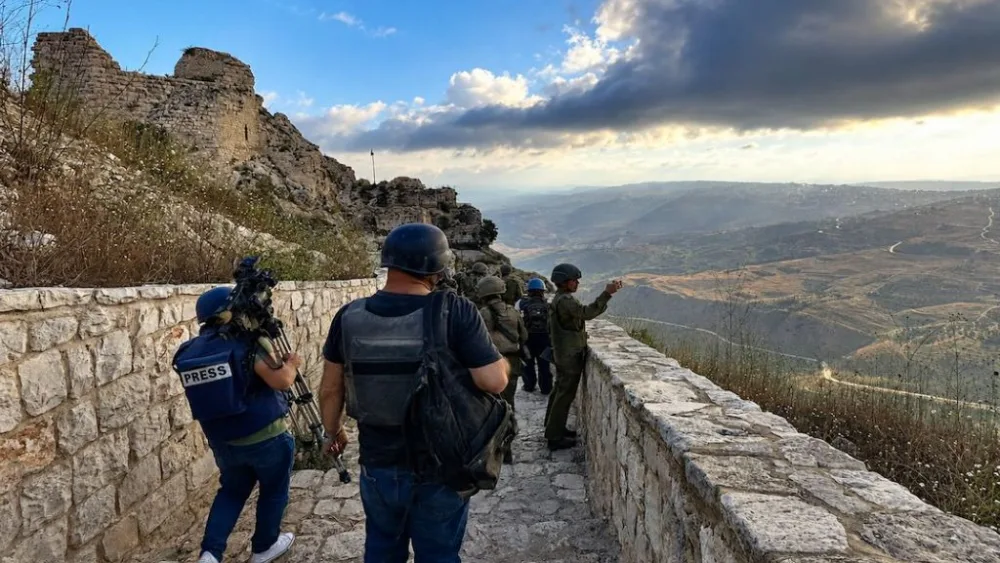
For the first time, a small press group was granted wartime access to Beaufort Castle, the strategic fortress overlooking Southern Lebanon and Israel’s northern border.
The visit offered a rare view from a position armies have sought to control for centuries. Rising 700 meters (2,300 feet) above the Litani River near the Hezbollah stronghold city of Nabatieh, the Crusader-era castle dominates the roads through Southern Lebanon, the approaches to the Israeli border, and a broad sweep of territory extending toward Israel’s northernmost town of Metula and the Galilee.
The IDF captured Beaufort on May 31, marking the first IDF presence at the fortress since Israel withdrew from Southern Lebanon in 2000. Several weeks later, TPS-IL traveled to the site in a convoy of five military vehicles, accompanied by reservists from elite IDF units.
Although the castle lies only about three miles from the Israeli border, the journey took approximately 90 minutes. The convoy descended through steep terrain toward the Litani before climbing the western side of Beaufort Ridge, with the approach accessible only to military vehicles.
From the fortress, Beaufort’s strategic value is immediately clear. It offers an almost uninterrupted view across large parts of Southern Lebanon, including the Litani Valley and the routes linking the border area to the country’s interior. Metula is also visible.
Soldiers from different units were made available to speak to the reporters on condition of anonymity, per military protocols.
The IDF said Hezbollah used Beaufort Ridge as an observation and launch zone during its attacks on northern Israel. According to the military, the Iran-backed terrorist organization fired more than 400 rockets and missiles from the area last March, primarily toward Metula.
The castle—which is on the United Nations Educational, Scientific and Cultural Organization (UNESCO) Tentative List for future World Heritage status—was only part of what Israeli officers brought the journalists to see.
Approximately 0.6 miles south of the fortress, the IDF uncovered an extensive underground military complex that it said Hezbollah had constructed over a period of 10 to 15 years with direct Iranian assistance. Another four similar structures were uncovered in Southern Lebanon.

Rocket and missile attacks
An officer from the IDF’s elite Yahalom combat engineering unit said the facility had two principal purposes: enabling rocket and missile attacks against Israel and providing Hezbollah personnel with protected defensive positions in the event of an Israeli ground advance.
Sections of the tunnel system faced toward Metula and northern Israel, according to the officer.
The journalists were shown part of the underground installation and some of the military equipment recovered from the area. Israeli officers said most of the sensitive weapons had been transferred to Israel for intelligence and technical examination.
The IDF said troops found, there and elsewhere, large quantities of weapons including anti-aircraft systems, Iranian-made “helicopter mines” designed to detect and attack helicopters. Officers described some of the captured weapon systems as “rare and technologically significant,” including Iranian technology that had never previously fallen into Israeli hands.
The underground complex was designed to support Hezbollah personnel for extended periods, and included sleeping quarters, showers, toilets and small kitchens.
Troops also discovered a fully equipped surgical operating room that Hezbollah managed to keep sterile, containing equipment for performing medical procedures underground.
The tunnel’s scale and quality indicated that this was not a temporary wartime shelter, but a permanent military installation.
Officers said building the complex would have required extensive drilling and controlled blasting through the rock, as well as the removal of large quantities of excavated material without exposing the project to Israeli surveillance.
The Beaufort installation was one element of a broader underground network uncovered by Israeli forces during operations in Southern Lebanon.
At a separate site in the southwestern Lebanese area of Majdal Zoun, the IDF said it found a concealed Hezbollah drone production, storage and launch facility extending approximately 650 feet and reaching a depth of 95 feet.
According to the IDF, that complex contained 12 rooms, drones, anti-tank weapons and approximately eight tons of explosives. Its entrance was protected by reinforced steel blast doors. The IDF said the facility had also taken about a decade to build with direct Iranian support.
Beaufort Castle has occupied a central place in the military history of Southern Lebanon. Israeli troops first captured it from the PLO during the First Lebanon War in 1982. The IDF maintained a position at the castle until Israel’s withdrawal from Southern Lebanon in May 2000.
Officers stressed that the IDF continues to search for additional Hezbollah tunnels and military positions in other areas across Southern Lebanon.
Israeli officials insist that any future withdrawal of forces from Southern Lebanon be accompanied by the deployment of the Lebanese Armed Forces and effective measures preventing Hezbollah from returning to the area.