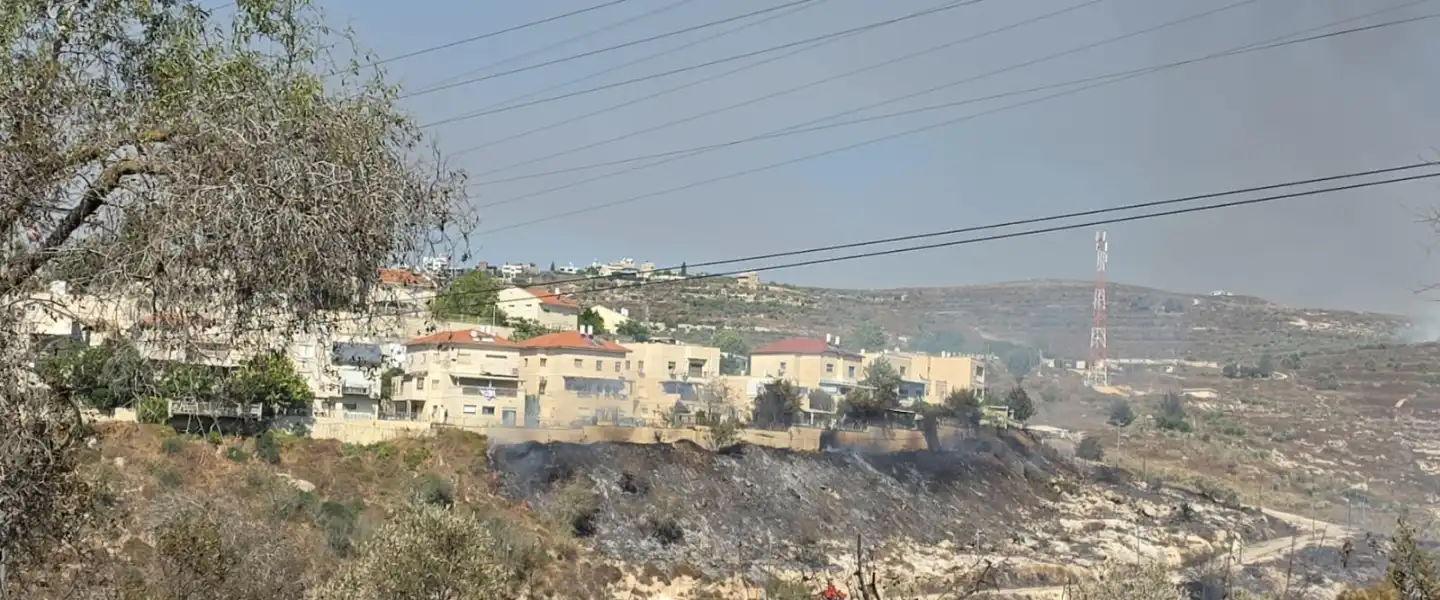
A massive blaze swept through the Samaria community of Havat Gilad (Gilad Farm) near Shechem (Nablus) over Shabbat, destroying 15 homes, 10 businesses and more than 30 structures, damaging infrastructure and forcing the evacuation of approximately 100 families.
A total of 41 firefighting and rescue teams, supported by additional forces, operated at the scene in an effort to extinguish the blaze, prevent it from reigniting and bring the incident under full control.
Following hours of firefighting efforts, Samaria Regional Council head Yossi Dagan issued a statement from Havat Gilad on Saturday night, saying there was a “very strong suspicion” the blaze was the result of arson. He said the fire began after a burning object was thrown from a moving vehicle into a nearby field of dry brush.
However, in a joint statement, the Israel Police, Israel Fire and Rescue Authority and the IDF Spokesperson said the investigative team’s preliminary conclusion was that the fire originated from a single ignition point after a cigarette butt was thrown from a vehicle onto the roadside, igniting dry vegetation. Authorities said the investigation is ongoing, and security forces are continuing efforts to locate the vehicle involved.
A statement from the Havat Gilad community said Arabs in nearby villages launched fireworks while firefighters battled the blaze, describing the displays as celebratory.
Havat Gilad community administrator Moshe Chachmon told JNS that the evacuation began within minutes of the fire being detected on Shabbat. He said the blaze destroyed an entire row of homes.
Chachmon called it “a miracle” that no residents were injured, although a firefighter sustained moderate injuries while battling the blaze.
He said he believed the fire was “absolutely” an arson attack, despite the authorities’ preliminary conclusion that it was sparked by a cigarette butt thrown from a passing vehicle.
Chachmon said the evacuated families were temporarily staying with relatives or at community centers until permanent housing solutions could be arranged. In addition to losing their homes, many families also lost all of their belongings.
“We are now working to ensure that families have homes, clothing and other basic essentials,” he said.
He said an online crowdfunding campaign had been launched to assist families whose homes were damaged. As of publication time, more than 5 million shekels (more than $1.6 million) had been raised in about 12 hours.
“Instead of gloominess, families will return and rebuild the community better than ever,” Chachmon said.
Dagan said he expected the security establishment and the Israeli government, with whom “we always work in full partnership,” first and foremost to apprehend those responsible.
“Together with all the relevant agencies, they must provide a comprehensive response to the phenomenon of arson,” he said. “I expect the State of Israel to immediately begin restoring the infrastructure that was destroyed as a result of this arson.”
Dagan added: “From here I say to those barbarians who celebrated with fireworks, and to those who have carried out these arson attacks throughout this period: We will never be broken.”
He pledged that Havat Gilad would emerge stronger, with homes rebuilt “larger and more beautiful.”
“You will never break us,” he said.
Israel’s Cabinet voted unanimously in February 2018 to legalize Havat Gilad, 15 years after its founding. The community was established in 2002 and named in memory of Gilad Zar, the Samaria Regional Council security coordinator who was murdered in a Palestinian terrorist shooting attack the previous year.