PSAGOT WINERY, Israel—More than 300 men from across Israel traveled to Psagot Winery in Judea and Samaria to participate in a first-of-its-kind evening last Thursday night for bereaved fathers.
They included Mendy Katz, the father of Moshe Yitzhak Katz, a paratrooper and a “lone soldier”— an Israel Defense Forces member without immediate family support in Israel—who was killed while serving the country at the age of 22. Katz flew to Israel from New Haven, Conn., to attend the event.
The program, organized by Hayeladim Shelanu (“Our Children”), a Miami-based nonprofit founded by CEO Joseph Waks, focused on unity, resilience, hope and mutual support from fathers whose children fell while serving in the Israel Defense Forces or who were victims of terrorism. Israeli model and actress Nataly Dadon hosted the event,
“You are not bereaved fathers; you are fathers of heroes,” Dadon told the crowd, raising their spirits.
IDF soldiers hail from all sectors of Israeli society, and the evening represented that diversity. The purpose was to connect the bereaved fathers from many different religious, political and cultural backgrounds with the message that they are all one people and are not grieving alone.
Among the fathers who attended were Itzik Gvili, father of Staff Sgt. Ran Gvili, who voluntarily left medical leave with a broken shoulder to defend communities near the Gaza border on Oct. 7; Yigal Tamam, who lost his son, Adir, and daughter-in-law, Shiraz, in the Hamas massacre; Amir Daniel, father of Sgt. Oz Daniel, 19, a combat soldier in the 77th Battalion of the Golan Brigade who was killed on Oct. 7; Reuven Yablonka, father of Hanan Yablonka, 40, who was murdered while fleeing the Supernova music festival; Rafael Arvis, father of Staff Sgt. Shai Arvis, 20, a combat medic in the Givati Brigade from Holon who fell in northern Gaza on Oct. 31, 2023; and Tahar David, father of Sgt. Adir Tahar, 19, of Jerusalem, who was killed battling Hamas terrorists near the Erez Crossing on Oct. 7.
Also attending were Ofir Shaer, father of Gil-ad Shaer, one of three Israeli teenagers kidnapped and murdered by Hamas terrorists in June 2014; Mark Abergel, father of First Sgt. Eliran Abergel, 29, who was killed fighting Hamas terrorists in Kibbutz Be’eri on Oct. 7; Eli Biton, father of Bnayahu Bitton, a musician murdered by Hamas terrorists after fleeing the Nova music festival; Shimon Suissa, father of Moriah Or Suissa, 24, who was murdered at the Nova festival; and Dudu Jarfi, whose son, Liel, was murdered in the Nova massacre along with his cousins Shoham and Shinhav Yaakov.

‘Men grieve differently’
Some of the fathers who attended the program had not left their homes since losing their sons on Oct. 7, 2023, but they came because they felt it was a place where they would be truly understood.
“Men absolutely grieve differently,” prominent Israeli clinical psychologist Dr. Oren Gur said in an episode of the Israeli bereavement podcast The Life After Death in June 2025. “Men often process grief silently, turning inward or channeling it into physical action. When we don’t give men specialized spaces to let their guard down, that repressed grief manifests as severe emotional isolation, anger or total burnout.”
Gur is among many mental health experts in Israel and elsewhere who have highlighted the unique emotional needs of bereaved men. That is why a father-focused event last Thursday was so meaningful to the bereaved fathers who attended.
The event included performances by Israeli musicians Raviv Kaner and Noam Buskila and a surprise appearance by IDF reservist and singer Matan Hassan.
‘I look to the future’
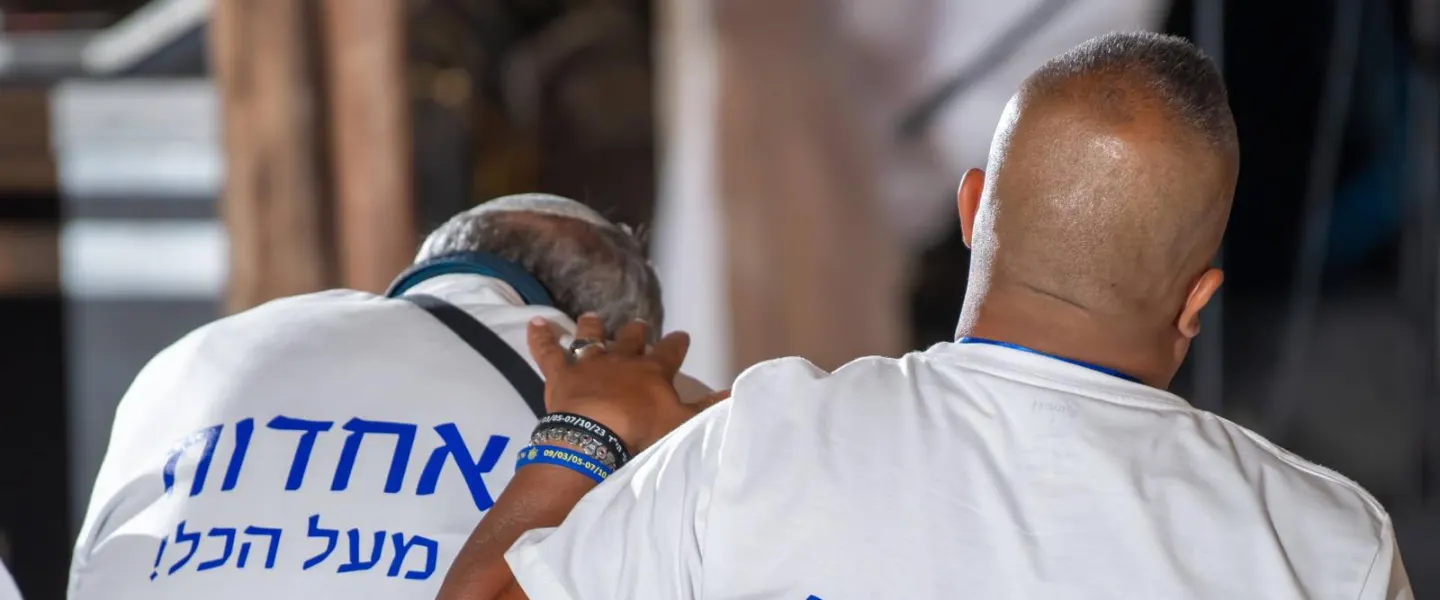
“Unity above all” was written on some of the T-shirts worn by the fathers.
Katz’s powerful address to his fellow bereaved fathers reinforced that message.
“They called him a lone soldier,” he said, referring to his son, Sgt. Moshe Yitzchak Hacohen Katz, a paratrooper who was killed while serving the country at the age of 22. “What I learned after his passing is that he was far from alone.”
“Regardless of affiliation or religious background, my son was able to unite many,” Katz, a Chabad Hasid, continued. “How can you call him a lone soldier? So many of you are in the same shoes as I am. Losing a child—the pain has no end. I, too, have been able to connect, like my son ... to connect with all of you. I am inspired by all of you. I join in your sorrow and pain. Yet I look to the future. I see the souls of all your children connected with my son.”
“I only wish there weren’t so many bereaved families,” said Coby Samerano, the father of Yoni Samerano, 21, who was taken to Gaza and murdered by Hamas terrorists on Oct. 7. “But since that has become our reality, being together gives us the strength to lift our heads high and strive to be worthy of our children’s legacy.”

‘A historic moment’
Hayeladim Shelanu currently supports nearly 2,000 bereaved families across Israel, providing emotional, practical and community-based assistance. After years of supporting widows, mothers and children, the organization recently expanded its work by establishing more than 10 support groups for bereaved fathers, which now meet regularly throughout the country.
“This evening is much more than an event. For me, it is a historic moment,” Waks said. “For the past 1,005 days, we have stood beside bereaved families, cried with them, embraced them and promised they would never be alone.”
“Tonight is the realization of a vision: hundreds of bereaved fathers from every part of Israeli society sitting together as one family. There is no right or left, no religious or secular. There is only one people—the people of Israel,” he said.
Many fathers remained after the event ended, exchanging contact information and embracing one another.
“If every father leaves here feeling seen, loved and supported by a family that will continue walking beside him tomorrow, then we have succeeded. This is only the beginning.”