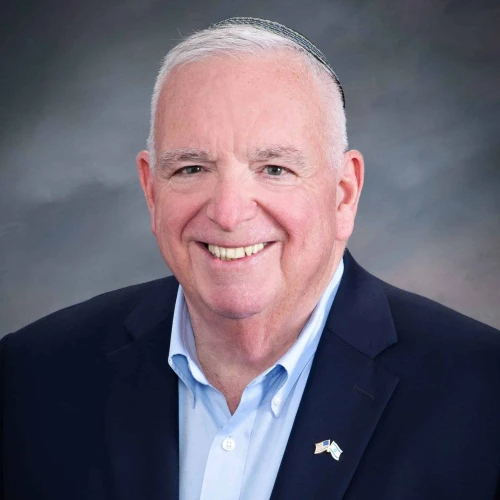
Pervasive faculty activism had a chilling effect on free speech and debate at Harvard University, Alan Garber, the Ivy League school’s president, recently told the Shalom Hartman Institute.
Garber, who is Jewish, spoke with institute president Yehuda Kurtzer during a Dec. 16 taping of the latter’s “Identity/Crisis Podcast” at the Vilna Shul in Boston on why universities have “become flashpoints for broader cultural and political battles.”
“What we need to arm our students with is a set of facts and a set of analytic tools and cultivation of rigor in analyzing these issues,” Garber said on the podcast, which aired on Dec. 30. “But we’re not about the activism. We’re not about pushing particular points of view.”
Garber said the university, which has not yet settled with the federal government on claims related to antisemitism and other forms of campus discrimination, “went wrong” by letting professors allow their personal views into their classroom settings.
“How many students would actually be willing to go toe-to-toe against a professor who’s expressed a firm view about a controversial issue?” he said.
Garber, whose tenure was extended indefinitely the day before the podcast was recorded, took over as head of the school in August 2024, with antisemitism prevalent on campus in the wake of the Hamas-led terrorist attacks in southern Israel on Oct. 7, 2023, and Jerusalem’s subsequent military response.
He has since announced several initiatives to reopen a culture of debate within Harvard, including a ban on the university taking official positions on political issues.
Garber also included the introduction of a module about discussing controversial topics and expansive reports from Harvard task forces on combating bias toward several demographics, including Jewish, Israeli, Muslim, Arab and Palestinian students, as well as campus community members.
“It’s about learning how to listen and how to speak in an empathetic way,” Garber said. “I’m pleased to say that I think there is real movement to restore balance in teaching and to bring back the idea that you really need to be objective in the classroom,” he added.
Garber did not address ongoing talks between the school and the Trump administration, which is seeking $500 million to restore federal funding to the Ivy League institution. U.S. President Donald Trump stated last month that the sides were close to a settlement.
The Trump administration has demanded that Harvard implement reforms to reduce the influence of activist faculty and administrators.